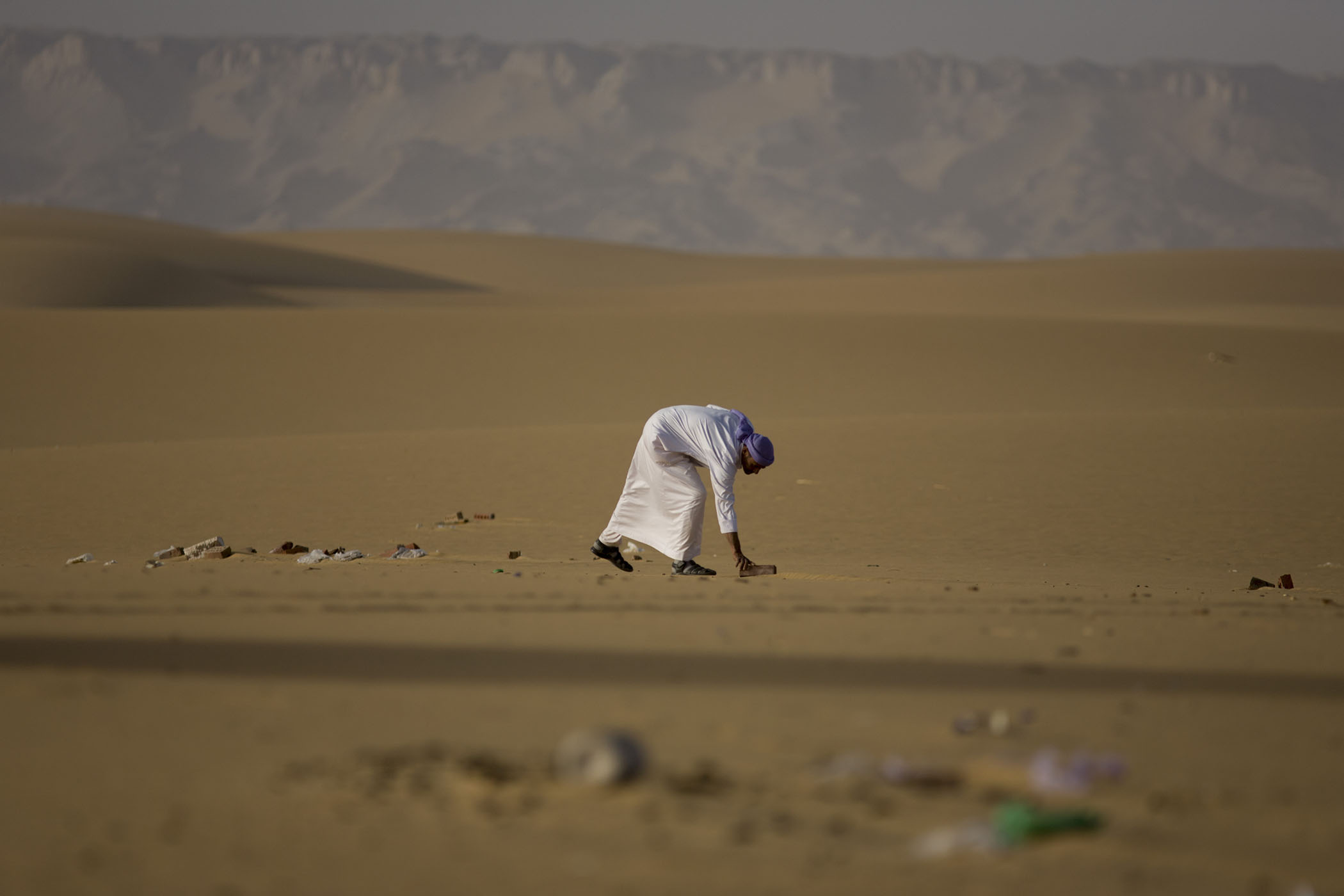
Shipwrecked on a pale crescent of sand, Odysseus languishes on the island of Ogygia, his memory dulled by eating lotus flowers supplied by an obliging nymph. Seven years go by before the war hero begins to remember his quest: to return home to Ithaca.
The theme resonates powerfully with Brahim Chagaf: the 37-year-old filmmaker has yearned for the pristine dunes where the scene of The Odyssey was shot since he was born in a refugee camp in neighbouring Algeria. His family fled there after Morocco occupied the Western Sahara fifty years ago, displacing a large part of its indigenous population.
“The dream is alive,” said Chagaf. “I hope to achieve it and return to Dakhla and its heavenly beaches”.
For now, the dream is out of reach. Morocco has successfully cemented control over the sparsely populated territory the size of Britain in recent years through a mixture of diplomacy and culture. Getting The Odyssey to film in the Western Sahara was a major coup for Morocco after years of courting Hollywood with tax breaks and other perks. But it has drawn rare attention to the status of a territory dubbed Africa’s last colony – and to the plight of its indigenous Sahrawi population. British American director Christopher Nolan is also facing criticism for complicity in Morocco’s dispossession of Sahrawis.
“He could have chosen any sand dune in the world but this one,” said Maria Carrión, executive director of the Western Sahara International Film Festival, which has led a campaign against the film.
When Nolan landed in Dakhla with several Hollywood stars last July, Sahrawi activist Hassan Zerouali decided to seize the opportunity. The 23-year-old wanted to tell Zendaya, Matt Damon and Charlize Theron about the realities of life under Moroccan occupation: repression, censorship and arbitrary arrest. But he couldn’t get anywhere near them. Moroccan authorities closely guarded their movements and sequestered them in tourist resorts, he said. Morocco’s minister of culture Mehdi Ben paid Nolan a visit on set, telling a local media outlet that Dakhla was destined to become “a major film destination” and noting plans to establish a film school there.
“Behind this false touristic picture propagated by the Moroccan occupation there is a different reality,” said Zerouali, who called on Sahrawis to protest. When he next travelled abroad, the authorities summoned his relatives in Dakhla. If Zerouali returned, he would be arrested, they warned.
As filming got underway, the Western Sahara Film Festival demanded Nolan and his team leave Western Sahara and cut the scenes shot there. The campaign was supported by Greta Thunberg, Spanish film director Petro Almodóvar, and actor Javier Bardem, who made a documentary about the occupation of Western Sahara called Sons of the Clouds: The Last Colony.
There was no response. When Carrión sent an angry message to The Odyssey’s official account on Instagram, she was blocked.
As the release date approached this month, the Western Sahara International Film Festival called for a boycott. The public should treat The Odyssey like it would a film made in Russian-occupied Ukraine, or in illegal Israeli settlements in the Palestinian territories, it said.
Newsletters
Choose the newsletters you want to receive
View more
For information about how The Observer protects your data, read our Privacy Policy
“It amounts to plunder,” said Carrión. “These are stolen images – this is extractive filmmaking that Nolan has done – and people need to know that.”
On its opening weekend, the film topped the box office, grossing $264.1m in global ticket sales.
Chagaf is conflicted about watching the film. As a young film-maker, he grew up revering Nolan, and longs to glimpse his homeland as portrayed by one of the leading filmmakers of the century. But he is deeply disappointed by Nolan’s silence: “He could have said something,” Chagaf said. “I would settle for an apology.”
The only time Chagaf laid eyes on Dakhla himself was during a UN-facilitated visit in 2010 accompanying his mother to be reunited with her sister who remained in the Moroccan-occupied Western Sahara after Spain ceded control. Chagaf’s father was killed fighting Moroccan forces in the ranks of the Polisario Front, an armed group which is still seeking Sahrawi independence.
The beaches of Dakhla were as beautiful as Chagaf had been told, but he saw few people dressed in the melhfa – a traditional flowing garment worn by Sahrawi women. “Unfortunately the people walking around there were mostly settlers,” he said. Moroccan flags flew over Dakhla and there were soldiers everywhere.
Chagaf had planned to film the moment his mother and aunt were reunited after more than three decades apart, but the authorities confiscated his camera. “They are afraid of anything that could testify to the atrocities committed against the population,” he said. He hasn’t tried to go back since. It would be risky because of his advocacy for the Sahrawi cause, he said. “Anything could happen.”
Meanwhile, Morocco is transforming Dakhla into a tourist destination, enabled by airlines including Ryanair. On the Moroccan Tourism Ministry website, Dakhla is described as “a Robinson Crusoe experience” and “the pearl of southern Morocco”. Donald Trump’s daughter Ivanka visited with her husband Jared Kushner in 2022, posing in a melhfa on the beach. The photographs she posted on Instagram were captioned “Morocco”.
The US became the first country to recognise Moroccan sovereignty over the Western Sahara in 2020, rewarding Rabat for normalising relations with Israel. In a proclamation weeks before the end of his first term, Donald Trump said an independent Sahrawi state was “not a realistic option”.
Other countries including the UK have since shifted their position, endorsing a Moroccan autonomy plan. The US, Spain, Morocco are working to flesh out a plan acceptable to the Polisario and the group’s main backer, Algeria. Polisario fighters have engaged in a low-level conflict with Moroccan forces since a ceasefire broke down in 2020. Morocco uses drones to target Sahrawi fighters across the 2,700km wall of sand studded with mines that separates a sliver held by the Polisario in the east.
“A fair autonomy plan would say that any sort of economic development including the film industry that takes place in Western Sahara, that a set portion… is given back to the local people,” said Sarah Yerkes, a senior fellow in the Middle East Program at the Carnegie Endowment for International Peace.
That is not what Chagaf wants. Like many Sahrawis, he insists on a referendum as mandated by the UN in 1991. The International Court of Justice assessed in 1975 that there was no “tie of territorial sovereignty” between Morocco and the Western Sahara that would deny its people the right to self-determination.
As Matt Damon, Robert Pattinson, Anne Hathaway and Zendaya posed on the red carpet in Leicester Square, a small group of protesters stood outside carrying the flag of Western Sahara and homemade placards: “Shame on you Nolan”. “Free Western Sahara”. “Dakhla is not in Morocco”.
In the closing credits, the shooting locations are listed as Scotland, Greece, Italy and Morocco.
For the people of Western Sahara, the odyssey continues.
Photograph by Richard Baker/Getty Images