My parents didn’t want me to go to Nigeria.
Even though they have both gone back for multiple visits since they emigrated to Britain in the 1990s, my mother told me that if I were to travel by myself this year, to the country she was born in, she would “cry every day” that I was there.
On WhatsApp, older Nigerians who left their homeland decades ago are constantly bombarded with videos of kidnappings, murders and terror attacks in the West African country. This week, 28 people travelling to an Islamic festival were kidnapped in the north of the country, and in November 253 children were kidnapped by a terror group from a Catholic school in the north – the largest kidnapping in Nigeria since 2014, when the abduction of 276 girls by the Islamist militia group Boko Haram from another school in the north led to a global #BringBackOurGirls social media campaign. Many of those girls remain with their kidnappers today.
But northern Nigeria is different from southern Nigeria – particularly Lagos, the country’s largest city, which though geographically smaller than London is home to more than double the UK capital’s population.
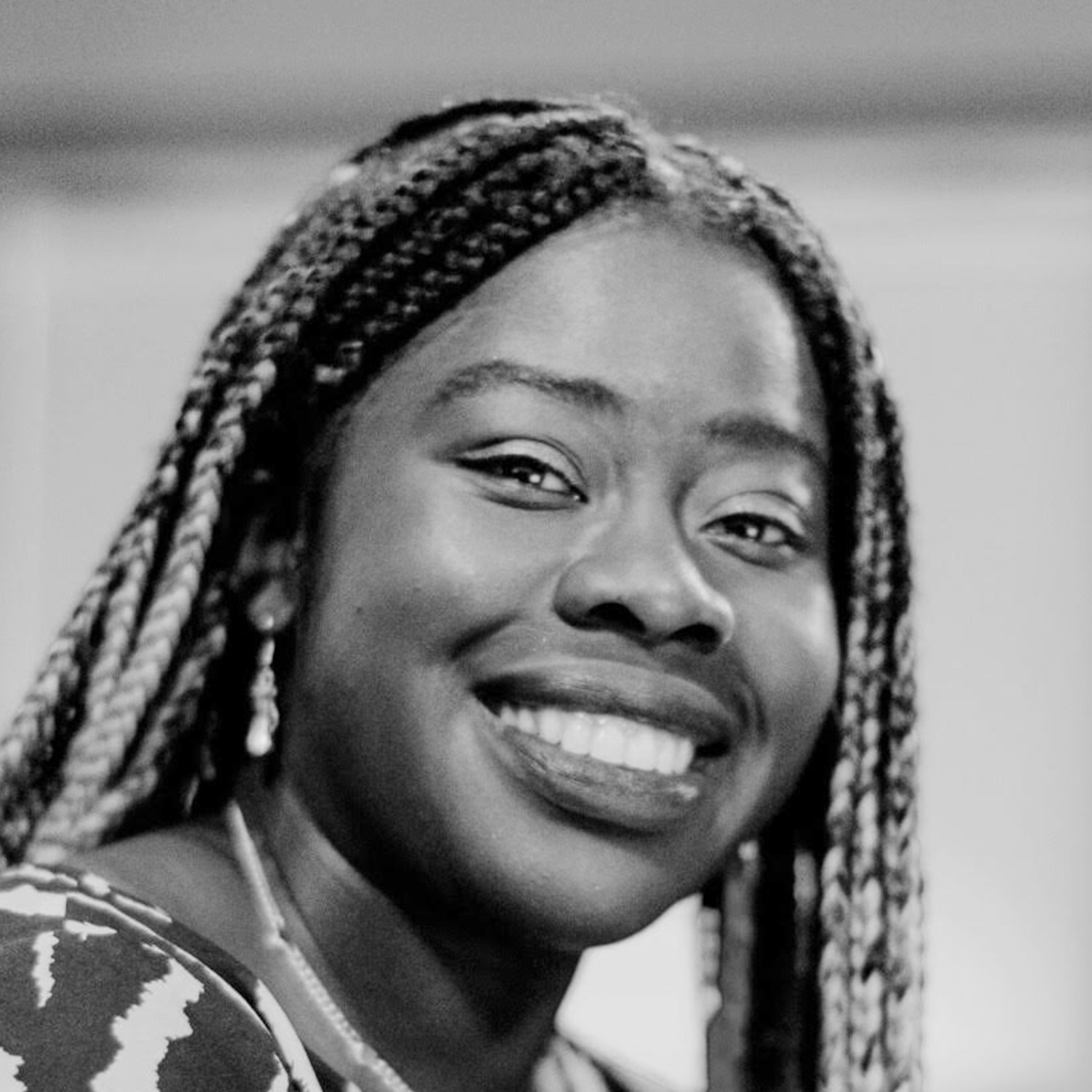
“Nigeria is a huge country – 238 million people,” Aderonke Adeola, a writer and filmmaker born and raised in Lagos, explains over WhatsApp. “There are many realities occurring at once. Lagos is not Nigeria the same way London is not Britain. If you’re from a certain class background, not to say that things can’t happen to you… but it’s far less likely.”
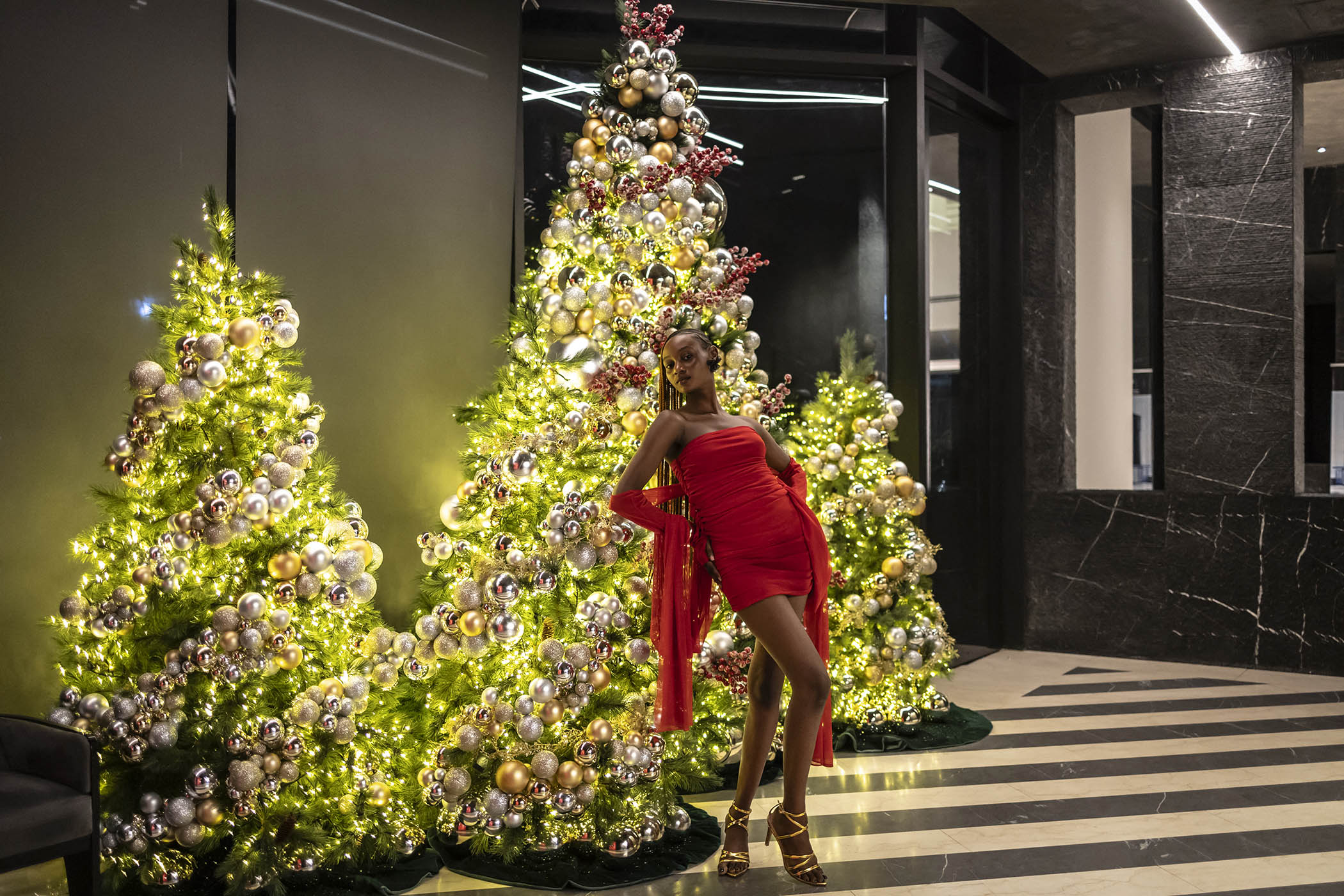
For those with money from the diaspora (a round trip from London to Lagos can cost more than £2,000), Lagos has become an increasingly attractive Christmas destination. Last year, about 1.2 million tourists visited the city between 19 November and 26 December, with 550,000 coming from overseas. These visitors injected about $70m into the country’s economy, with more than half of that money coming from hotel bookings.
Some 50 years ago, the Nigerian government had thought that the most populous Black country on Earth, now starting to shake off the auspices of colonial rule, could perhaps become a popular Black tourism destination. In 1977, the government spent more than $400m to create Festac, a Pan-African arts and culture festival that saw artists such as Stevie Wonder and Miriam Makeba perform while thousands of revellers from the UK, US, South America and the Caribbean stayed in a specially built village called Festac Town. At the time it was described as “the biggest family reunion in human history”.
The hope, as a former editor of Ebony magazine put it, was for Festac to “lead to an abandonment of the ‘museum approach’ to Black culture… judged only in terms of static, prehistoric objects to be occasionally dusted [instead of] as a living, organic reality”.

Detty December clubbers at the Boho nightclub in Lagos earlier this month.
Political turmoil in the days leading up to and after Festac, including government soldiers murdering Funmilayo Ransome-Kuti, a feminist activist and mother of outspoken activist-musician Fela Kuti, quickly dashed any hopes that droves of tourists from the west would start regularly making their way across the Atlantic. Today, Festac Town stands in disrepair.
However, interest in Nigeria, from Black people living in the west, has once again started rising. This is perhaps linked to Ghana’s Year of Return, a 2019 government-backed tourism scheme that encouraged the descendants of enslaved Africans in the Americas to visit Ghana for the first time – injecting $1bn into the economy.
Newsletters
Choose the newsletters you want to receive
View more
For information about how The Observer protects your data, read our Privacy Policy
Black people from America and the UK, including many with parents or grandparents who were born in Africa, have since turned their eye to other West African countries, including Nigeria, where thousands of gen Z and young millennial tourists come each year to enjoy “Detty December”.
“Detty” means “dirty” in West African pidgin English. Afrobeats artist Mr Eazi is widely credited with coming up with the phrase Detty December to describe a month in the Nigerian calendar that is often filled with outrageous and unapologetic partying and enjoyment. Young people come to reconnect with their African heritage but also to enjoy nightlife, shop and eat the spiciest food money can buy, in an environment where they are less likely to stand out because of the colour of their skin.
Shaniyaa Holness-Mckenzie, a 29-year-old data analyst from London, with Barbadian and Jamaican heritage, is travelling to Lagos for the first time later this week. “Just being Black British, when you go to events, you’re always going to hear Afrobeats or something connected to Nigeria. I just feel in love with the culture enough that I want to go there, experience it for myself and have some fun.”
Most Black people in the UK are of direct African descent, as opposed to Caribbean descent, and most people of African descent in the UK are West African. In the 1980s and 1990s, when most Black Britons were of Caribbean descent, some British Africans pretended to be Jamaican. Now, with the global rise of Afrobeats stars such as Burna Boy, Ayra Starr and Davido, things are different. “People are really bigging up the countries that they come from,” says Holness-Mckenzie. “They are more upfront with it now than they were before. I feel like it’s not even just, ‘Oh, being African is now cool.’ I think being who you are is now cool.”
Although people with Nigerian heritage have always come to the country at this time of year to visit friends and family, Aderonke says that, since at least 2020, she has seen Lagos transform into a “party town” every December, with a major influx of people with British and American accents. “I’m experiencing more traffic this year.”
‘You do worry about the sustainability of it and how it has a trickle-on effect on locals, because now locals can’t afford those prices’
‘You do worry about the sustainability of it and how it has a trickle-on effect on locals, because now locals can’t afford those prices’
Ade Onibada, British-Nigerian journalist
Several music festivals and club nights have popped up to cater to the Detty December crowd. Flytime Fest is a music festival that places British and American stars in the same lineup as more local acts, in the hope of attracting audiences from across the globe. Craig David, Ne-Yo, Bell Biv Devoe and Megan Thee Stallion (performing in a bodysuit adorned with the colours of the Nigerian flag) have all performed on the Flytime stage.
As I speak to Aderonke, she’s getting ready to see Busta Rhymes at a concert forming part of the month-long Detty December Fest, which involves concerts, raves and a Christmas grotto. Cardi B visited Lagos for the first time in 2019, to perform at Livespot X Festival, and told her millions of followers on an Instagram livestream that the city reminded her of “a Caribbean island with a touch of New York because everybody is busy”.
Put another way, “everybody is hustling” as Ade Onibada, a 33-year-old British-Nigerian journalist, explains from her hotel room in Lagos. “There’s this idea of a ‘December rate’, intended to reflect that you have an influx of foreign currency in the economy, and service providers that want to make the maximum amount of money. I’ve seen a hair braider who was charging maybe 40,000 naira on 28 November now charging 60/70k in December.
“While I can’t be mad at it, because it’s a hustle, you do worry about the sustainability of it and how it has a trickle-on effect on locals, because now locals can’t afford those prices.”
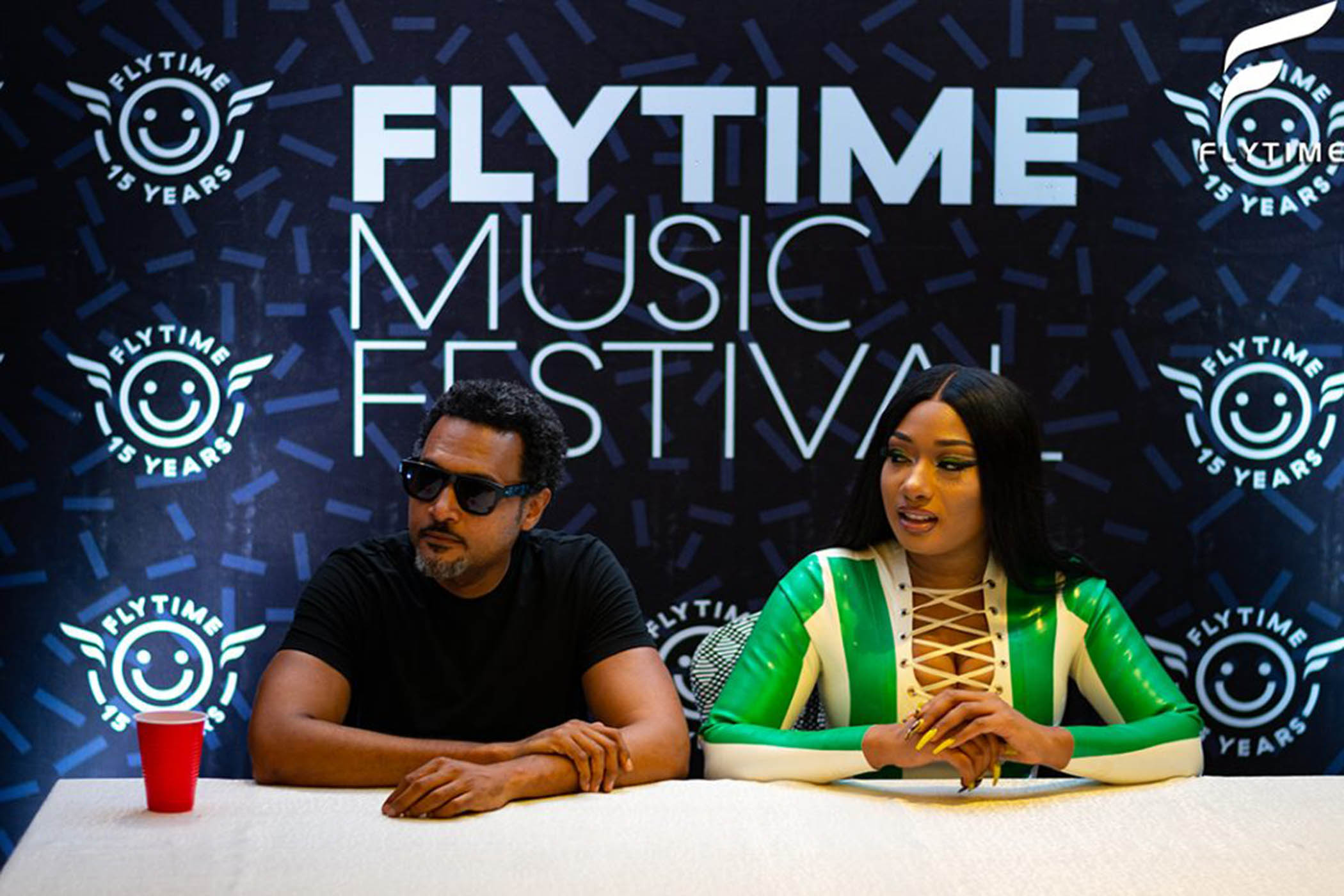
Cecil Hammond, the founder of Flytime Fest, with Megan Thee Stallion.
The negative impact of tourism on locals has become a controversy in several countries in West Africa. Following Ghana’s Year of Return, some African-American and African-Caribbean visitors liked the country so much that they stayed. In a rural town in southern Ghana, a 5,000-acre settlement was set up called the Pan African Village, where dozens paid a nominal administration fee to buy land and build houses. Some local people have protested, arguing that this is their ancestral homeland and should have never been put up for sale. When a local farmer confronted developers, he was told he would be shot if he ever came back.
“Five years ago, nobody was thinking of Lagos as a tourist destination. I feel a sense of pride that people want to come and spend a really important holiday in Lagos,” Aderonke says. “But I also have a sense of fury at the government for just not preparing.
“This is one month in a year… I wish our government could approach this as an investment opportunity to build our tourism and to build our infrastructure. We need more roads. We need more and better public transport. A knock-on effect is rent prices go up, Airbnbs go up – the prices are insane. I think that with government supervision, there could be better laws and policies in place to protect residents and people who come here.”
This year, on his first trip to the country, the 24-year-old British-Nigerian musician Sam Lawal, known as DJ Munii, experienced some of the difficulties that travel to Nigeria can bring. “Getting through certain checkpoints… if you look like someone that they [the police] can disturb, they will disturb you.” He says police officers knocked on his driver’s car window (many tourists, to navigate Lagos safely, hire a driver) three times during his trip, asking for money. “They look at you and say, ‘Anything for the boys?’”
“Sometimes I say I get the Lagos crazies, because 10 days in you’re also shouting,” Ade Onibada says of her regular trips to Nigeria. “You come in and you’re like, why is everybody so angry? But then you understand that some lead very frustrating lives. That could include two or three hours in traffic just trying to get to work.
“You know, the most minor conveniences – the network is down so you can’t make a phone call, you can’t take a meeting. The banking apps have crashed, so you can’t move money. The smallest conveniences that make life in places like the UK super seamless can be big pain points for people here.”
‘Given that it’s my first time going to an African country, as much as it’s about partying, it’s also about connecting’
‘Given that it’s my first time going to an African country, as much as it’s about partying, it’s also about connecting’
Shaniyaa Holness-Mckenzie, 29, London data analyst
While Ghana’s Year of Return was planned by the government, the growth in Nigeria’s tourism scene has happened much more organically, with the Nigerian government only now playing catch up. Former British solicitor Hannatu Musawa, who is now Nigeria’s culture minister, announced in November that she has asked the president to launch a presidential task force so the country can finally “maximise on the potential of Detty December and build it as a global brand”.
Realistically, with or without government support, it already is a global brand thanks to the young people sharing Detty December content online. Holness-Mckenzie and her friends are planning to hit a few spots next week that they’ve seen on TikTok. Some of these accounts use the acronym IJGB (“I just got back”) in their bios to signal that their content will be relevant for diasporans coming to Nigeria on holiday.
“Young people have definitely amplified Detty December,” Onibada says. “Now, everybody wants a piece. I’ve met people in Lagos from Bangladesh, Morocco and Jamaica. I think they want to see if the stories are true, because sometimes Lagos can be a super outlandish place where there’s a Rolls-Royce rotating in front of a club or there’s stacks of money being thrown in the air… I jokingly say that if you’re not Nigerian, and you’re able to navigate it, you can take on anything.”
Holness-Mckenzie, who is counting down the days until she will spend Christmas in Nigeria, says she wants to experience it all. “I want to do the fun partying stuff, but I also want to take in the cultural heritage where possible. Given that it’s my first time going to an African country, as much as it’s about partying, it’s also about connecting.”
Photographs by Olympia De Maismont/Getty