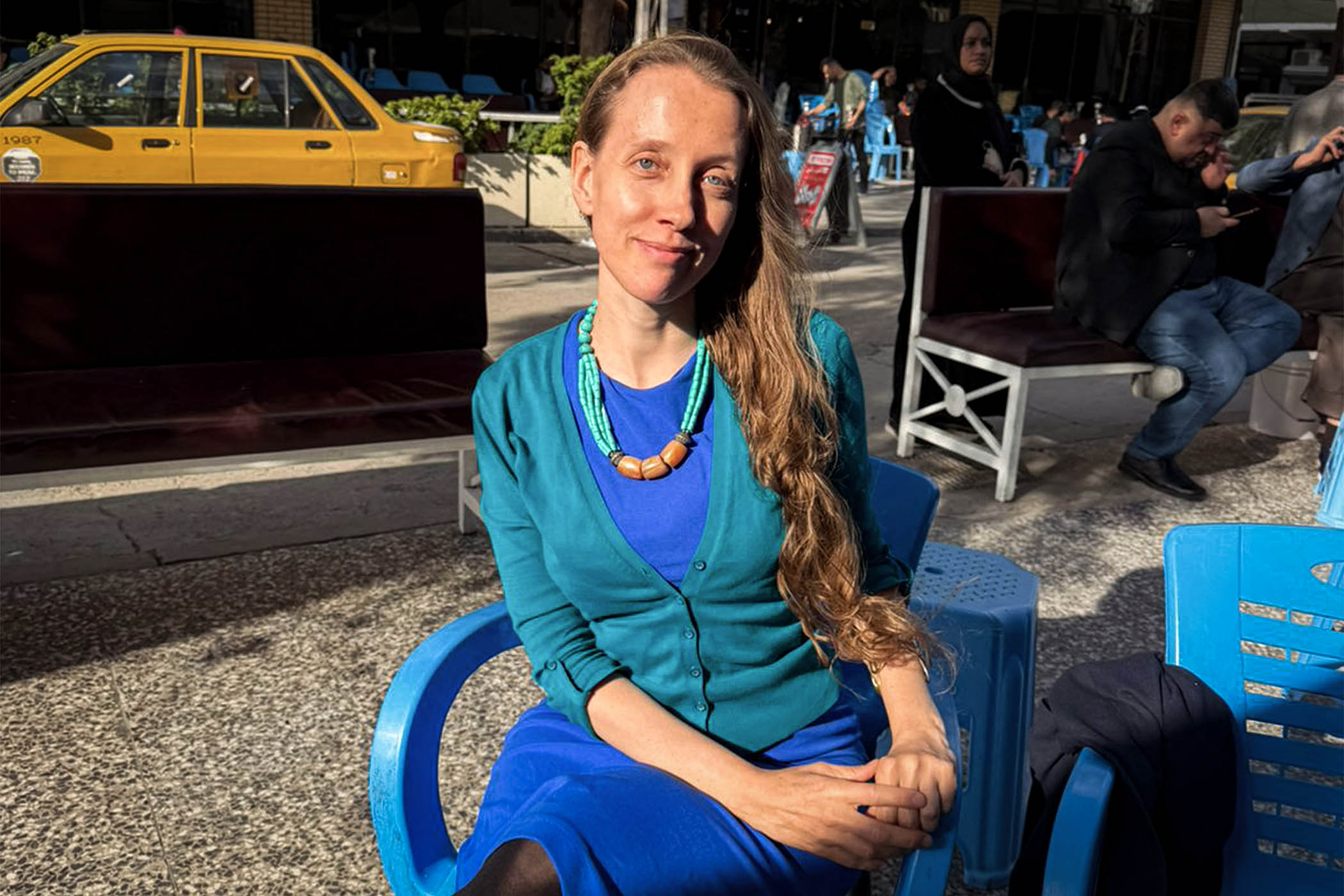
Two men closed in, seized her by the head and forced her into a waiting silver car. It was broad daylight on Saadoun Street, a busy artery in central Baghdad, when Shelly Kittleson, a US journalist, was taken on Tuesday.
Iraqi security services gave pursuit. During the chase the kidnappers crashed and flipped the car. Kittleson was dragged out by her abductors and bundled into another vehicle. One injured kidnapper, left behind in the chaos, was arrested.
The 49-year-old reporter had been targeted by Kataib Hezbollah, a powerful militia in Iraq and a component of the Popular Mobilisation Forces (PMF), an Iranian-backed group of paramilitary forces that operate within Iraq and are legally part of the country’s armed forces.
In March 2023, the group seized Elizabeth Tsurkov, an Israeli-Russian dual national who is a doctoral researcher at Princeton, and held her for more than two years, during which she suffered sustained abuse at the hands of her captors.
Although Kataib Hezbollah is a formal part of Iraq’s security apparatus, the Iraqi government has taken steps to combat its influence, including conducting raids against the militia in an attempt to restrain armed groups that refuse to be controlled by the state.
The Iraqi interior ministry said in a statement that efforts were ongoing to track down the kidnappers and secure the release of Kittleson: “The Ministry of Interior reiterates its commitment to not permitting any attempt to destabilise security or target foreign guests, and its security forces will remain vigilant and resolute in pursuing lawbreakers and bringing them to justice.”
Yet the abduction comes at a moment when Iraq’s fragile equilibrium is under acute strain.
Since Israel and the US launched strikes on Iran, killing its supreme leader Ayatollah Ali Khamenei, its neighbour has been caught in the crosshairs of both sides. The regional war is now dragging Iraq down a dangerous path – and one that is all too familiar.
In the uneasy aftermath of the 7 October 2023 attack on Israel by Hamas, Baghdad and Tehran found alignment in the strategy of restraint. While Iran’s wider axis – from Lebanon to Yemen – was drawn into confrontation, Iraq instead practised a quieter policy of stability, sustaining ties with both Washington and Tehran and keeping escalation at bay.
Stability served many masters: it secured Iran’s western flank, sustained a network of powerful paramilitary actors, and underwrote a shadow economy through which Tehran accessed dollars and skirted sanctions, often via Iraq itself.
Newsletters
Choose the newsletters you want to receive
View more
For information about how The Observer protects your data, read our Privacy Policy
However, Iranian-backed militias have launched attacks on US assets in the oil-rich country in retaliation for the US killing of Khamenei. Rocket fire, widely attributed to Kataib Hezbollah, has struck US-linked sites. A strike on the US embassy compound in Baghdad caused no casualties but signalled intent. Days later, five missiles hit Baghdad international airport, injuring four, including staff and security personnel. The militia claimed responsibility, asserting that its rockets struck Camp Victory, a former US base now functioning as a diplomatic hub.
Washington’s response was swift and lethal. Airstrikes on the Habbaniyah military base west of Baghdad killed seven Iraqi soldiers and injured 13 others, hitting a military medical clinic and an engineering unit. Baghdad’s outrage was immediate.
“We are confronting a fully fledged crime that violates international law,” the Iraqi prime minister’s office said, adding that the attack harmed the relationship between Iraq and the US.
The rupture is striking given the trajectory of recent years. Dr Renad Mansour, director of the Iraq Initiative at Chatham House, believes that economic growth, buoyed by oil revenues and foreign investment, had offered cautious optimism. “Chevron, Halliburton and other US companies were coming back,” he said. “So there was this boom that was based on both the opportunities of the Iraqi oil and gas fields, and a government in Baghdad that was willing to bring western companies back, rather than pivoting completely to China.”
But with the region so volatile, violence in Iraq has intensified. In recent weeks, America reportedly drew up a list of pro-Iranian militia figures in Iraq and systematically began assassinating them. In just 23 days, there were 86 attacks on PMF headquarters. Iraqi army buildings were also hit in six incidents. The consequences are beginning to seep into Iraq’s own institutions.
According to one Iraqi security analyst, who spoke to The Observer anonymously for fear of reprisals, disgruntled members of the Iraqi army are reportedly providing militias with radar information and coordinates of US assets. What began as tit-for-tat exchanges risks evolving into a broader confrontation between the US and Iraq’s entire security apparatus.
Against this backdrop, Washington has issued stark warnings. The US embassy in Baghdad has taken to X to ask for help to “stop the terrorist attacks”, offering rewards of up to $3m for “information on Iranian-aligned terrorist militia groups or others responsible for these attacks”.
The US assistant secretary of state for global public affairs, Dylan Johnson, warned US citizens to leave Iraq immediately. He said the state department was aware of Kittleson’s kidnapping.
“The state department previously fulfilled our duty to warn this individual of threats against them and we will continue to coordinate with the FBI to ensure their release as quickly as possible.”
Kittleson’s whereabouts remain unknown.
Photograph by AFP via Getty Images