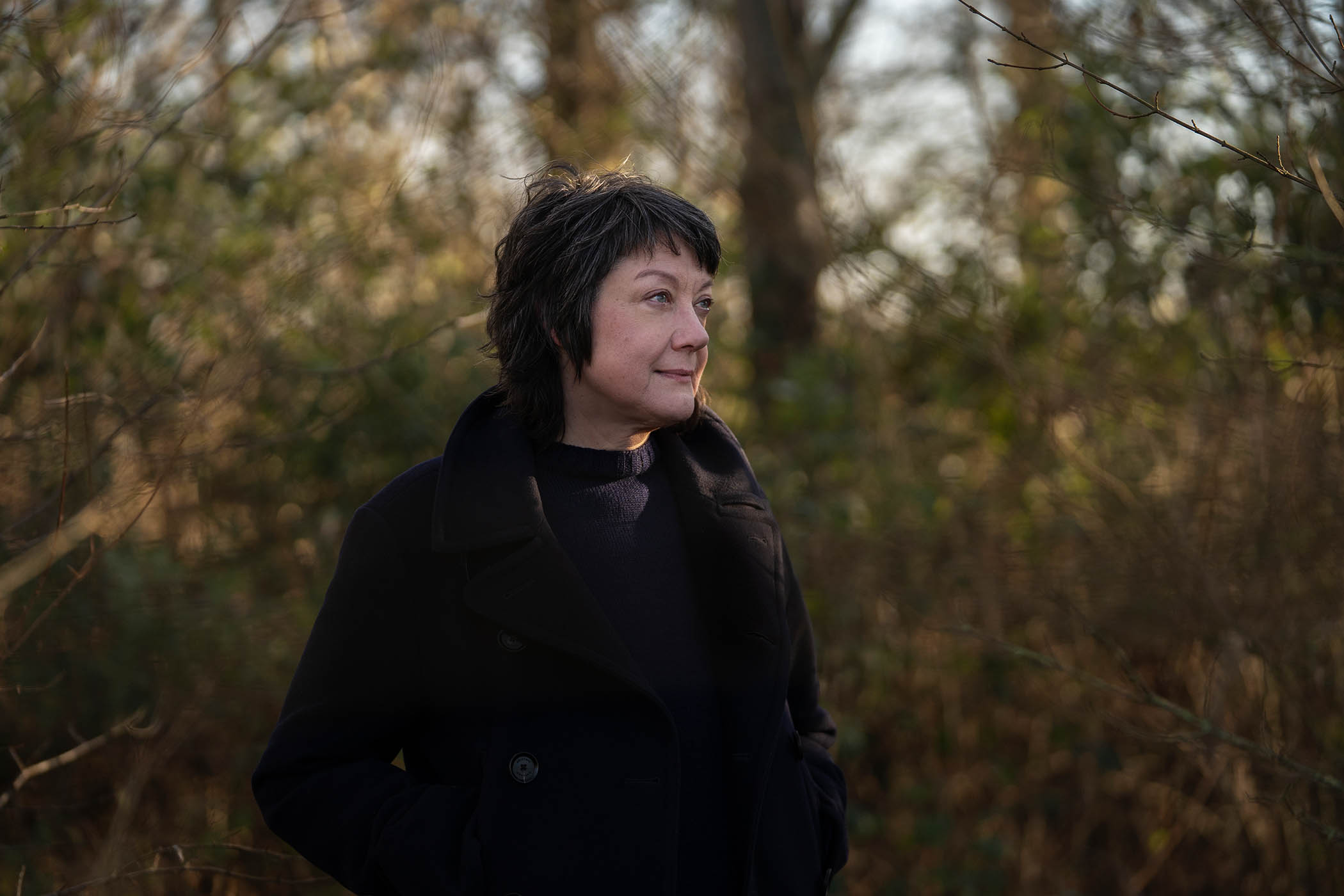

Portrait by Tom Pilston for The Observer
As soon as we leave the car on a farm track and set off walking up a broad grassy path flanked by thick hedgerows of elder and blackthorn, Helen Macdonald can’t help feeling something is missing.
It was here, 18 years ago and in the throes of reckless grief after the death of her beloved father, Alisdair, that Macdonald would come to walk and hunt with a goshawk, Mabel. They are scenes that will remain close to the heart of anyone who has read her raw and wonderful memoir H is for Hawk.
We are near the village of Barton, a few miles west of Cambridge. It’s minus three degrees and there are patches of hoarfrost on the grass and a tracery of rime on the tree branches. The big sky is a piercing pale blue and hanging over the horizon is the ghost of a full day-moon. The path stretches to a vanishing point half a mile up ahead, where signs mark the margins of a military firing range.
Macdonald – who identifies as non-binary but accepts both they and she pronouns (“I never felt I fitted the categories and now there is language I can use to describe that”) – senses shadows of previous winter mornings everywhere up here.
“I’d let Mabel off the glove straight away and she’d fly up this track, or sometimes she’d get into the bottom of the hedge, where she once found a rabbit warren, or into those trees,” she says. “You never knew what she would do on any particular day.
“One time, right here by this farm building” – she gestures to a barn with a tower of circular hay bales – “she discovered loads of rats, and spent about two hours trying to catch one, so I just went and sat in the car and had a cigarette.”
The thrill of training and living with a hawk, Macdonald suggests, particularly a goshawk, by legend the most unruly and capricious of birds, is that you start to see the landscape through its eyes, alert to any movement in the undergrowth, twitchy for all the life around you.
There is much talk, Macdonald says, of nature walks being good for mental health. “But I’d rather discuss how, if you spend a lot of time with another creature, you start to sense another world overlaying yours or next to it – with all the expansion [of empathy] that implies.”
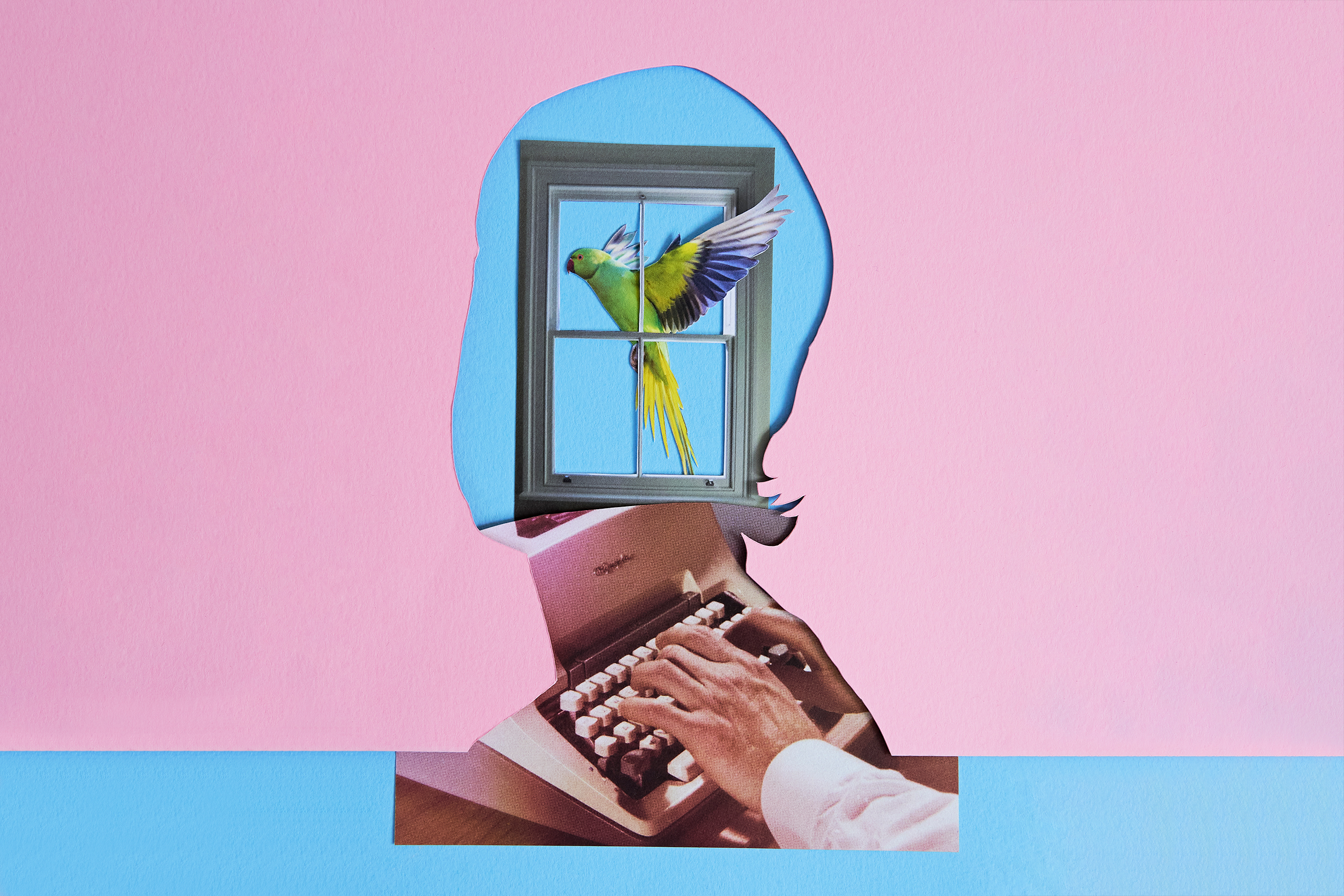
Macdonald no longer has a hawk. There isn’t the all-consuming time in their life for one at the moment – only for three parrots at home in Hawkedon (no less) near Bury St Edmunds. But still, there has been a vivid reason to revisit that lifelong passion in recent months. A film has been made of H is for Hawk, starring Claire Foy (of The Crown) as Macdonald, and Brendan Gleeson, craggy and big-shouldered in a well-worn suit, as Macdonald’s late father, a Daily Mirror photojournalist.
Newsletters
Choose the newsletters you want to receive
View more
For information about how The Observer protects your data, read our Privacy Policy
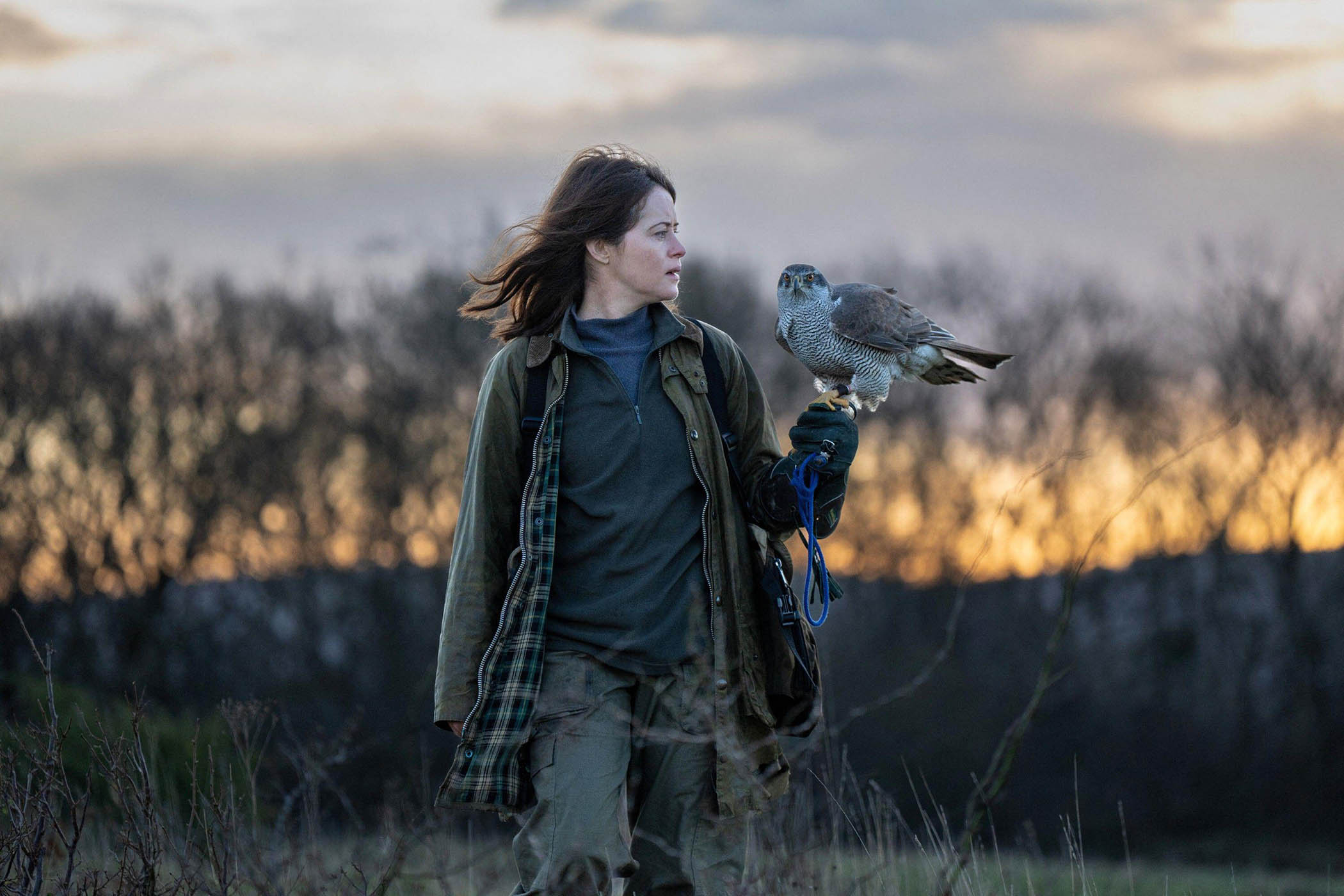
Claire Foy in H is for Hawk
It is a fabulous movie in every sense – one that captures all the tangled lyricism and lunacy of Macdonald’s book. Watching it brought back to the author that year of magical thinking in which Mabel became a kind of personal spirit guide to the underworld, red in beak and talon, capable of free-spirited kinship around thoughts of death.
There was plenty of love along the way too: Macdonald was besotted from the moment she and Mabel first set eyes on each other on a quayside in Scotland, where she had arranged on the internet to meet the falconer who had raised her. “My heart jumps sideways,” she wrote. “She is a conjuring trick. A reptile. A fallen angel. A griffon from the pages of an illuminated bestiary. Something bright and distant, like gold falling through water…”
Macdonald is explaining some of this as we walk up the frosted slope, pointing out landmarks as we go, and recalling some of the charged anxiety of Mabel going rogue and hunting in a farmer’s field where they had no permission. Looking around she remarks: “I always thought this was classic ‘Helen country’.”
What does Helen country involve?
“Well,” they suggest of her various obsessions, “it’s often got strange military stuff”. (Full Metal Jacket was filmed beyond the Keep Out signs of the firing range.) “It’s got, like, weird, spiritual, astronomical stuff.” (In the near distance behind us you can see the upturned dishes of the Mullard Radio Astronomy Observatory.) “And it’s got a burial ground…”
We wander off to the side of the path at one point to peer over a fence at the edges of the humanist Barton woodland cemetery – “there’s millions of hares here”, Macdonald notes – and we agree that, all in all, it wouldn’t be a bad place to end up.
Macdonald was, by choice, at one remove from the film, deciding straight away to leave the screenplay entirely to screenwriter Emma Donoghue and director Philippa Lowthorpe. “I said I was happy to talk to Claire [Foy] but she didn’t contact me until quite late in the process.
“We had a Zoom call. Claire, basically, said: ‘Is there anything that you’re really concerned about?’ And I found myself saying I really, really don’t want to come across as this sort of weepy miserable disaster – which I had been, of course.”
What was amazing about that call, Macdonald says, is that “after about 40 seconds, I remember thinking, ‘Oh, my God, she’s exactly like me,’ – and then I later thought, ‘Wait a minute, she’s an actor and she had already got her performance completely, and she’s just finessing it by talking to me.’”
Macdonald was most invested in making sure the falconry was done right. You wouldn’t be able to tell, she suggests, but two goshawks were used in the filming – a slightly tamer bird for the scenes at home, and a more wayward spirit for the hunting. The scenes with the stand-in Mabels are uncannily moving: “Claire mentioned she’d had some issues with the horses on The Crown and I was immediately like, oh, no, this doesn’t sound good, but it turned out she’s one of the greatest intuitive falconers I’ve ever met,” Macdonald says.
The on-screen bond between Foy and Mabel flapping at the end of her arm is indeed something to see. “My go-to theory,” Macdonald says, “is that being a great actor, you have capacity to really be very alive to micro expressions and the tiniest sort of shifts in mood, and that’s the same with handling a hawk.”
The two Helens – real and fictive – saw the film together at the Telluride festival in Colorado. “Claire said this incredible thing,” Macdonald recalls. “We were being interviewed, and she said that at drama school, one of the things that you’re often told is that it is impossible to compete on stage with a lighted match. Everyone is looking at the match. The hawk, she said, is the lighted match. I loved that.”
The hunting scenes in the film were made with a drone – presumably with a weapons-grade operator – flying alongside the goshawk, giving a real sense of wild hurtling velocity through the woodland around here. Macdonald started crying when watching it for the first time. “When you train a hawk you’re running along with it, your heart is very much tied up with that bird. That is the only footage I’ve ever seen that makes that feeling manifest.”
‘I still miss my dad terribly. He was a really good bloke’
‘I still miss my dad terribly. He was a really good bloke’
The other great emotional jolt was seeing Gleeson on set. “I still miss my dad terribly,” Macdonald says. “He was a really good bloke. Brendan told me that one of the reasons he took the part was that there are very few roles that show good fathers and good men, but this was one of them.
“What he managed to conjure, which is exactly like my dad, was a certain very lovable awkwardness coupled with a very soft and gentle fatherly kind of vibe.”
Father and daughter shared an obsession with birdwatching (and plane spotting) and a deep-seated love of all things bright and beautiful, all of which is tangible in the film. Alisdair was both big-hearted and microscopically attentive, traits clearly active in his daughter. “I really do still have his prized edition of Nymphs of the Sahelian Grasshoppers,” Macdonald says, with a giggle.
Macdonald’s mother (played by Lindsay Duncan), also a former journalist, indulged, it seems, the eccentricities of both husband and daughter. What did she make of the film? “The book itself was more of a worry,” Macdonald says. “The first chapters are hard, because the second one is about Dad dying. She couldn’t face it at first, then three weeks after I’d sent it to her she woke up one night and read all of it and sent me an email saying, ‘Don’t change a word!’, which is the best thing anyone could say.
“With the film, I’d told her, look, it’s a story about a family that is based on us, but it’s not us. When she saw the movie, she was like, ‘Yeah, you’re right. It’s not us – but that is you, Claire is you.’”
In the collection of essays Vesper Flights, published in 2020, Macdonald describes a childhood growing up in a cottage in the grounds of Tekels Park near Camberley in Surrey. It was a Wordsworthian “fair seed-time” in which the young Helen would disappear for afternoons knee-deep in a pond looking for newts and return home with “a big grass snake, two feet of supple khaki and gold twined about my arms”.
Falconry was one abiding compulsion among several, pursued first in Wales and then in the Gulf states, in the years before Macdonald became a teaching fellow – history of science – at Cambridge.
Macdonald felt unmoored from all of that in the time the film details and for a long time after; Mabel, who died in 2014, lent her a focus. “When I’ve looked back on my academic career, I just feel like I’ve been a complete flake and a disaster right the way through,” Macdonald says, with a laugh, explaining how a deadline for a (wonderful sounding) book about the albatrosses which have taken over the abandoned US navy base at Midway Atoll has been repeatedly extended.
“Like lots of people, I got diagnosed with ADHD during the pandemic because I had time to sort of sit and look at myself. It has helped me understand a lot of my shame at messiness and my inability to finish things. My dad said to me once, ‘You need a job in which you’ve got short-term goals.’ He loved being a photojournalist for that reason. It was like stepping up to the crease every day.”
By this time we have reached the top of the hill and the no-entry sign that prevents us going further. When The Observer’s photographer Tom Pilston arrives, Macdonald is delighted to discover that he used to be out on the same jobs with her old man back in the day, when the seasoned hands of the press pack would swap negatives with rivals who had missed a crucial shot.
When Pilston has got his portrait we all wander back to the car in the winter sunlight, swapping Fleet Street stories. Even in the absence of a goshawk, it’s not the worst way to spend the first magical Sunday morning of a new year.
H is for Hawk will be in cinemas from 23 January
Image courtesy Everett Collection