Portrait by Tom Pilston for The Observer
Martha Lane Fox has many memories around Hyde Park and Kensington Gardens. This is, she says, “the place where I learned to walk, aged one, and then again, aged 31”. Her first word was “ducks” as she looked into the Serpentine when she was a toddler growing up in west London.
She returned to the parks three decades later to take her first tentative steps in the outside world after two years in hospital following a horrific car accident. “I remember measuring out the distances,” she says. “I would say: ‘Can I get across the road to the park without the wheelchair? Can I get down the path to the end of the Serpentine? Can I walk around the whole Serpentine? It was like that famous line in TS Eliot’s [The Love Song of ] J Alfred Prufrock about measuring out your life in coffee spoons.”
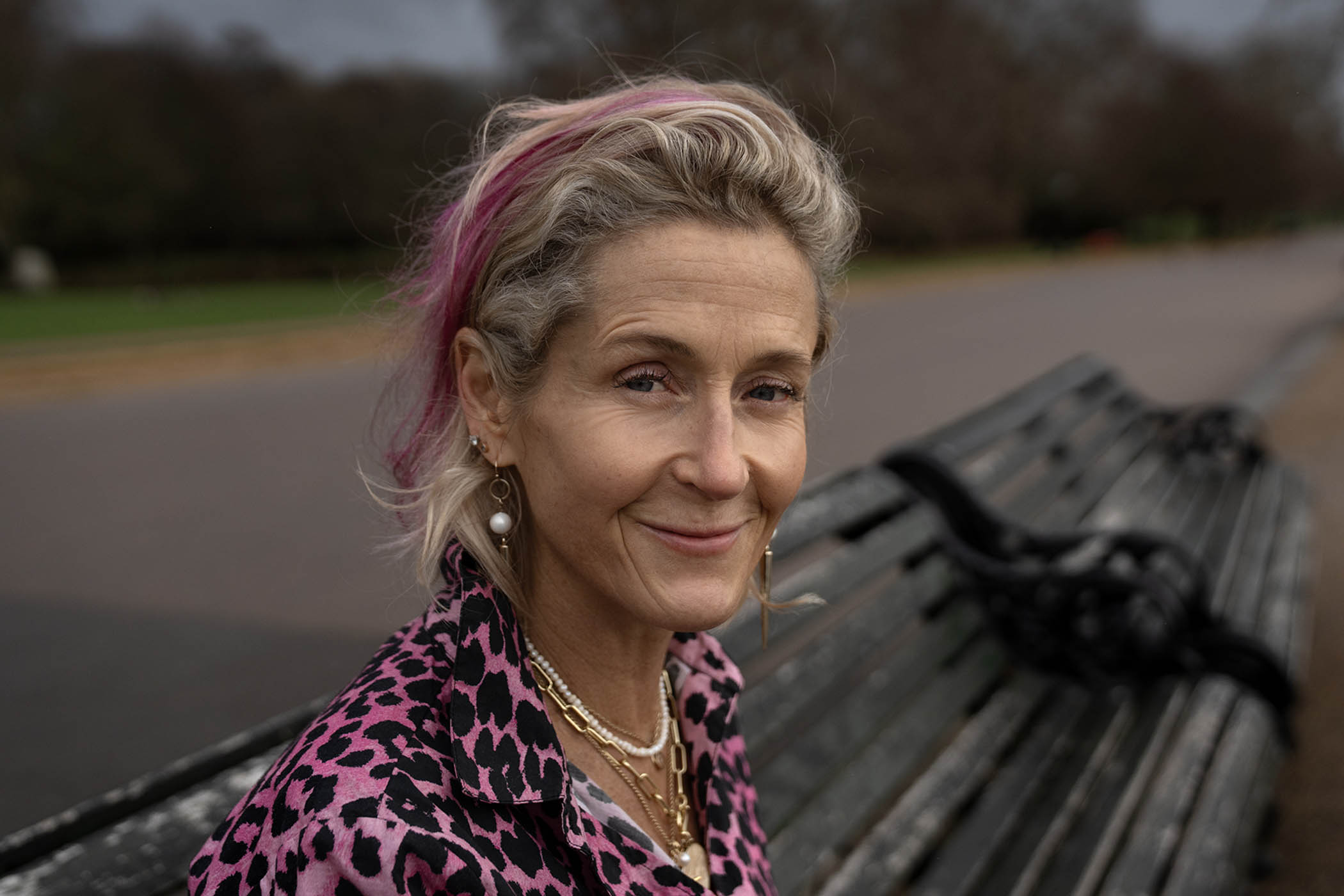
We meet at the cafe near the Serpentine Gallery. Lady Lane-Fox – entrepreneur, philanthropist, crossbench peer, government technology adviser – has pink streaks in her hair and fluorescent orange nails. The co-founder of Lastminute.com – the clever, glamorous figurehead of the 1990s dotcom boom – may have become a member of the great and good at the age of 52 but she does not look like one. She is wearing a pink and black leopard print shirt, black jeans and trainers.
As we set off on our walk, a group of horseriders clip-clop along the bridleway that runs through the park, and dog walkers huddle together in the wintry drizzle.
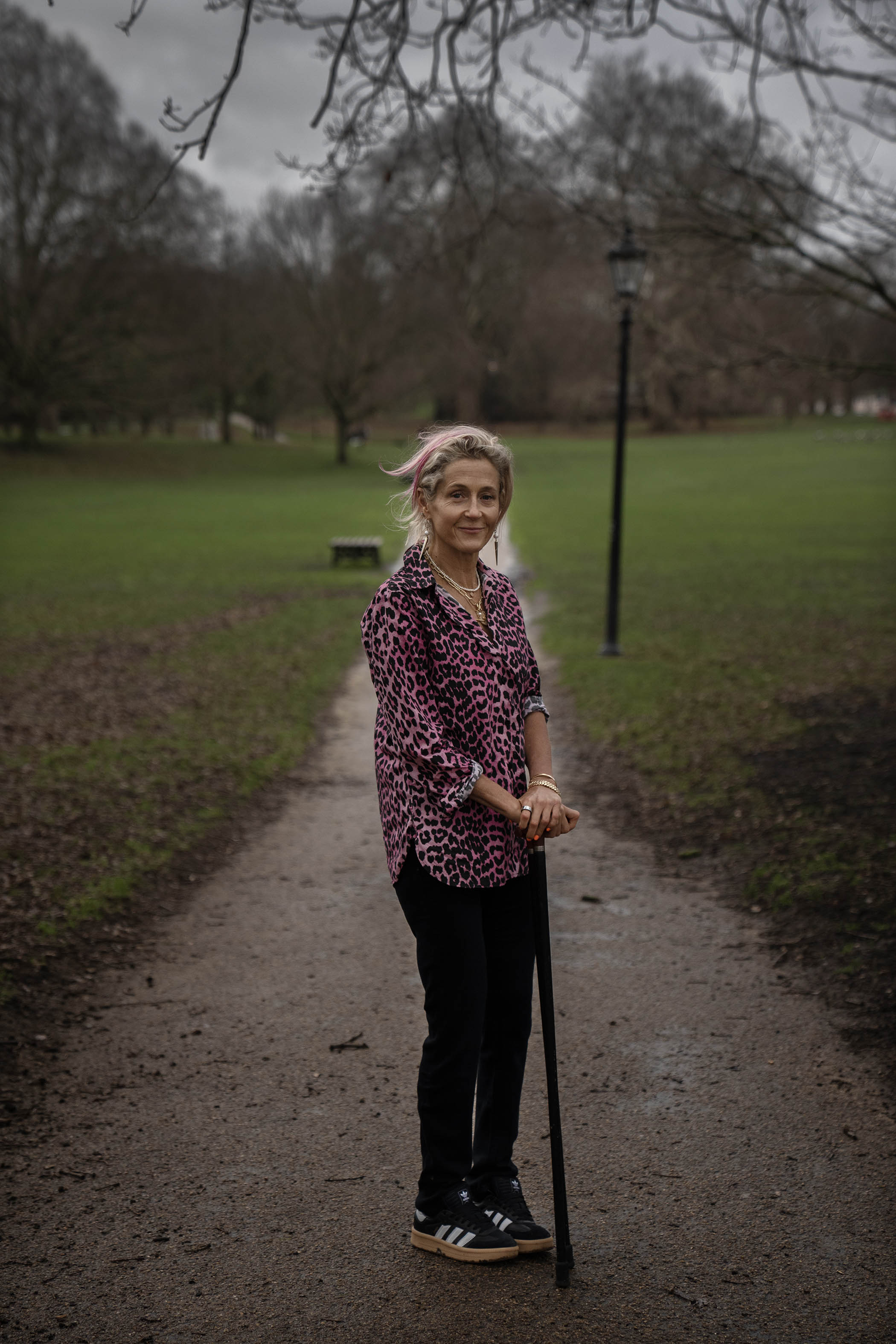
“I’m more of a cat person,” Lane Fox says. She walks with two sticks and is in almost constant pain. “I won’t be able to do more than 15 or 20 minutes,” she says, but in fact we stroll for almost three-quarters of an hour.
She has dealt with her life-changing injuries by refusing to let them stop her. “I have never really thought about what’s not possible,” she tells me. “I’ve just focused on what’s possible. I’m lucky that that’s where my brain's gone. If I focused on all the things that could go wrong, or on reasons not to do things, I’m not sure I would get out of the house very often. I think denial is a massively underrated emotion. There’s a lot of benefit in just putting things in a box and burying them.”
We cross the road and turn into Kensington Gardens, past cyclamens and snowdrops that have popped up beneath the bare trees. Squirrels scuttle around us and magpies perch on the metal fence as we take the path around the lake. In 2004, Lane Fox was on holiday in Morocco, having just cashed in £4.6m of Lastminute.com shares, when the 4x4 she was a passenger in skidded off the road. She flew through the windscreen, landed on a rock and broke 28 bones, including her pelvis, which was smashed into six pieces, causing severe internal bleeding and leading to a stroke. She was airlifted home, nearly died on the plane, then had dozens of operations as the doctors tried to piece her broken body back together.
Learning to walk again was “absolutely awful”, she says. “I don’t say that for sympathy, but one of the hardest things I’ve ever had to do was stand up for the first time. It’s so beyond pain: it’s everything – you’re unable to have any confidence in your body.” She was strapped into a machine that held her upright “and then you have to try and manage as long as you can – 10 seconds, 20 seconds. And because of the nerve damage from my pelvis, it felt as though I was covered in ants all over my body. The burning pain was unbearable and it was also just completely discombobulating because I’d been flat for nine months. I just remember the feeling that seconds become like years.”
The park was a crucial part of her recovery. “It was so important to get outside,” she says. “I spent so much of my youth in London, but I didn’t really ever think about nature in the way I do now. For me, because I can’t run – I can’t do anything, really, at speed – being able to be outside and move is the most fast-track way to clear my head or just take myself out of my current pain.”
Newsletters
Choose the newsletters you want to receive
View more
For information about how The Observer protects your data, read our Privacy Policy
We walk past Henry Moore’s sculpture the Arch, a large marble structure based on the shape of a bone. “I always think of it as a wishbone but, actually, it’s much more like a pelvis, which is ironic, because that’s where a lot of the trouble I have stems from.”
Lane Fox insists she is “not fragile”. In 2024, 20 years after the accident, she climbed the three highest peaks in the UK and raised £400,000 for charity. “It’s patchy,” she says. “The unpredictability is hard. That’s the biggest change since going from being able-bodied to disabled. I was used to thinking: ‘If I work hard at something, I can probably achieve it’ – and now that’s not the case. If I say yes to something next Thursday, I don’t know that I’ll be able to do it. I find that slightly soul-destroying. You let people down.”
‘There’s a notion that resilience just happens – you can magically be tough. That’s not true’
‘There’s a notion that resilience just happens – you can magically be tough. That’s not true’
When she realised she would not be able to do a full-time executive job, she created a “portfolio career”, serving on prestigious boards, from Marks & Spencer to Channel 4, creating the Gov.uk digital system, co-founding the karaoke company Lucky Voice and becoming chancellor of the Open University. She is just standing down as president of the British Chambers of Commerce (BCC).
“I’ve had so much luck,” she says. “I’m lucky that I’m alive, I’m lucky I had the resources to get out of the hole of the accident, and so I want to make sure I keep contributing to the UK.” Her positivity is extraordinary. “I do really believe in everybody’s capacity to make a difference, and I think that’s a much better way of charging through life, as opposed to feeling as though everything must be as it has always been.”
In the late 1990s, when Lane Fox founded Lastminute.com with her friend Brent Hoberman, the world wide web seemed to embody the optimism of a new technological age. The internet did not just offer to make it easier to book a holiday; it promised to democratise information and connect the globe. Now children are being radicalised online and images of women are nudified to create pornography without their consent.
“I don’t think you could say it was a net negative for the world that the internet emerged,” she says. “Think of the connectivity between people and the access to education. It’s liberating.” But she acknowledges that “horrendous things” have also been “let loose”.
As we reach the ornate fountains of the Italian Gardens, believed to have been created by Prince Albert for Queen Victoria, she says she thinks the “monoculture” of the tech bros is to blame. “When you look at the people running the biggest technology businesses in the world, they are mainly men. They come from one small bit of the world in the US and another small bit of the world in China. It means that we’re not getting a broad spectrum of considered, careful products.”
And she thinks this “is getting worse, not better”. Last year, she was one of only two women at a meeting in New York. “I said to the man sitting next to me: ‘It’s a bit depressing there are so few women in this room.’ And he looked at me and said: ‘Haven’t you heard? We’re done with women.’ The House of Lords is old-fashioned but it’s not the same as the systemic nature of the power in the tech sector.”
In her view online misogyny is a direct consequence of male dominance. “I don’t think, generally, people get up to trash the world; I think it’s just a lack of care about the consequences,” she says. “You get engagement by provoking rage, and the people who have tended to have the loudest voices in anger are male.” Lane Fox was on the board of Twitter before it was taken over by Elon Musk andrebranded as X. “I remember saying in a board meeting: ‘If you haven’t felt frightened in the street, as every single woman has, why would you ever consider that it can be frightening in the streets? And the same is true online. If you’ve not had that vulnerability yourself, it’s almost impossible to imagine that that might be the experience of a very large group of other people.”
She points to Grok, Musk’s online AI tool, which has been churning out sexualised and topless imagery of young girls. “That’s just the most terrifying example. It’s horrendous.” She was appalled to hear Pete Hegseth, the US defence secretary, promise earlier this month to unleash Grok – “this completely lawless, horrifying, exploitative tool” – across the US military. “I find that really very alarming.” She had “some run-ins” with Musk during his takeover of Twitter. “I think he’s got way too much power and it’s kind of gross how this tech broligarchy has captured the presidency,” she says. “It feels to me that this is a person who has become more and more damaged – damaged by power, damaged by people around him not telling him the truth, damaged by banging around in his own social network late at night.”
Lane Fox was not in the Lords for last week’s vote on banning social media for under-16s – she does not have the strength to stay late in parliament – but she supported the amendment. “The evidence is irrefutably clear. Something needs to happen.” Her own twin boys are not allowed screens. “I don’t think I would ever give a 10-year-old any of this stuff. They have an hour at the weekends where they can play football games on an iPad, but they don’t have their own iPad. It wouldn’t even occur to me to give them a phone.”
Having advised successive governments, including this one, on technology, does she support the introduction of digital ID cards? “If you'd asked me that 20 years ago, I would have been much more conflicted. Now, I think if it’s done well and you feel like you’re in control of it, not the government, then, yes, I would. I think it’s been slightly convulsive, this whole process, and, actually, it could be a really useful tool.”
On AI she says: “We haven’t even begun to understand the potential opportunities. We should be optimistic. My kids are 10, and I think about the world they will be in, and there will be so much opportunity for creation, so many different exciting things they will be able to do that we just have no idea about yet.”
But the education system needs radical reform to prepare children for the new world, she says. “We put too much emphasis on testing in a rote way and not enough on building brains that are able to cope with what are inevitably going to be a complex set of challenges over the next couple of decades.”
In the age of the robots, children need to develop their human skills. “The capacity to talk to strangers, ask good questions, be able to understand context, think about where things come from. We need to encourage creative thinking, reading poetry, writing poetry, doing all these things that make your brain able to cope with ambiguity and complexity.”
As president of the BCC, she has seen the impact of new technology, regulation and tax rises on companies. “It’s hard running a small business but there’s absolutely no doubt in my mind that, over the course of the past three years, it has got harder,” she says. “There’s a lack of confidence. We need the government to have a positive sense of what we’re trying to shoot for. We’re an incredible country, we’ve got amazing businesses – and they just can’t seem to articulate that.”Lane Fox has always had an entrepreneurial streak. As a child, she would pretend she was running a hotel. “I used to set up a reception at home and have my family check in and out. I had very strict regulations and procedures. I don’t like the expression ‘bossy’, but if you asked my brother, he’d probably say I was.”
We are nearly back at the cafe and Lane Fox must be tiring, but she is still putting one foot in front of the other. “There’s a notion that somehow resilience is just a thing that happens – that, magically, you can be tough,” she says. “And that’s not true. It takes hard work. It’s about breaking things down into minutiae and small goals.” Every step is an effort but there is no self-pity. “Life is tough. You have to accept the things you cannot change and change the things you can.”
When things are difficult, she remembers a Martin Luther King quote. “He said, ‘If you can’t fly, run, if you can’t run, walk, if you can’t walk, crawl, but whatever you do, just keep moving forward’. That’s something I hold very close. You can always keep moving forward somehow.”