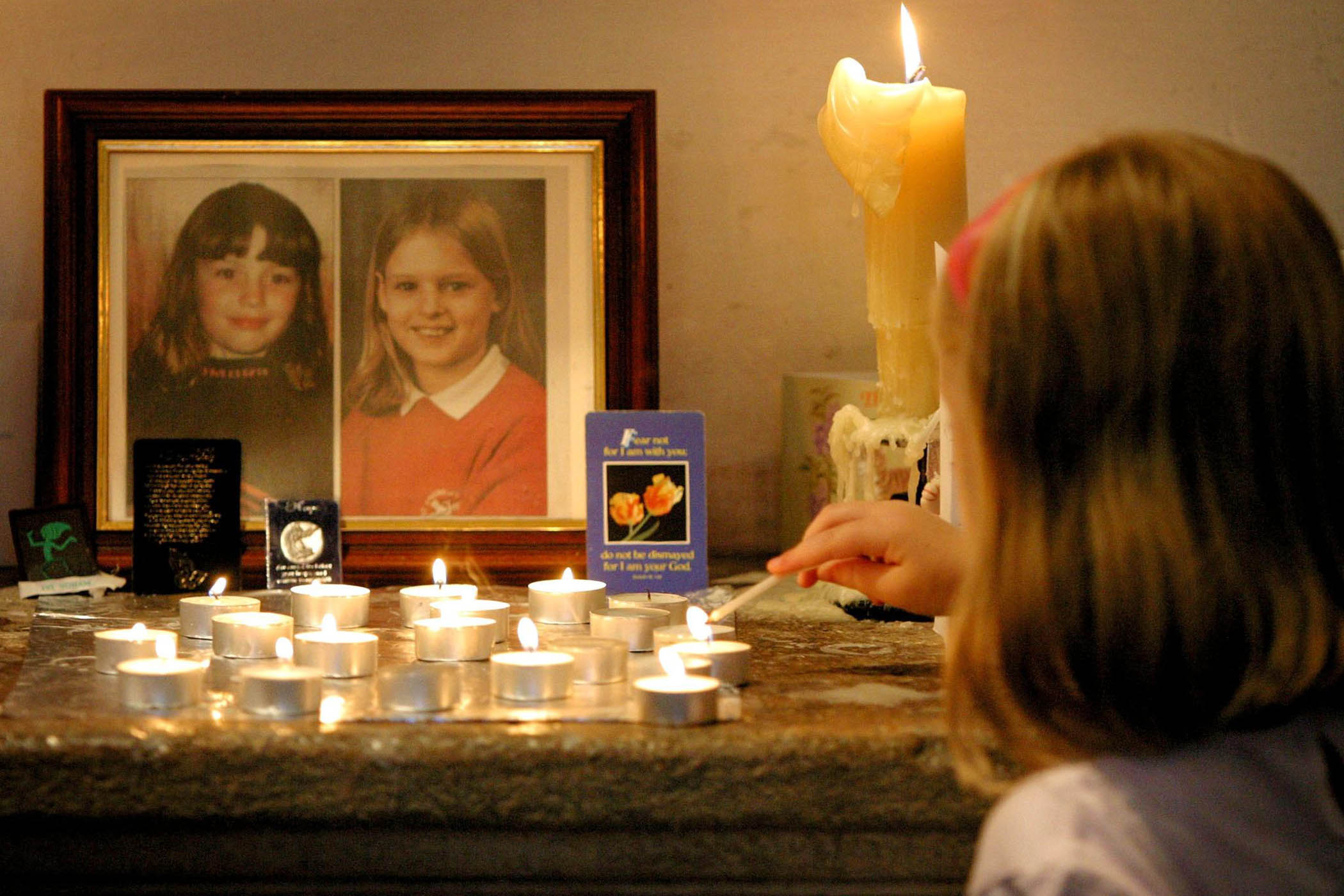

The names Holly and Jessica still evoke a single image. The photograph, circulated for nearly two weeks before their bodies were found, shows two happy schoolgirls; inseparable best friends wearing matching Manchester United shirts.
Yesterday the man who murdered 10-year-olds Holly Wells and Jessica Chapman in Soham, Cambridgeshire, in August 2002, died in hospital, 11 days after he was attacked in prison.
Ian Huntley lured the two girls, who had gone to buy sweets without telling their parents, into his home and strangled them before burning the football shirts and other clothing, changing his tyres and disposing of other evidence. A sexual motive was suspected but never proved.
‘Paedophiles and child killers are targeted as they are at the bottom of prison hierarchy’
‘Paedophiles and child killers are targeted as they are at the bottom of prison hierarchy’
Ian Acheson
The famous photograph of the girls was taken at about 5pm on the day they disappeared, an hour before the girls left a barbecue at the Wells’s family home. After panicked phone calls between their parents and efforts to find them, the police were called just before 10pm on 4 August.
Holly’s mother, Nicola Wells, said of that final image in 2013: “It is our last picture of our daughter, yet it represents something evil – that is exquisitely painful. We would love to reclaim that image for ourselves. Being unable to do so is, I think, the one last thing we have to deal with.”
The girls’ bodies were found by a gamekeeper on 17 August 2002, side by side in a ditch near the perimeter fence of RAF Lakenheath in Suffolk, 10 miles east of Soham. Huntley left them wearing only their necklaces, including one Jessica had given to Holly that day from her summer holidays.
After his trial, Jessica’s father, Leslie Chapman, said of Huntley: “I think he was a timebomb waiting to go off, and both our girls were in the wrong place at the wrong time. I hope the next time I see him, it will be like we saw our daughters – and it will be in a coffin.”
Huntley, who has died aged 52, was reported to have been attacked while at a recycling workshop inside maximum security HMP Frankland. He is said to have been blinded, suffered multiple jaw fractures and left with catastrophic brain injuries.
The death of one of the nation’s most notorious prisoners prompted websites to bid him “good riddance”, but experts warned that the death of such a high-profile prisoner stands as an example of the worsening security and parlous conditions across the prison estate.
John Podmore, the former governor of HMP Belmarsh, said yesterday: “There will be few tears, but there are many questions about an increasingly violent prison system and how prisoners with nothing to lose are managed for the decades they remain dangerous.”
Newsletters
Choose the newsletters you want to receive
View more
For information about how The Observer protects your data, read our Privacy Policy
The main suspect in Huntley’s murder is Anthony Russell, a fellow inmate. Russell, 43, is understood to have been arrested by Durham Constabulary and has yet to be charged.
The girls’ murders prompted a wholesale reassessment of child safety and police intelligence systems in the UK. The subsequent public inquiry, led by Michael Bichard, found serious failures in police intelligence systems. Different police forces held records about Huntley, who had been charged with rape and accused of indecent assault and inappropriate behaviour, but had still managed to get a job as a caretaker at Soham Village College using his mother’s maiden name, Nixon.
The girls attended nearby St Andrew’s Primary School, where Huntley’s girlfriend, Maxine Carr, was a teaching assistant. Carr, who knew the girls, was jailed for three and a half years for providing a false alibi for Huntley.
Responding to the news of Huntley’s death, Ian Acheson, a former prison governor and civil servant, said that no motive for the attack has been established, but that child killers and paedophiles are commonly targeted for violence as part of a prison hierarchy.
“People who murder children are normally at the very bottom of that. People like Ian Huntley.”
Describing the chaos in Britain’s prisons, Acheson said: “It sounds to me like there’s been a fairly catastrophic failure in that process that has allowed this to happen. Somebody’s dropped the ball here in relation to risk assessment in terms of the mix of people that should have been in that workshop.”
Acheson added that the risk to prison staff had become “intolerable”, describing the broader picture in prisons as dysfunctional.
“Rehabilitation is a total fantasy. It is simply not going to happen in places awash with drugs, which drive huge amounts of violence where we’re employing teenagers in uniform to look after sophisticated prisoners, and we wonder why there’s sexual misconduct and sexual boundary violations all the time, particularly with young female staff and prisoners. We’re reaping what we sow, and that is the collapse in every metric of control, order and decency in the prison service since 2010.”
A series of processes to establish the circumstances of Huntley’s death will now be under way. The governor must write a personal letter of condolence to the family and invite them to visit the prison. He must offer to contribute up to £3,000 to funeral costs, payable to the funeral directors.
The protocol also includes a memorial service to Huntley, arranged through the prison chaplain and open to the family, prisoners, and staff.
HMP Frankland, which is home to other high-profile offenders, is expected to tighten security measures. Other prominent prisoners include Michael Adebolajo, the key conspirator in the terror attack that saw the murder of Fusilier Lee Rigby; Levi Bellfield, the serial killer who murdered schoolgirl Milly Dowler; and former PC Wayne Couzens, the firearms officer who kidnapped, raped and murdered Sarah Everard.
The prison’s recent record will also raise concerns. In April last year, three prison guards were rushed to hospital after allegedly having hot oil poured over them and being stabbed with makeshift knives. Hashem Abedi, the brother of Manchester Arena bomber Salman Abedi, is awaiting trial for the attacks. He has denied the attacks.
In May 2024, Damien Bendall, 36, struck Michael Mullaney four times in the head with a claw hammer. He was given a further life sentence this month. A police officer was stabbed inside the prison in a separate incident in July, just two months after Mullaney was attacked.
A Ministry of Justice spokesperson said that “the murders of Holly Wells and Jessica Chapman remain one of the most shocking and devastating cases in our nation’s history, and our thoughts are with their families”.
Photograph by Dan Chung/Getty Images