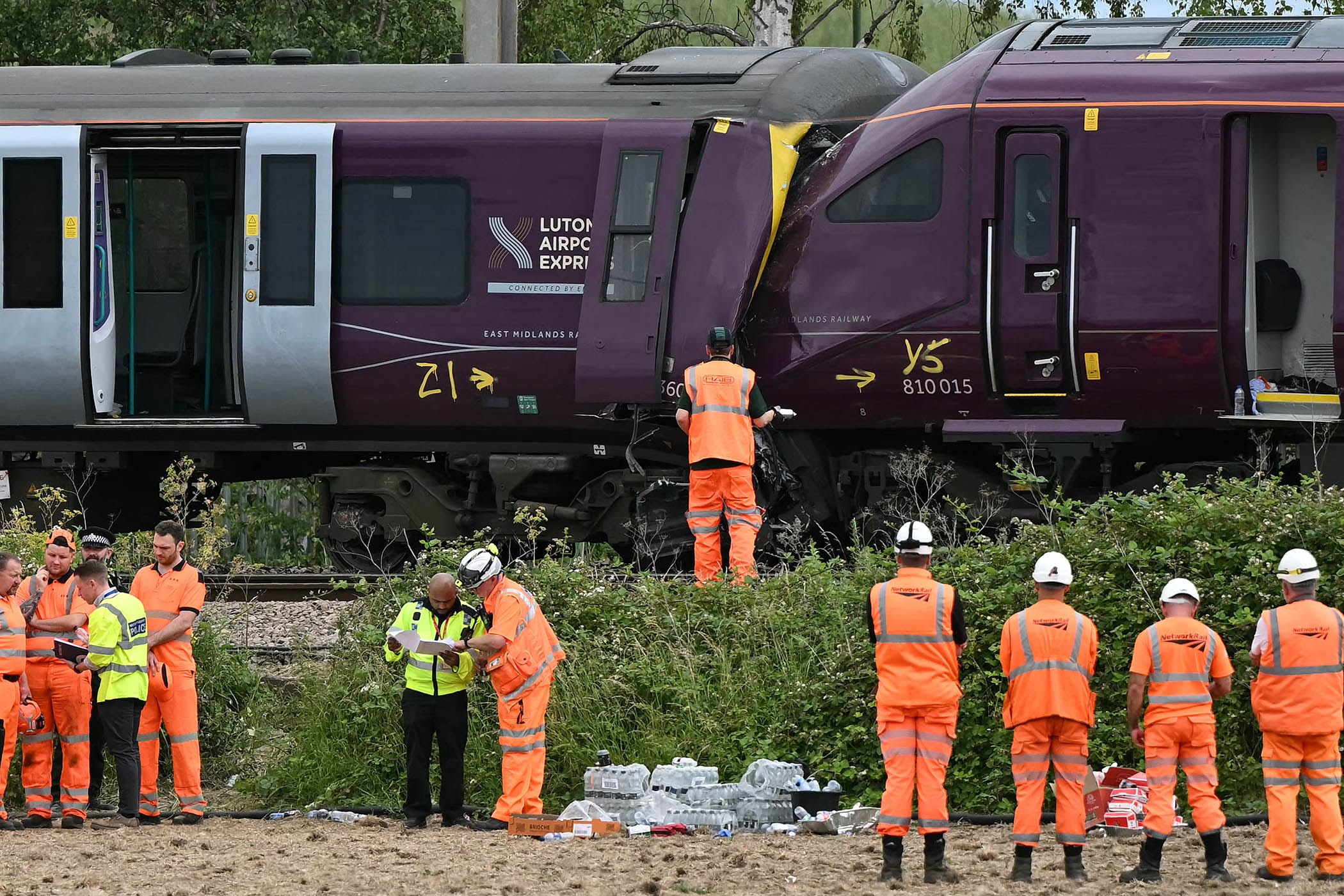


Passengers caught up in the Bedford train crash have described their shock and anger over the worst accident on Britain’s railways in more than two decades.
Nine people were in a critical condition on Saturday out of 100 passengers injured when the 4.40pm from Corby to London’s St Pancras collided with a train that had stopped on the line.
The driver of the Corby train died, it was confirmed on Saturday. The East Midlands Railway service had left Bedford station only a few minutes earlier, and at about 5.15pm it hit the stationary 3.50pm from Nottingham to St Pancras.
Keir Starmer and King Charles both offered their condolences and sympathies. On Saturday, those on board began to give details of what had happened, thanking the emergency services and bravery of the crew.
Mareks Grabovskis, a construction site manager, was in the last carriage of the Corby train. He passed out during the collision; when he came to, he saw people “covered in blood”.
“It was one of the most terrifying moments of my life, and I know how fortunate I am to be here today,” he told the BBC.
Nina Robinson was on the Nottingham fast train that had stopped on the track for a “couple of minutes”, she said. The driver had informed them the train had “lost power”, she told Sky News.
“Then, out of the blue, there was this big bang.” She was in the first carriage, the farthest from the impact. “It was only when I saw that the driver and the train staff were really panicking that we realised something quite serious had happened.”
Brett Byatt, a teacher from Bedford, was on the Corby train. “I knew something was wrong because I go on trains quite often, and they don’t brake [after] Bedford until you’re approaching Luton,” he said. “I thought: ‘Oh no.’”
There was a “huge impact” and “carnage”, he said. “Yesterday, I was pretty shocked. This morning, it feels surreal,” he told Radio 4’s Today programme. “I’ve moved into the stage of anger now – I’m feeling pretty angry.
Newsletters
Choose the newsletters you want to receive
View more
For information about how The Observer protects your data, read our Privacy Policy
“We’ve got one of the oldest railway networks, and signal failures happen a lot. Why did that train driver lose his life over this?”
More than 70 firefighters took part in the rescue, according to Andrew Hopkinson, chief fire officer for Bedfordshire, who said it was a “deeply distressing incident”.
Investigators from the Rail Accident Investigation Branch (RAIB) are examining the scene of the collision near the village of Elstow, about three miles (almost 5km) down the track from Bedford station.
They will be trying to work out why the second train did not stop, according to rail industry sources. Either the train went past a red signal, or there was no red signal, they said.
The railway network is divided into sections – some no longer than a train and others several miles long – with a signal showing whether it is safe to enter them or not.
Only one train is allowed to be in any one section at a time – a second train entering a section is classed as a “Spad”, or “signal passed at danger”.
There are automatic systems meant to prevent Spads from happening. The automatic warning system (AWS) is meant to alert the driver if the train goes through a red signal.
After the Ladbroke Grove disaster in London in 1999, when 31 people died after a train went through a red signal, then transport secretary John Prescott ordered the rail network should be covered by the train protection and warning system, which automatically triggers the brakes if the driver does not respond to an AWS alert.
Tracking data shows that the Nottingham train had stopped on the fast line to London, and the Corby train behind had switched from the slow line to the fast line. A control log from the time of the incident suggests that the Nottingham train had reported a fault with the AWS system, although that would not explain why the Corby train failed to stop in time.
Industry sources said the RAIB will be checking whether the track section at Elstow might have been faulty or damaged, if there had been works in the area that might have interfered with the signalling cables or if the automatic braking system was triggered.
They will also be examining video footage from the driver’s cab showing what he could see. Each signal also has a black box logging what it was showing.
Engineers had been due to start work on other parts of the Midland main line between Bedford and London on Saturday to make improvements to the track, crossings and drainage, Network Rail had announced last week, although no works had been mentioned at Elstow or in Bedford.
Ellie Burrows, managing director for Network Rail’s eastern region, said it had been a “profoundly sad day for everyone affected by this incident, and for the wider railway family”.
While RAIB teams work alongside police investigators, Network Rail has begun work on bringing the line back into operation. Burrows said it would be a “complex recovery operation”.
Photograph Justin Tallis/AFP via Getty Images