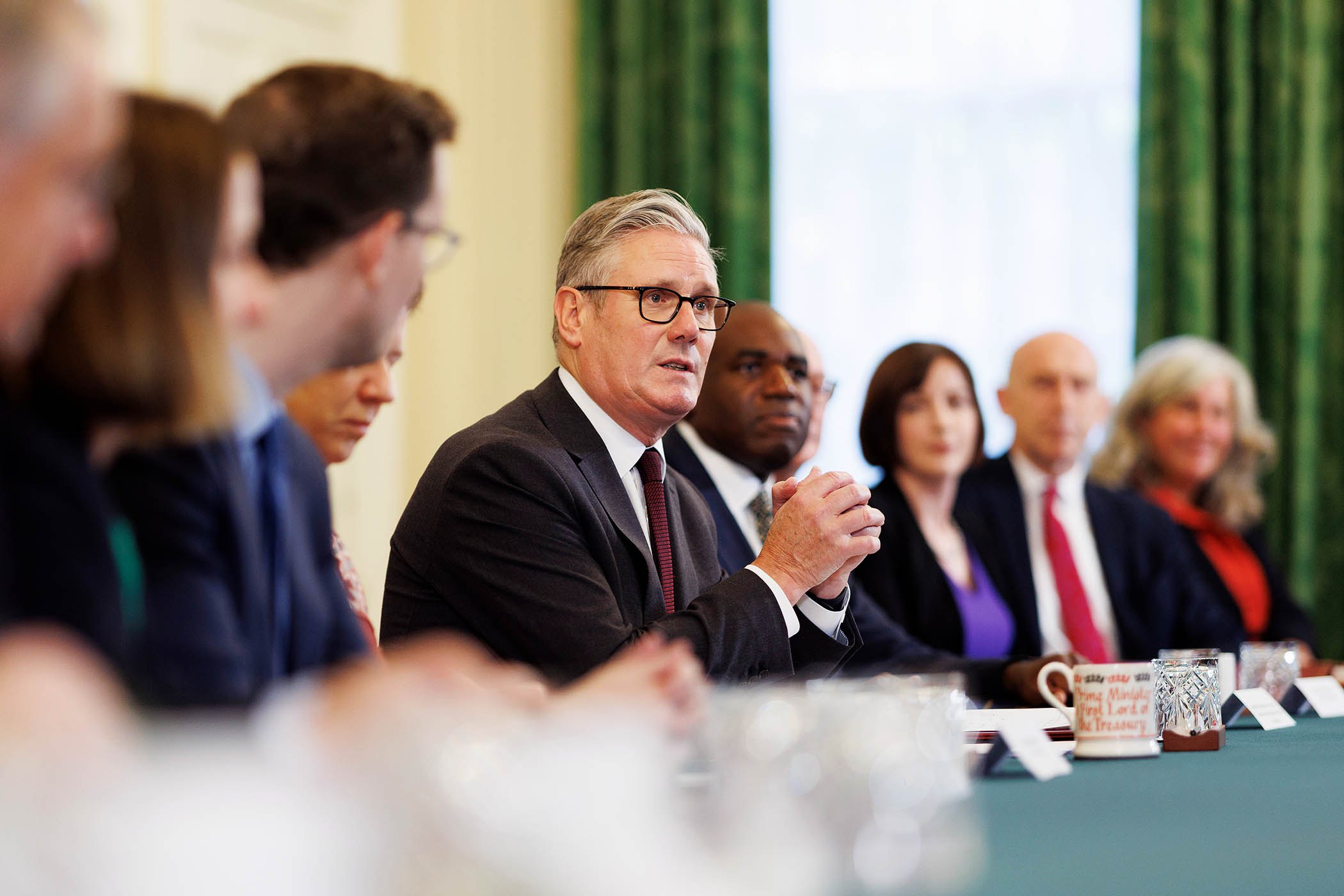

Resolution is both a virtue and a new year tradition, and it is one the prime minister must acquire. Politics is faster and more fevered than ever before, nowhere more so than within the ranks of Labour MPs. Canvassing has broken out into the open. Political reporters, oblivious to mobile telephony, write of putative candidates “putting the phone lines” into campaign headquarters. The prime minister’s consigliere continues telling anyone who will listen that Keir Starmer will fight on, which essentially concedes the point that he is going to have to.
Which, indeed, he will. There remains, just about, a chance that the various contenders prove so unappealing to a sufficiently large proportion of the Labour party that inertia will prevail. Perhaps the advocates of Wes will stay their hand for fear of Ed; those backing Shabana may worry about encouraging Andy; supporters of Angela may remain cautious lest she lets in any of the rest. It is conceivable that Keir Starmer could stay, as the lowest common denominator prime minister.
But he cannot rely on that. We are on the verge of a seasonal epiphany, and this is Starmer’s best hope of holding off the forces gathering against him. Twelfth Night is traditionally a festival in which everything is turned upside down, ending in the crowning of a Lord of Misrule. That would be one of the gentler epithets some Labour MPs might apply to the prime minister.
Yet there is a glimmer of hope because Twelfth Night is immediately succeeded by the Epiphany, a sudden and profound realisation or manifestation of the truth. The magi appear, bearing gold, frankincense and myrrh, symbols of power, divinity and mortality. What are the January 2026 equivalents of the gifts of the magi and what is the epiphany required?
The government’s deficiencies are rhetorical, intellectual and political and it is a stretch to suppose they can all be remedied over the break. However, there is no alternative but to try. The rhetorical problem is the easiest to deal with. The government is so much less than the sum of its parts. Its story consists of fragments shored against its ruins. There is no shape to the tale, no driving force. If Keir Starmer: The Government were a screenplay, the writers would struggle to define what the protagonist was seeking.
If Keir Starmer: The Government were a screenplay, the writers would struggle to define what the protagonist was seeking
If Keir Starmer: The Government were a screenplay, the writers would struggle to define what the protagonist was seeking
Belatedly, the prime minister needs to do something which is, frankly, a basic requirement. He must say, plainly that Britain will be a better place when it grows, when we invest in our people and our public services, and when we secure our borders. Then he should find elegant variations on those themes and repeat them over and over.
It is a simple change, which makes its absence all the more frustrating to those of us inclined to wish him well. Instead, there is a new priority every other week and a baffling lack of comprehension that no one has noticed the industrial strategy or credited the government with its small-bore efforts to tackle inflation.
The second defect is intellectual. It is common to observe that the Starmer government lacks direction; less often noted is that this may not be entirely his fault. Since the financial crash of 2008, what is the template for leading from the left?
The Obama and Biden successes, such as they were, involved standard state spending possible in a large economy with the power of a reserve currency. Mark Carney is doing well enough in Canada, which has avoided recession despite the trade war, but he has been gifted both an issue and an enemy in the form of Donald Trump. Anthony Albanese is confounding his critics in Australia. These are slim pickings.
The chancellor of the exchequer has just passed up, in the budget, another opportunity to make a defining statement about why this generation of Labour politicians wants to be in government. Instead, we got a budget of bits and bobs. She has found out that it is hard to be a vintage social democrat when there is no surplus to distribute. It is not impossible; it simply demands choices, about what not to do as well as what it would be nice to do.
Newsletters
Choose the newsletters you want to receive
View more
For information about how The Observer protects your data, read our Privacy Policy
This leads directly to the urgent political question. The prime minister absolutely has to associate himself with the bolder acts of his own government. If you think of Keir Starmer, what cause comes immediately to mind? None. Which of his own policies? None. He has to choose, now.
He could make the turn towards Europe more explicit by suggesting a returned Labour government would seek to rejoin the customs union. He could embrace climate change with Ed; welfare reform with Pat; small boats with Shabana; beat the BMA with Wes; boost science with Liz; increase the investment rate with Rachel. Something.
Things are so murky and vague at the moment that any one of these would be an improvement. It hardly matters which, but the prime minister needs to be all over his causes, visibly and audibly. The excessive anger directed at Starmer surely derives from the sense that he has squandered a gift. He received the blessings of the magi – and blew them all.
The prime minister might retort – and we might still accept the argument – that government is difficult and it takes time to work out what to do and how to do it. But the epiphany cannot wait until February. Acting as a distant chairman of the board worked for Clement Attlee, but that was 80 years ago.
The country now needs the sense that cabinet ministers act because the prime minister wills them to do so. Labour MPs need to feel that he is pointing the way. But, most of all, Starmer needs to act for himself. If he carries on as he is, by the time the next Twelfth Night comes around, some other Lord of Misrule will be in place.
Andrew Rawnsley is away
Photograph by Lauren Hurley/No 10 Downing Street