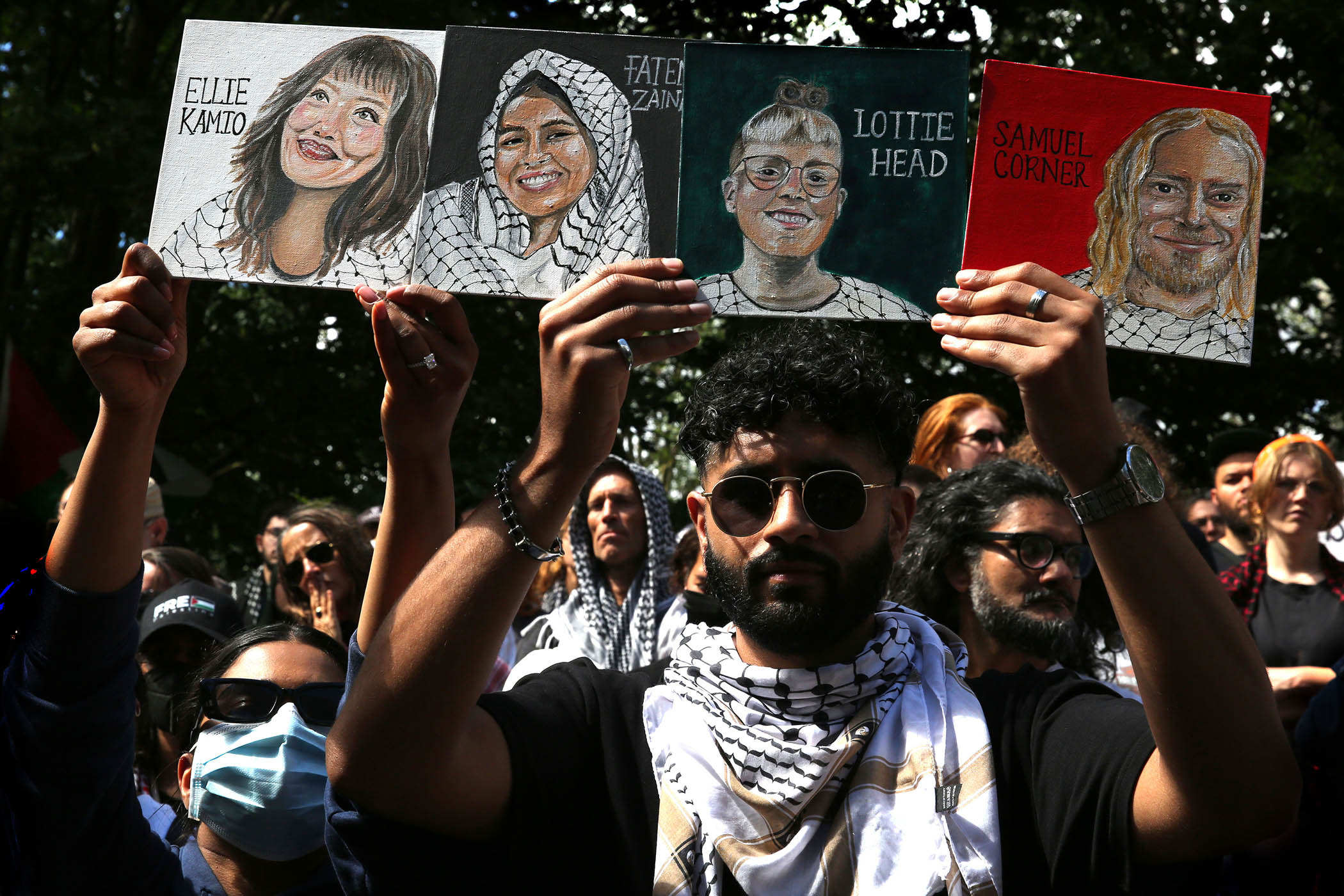


‘It’s perverse. Absolutely perverse.” The last time I met Rajiv Menon was almost 40 years ago when we were both young antiracist activists in east London. Last week we met again to talk about the sentences handed down to four Palestine Action activists for taking direct action against an arms factory near Bristol belonging to the Israeli-based defence firm Elbit Systems. They were imprisoned for between four years eight months and seven years eight months, the severity of which Menon calls “shocking”.
Menon is one of Britain’s leading civil rights barristers, who has participated in legal proceedings around the Stephen Lawrence murder, the Hillsborough tragedy, the Grenfell Tower fire and the undercover policing scandal. On Friday he was defending Charlotte Head, one of the four PA activists. At their first trial, in February, six defendants were acquitted of aggravated burglary and of violent disorder. A second trial last month found four of the six guilty of the lesser charge of criminal damage, and one of inflicting grievous bodily harm.
The judge, Mr Justice Johnson, insisted on Friday that the four be sentenced, not simply for criminal damage or GBH, but also for terrorism. Judges can rule defendants’ actions as having a “terrorist connection”, even if they have not been convicted of a terrorism offence.
It is, Menon insists, “totally arbitrary” how and why the “terrorist connection” rule is applied. Thomas Mair, who murdered MP Jo Cox in 2016, was not charged with terrorism. After the trial, both the Crown Prosecution Service and West Yorkshire Police described it as a case of terrorist violence. At the sentencing, though, while the judge referred to Mair as “advancing a political, racial and ideological cause”, he did not sentence him as a terrorist.
The day after their original arrest, Menon says, the activists were rearrested by counterterrorist officers on suspicion of having prepared terrorist acts. The CPS decided, though, not to charge them with terrorist offences. “So how on earth can the judge make that finding post-conviction on the exact same evidence?”, he asks.
The ability of a court to aggravate charges citing a “terrorist connection”, on the say-so of a judge, should trouble anyone who values liberties
The ability of a court to aggravate charges citing a “terrorist connection”, on the say-so of a judge, should trouble anyone who values liberties
The violence of one of the activists, Samuel Corner, who used a sledgehammer to attack a police officer and cause grave injury, is something we should take seriously. Nevertheless, the wider issues thrown up by the case should concern even those who oppose the activities of Palestine Action. The ability of a court to aggravate charges citing a “terrorist connection”, on the say-so of a judge, and with the jury sidelined, should trouble anyone who values liberties.
At the sentencing hearing Johnson declared the activists to be terrorists because the damage they caused was “serious” and they sought to “influence UK government policy”. Given that all direct action, and indeed all protest, seeks to influence policy, this could potentially turn any protest that causes significant damage into a terrorist act. That is why this is not simply an issue about Palestine or Palestine Action.
Next week, Menon is back in court in another case crucial to the question of civil liberties. This time, he himself is facing a charge, of contempt of court.
During the Palestine Action trials, Johnson ruled that the alleged use of Elbit weapons in Israel’s destruction of Gaza could not be employed as a “lawful excuse” for the activists’ actions. He also warned defence barristers not to tell the jury about the principle of “jury equity” – the freedom of jurors to reach a verdict according to their conscience. In essence, Johnson ruled that a barrister cannot tell a jury that it has the right to do what it legally has the right to do because it would breach his legal directions. While the right of juries to follow their conscience and come to a verdict independently of the judge is an established principle of common law, whether barristers can tell juries about that right remains a legal grey area.
In his closing speech at the first trial, Menon told jurors: “I am absolutely not asking you to disregard His Lordship’s legal directions”. Nevertheless, he said, “nobody, not even His Lordship, can dictate to you what factual conclusions to reach in this case, nor direct you to convict the defendants of any of the charges they face.” Menon also spoke of the famous Bushell case of 1670, which established the right of jury independence, and of the plaque in the Old Bailey that celebrates that case and “the right of juries to give their verdict according to their convictions”.
Newsletters
Choose the newsletters you want to receive
View more
For information about how The Observer protects your data, read our Privacy Policy
“I tried to construct a speech that positively didn’t breach the judge’s order”, says Menon. Johnson, though, deemed Menon’s remarks to be contempt and referred the case to the high court. That got thrown out for procedural reasons. Next week, Johnson will decide in court whether to refer the case to the attorney general for possible further action.
Menon fears that both the sentencing of the activists as terrorists and the contempt charge against him are part of a wider retrenchment of liberties. The Britain in which Menon and I first met was deeply racist and illiberal. Today’s Britain is much changed. Yet, within a more open, tolerant society, there is developing both more assertive forms of racism and deeper wells of illiberalism, including increasing state restrictions on protests and free speech. Next week, the government’s appeal against a high court ruling that its banning of Palestine Action as a terrorist organis ation was unlawful returns to court. What Menon described in court as “chilling and creeping authoritarianism” should worry all of us.
Photograph by Martin Pope/Getty Images