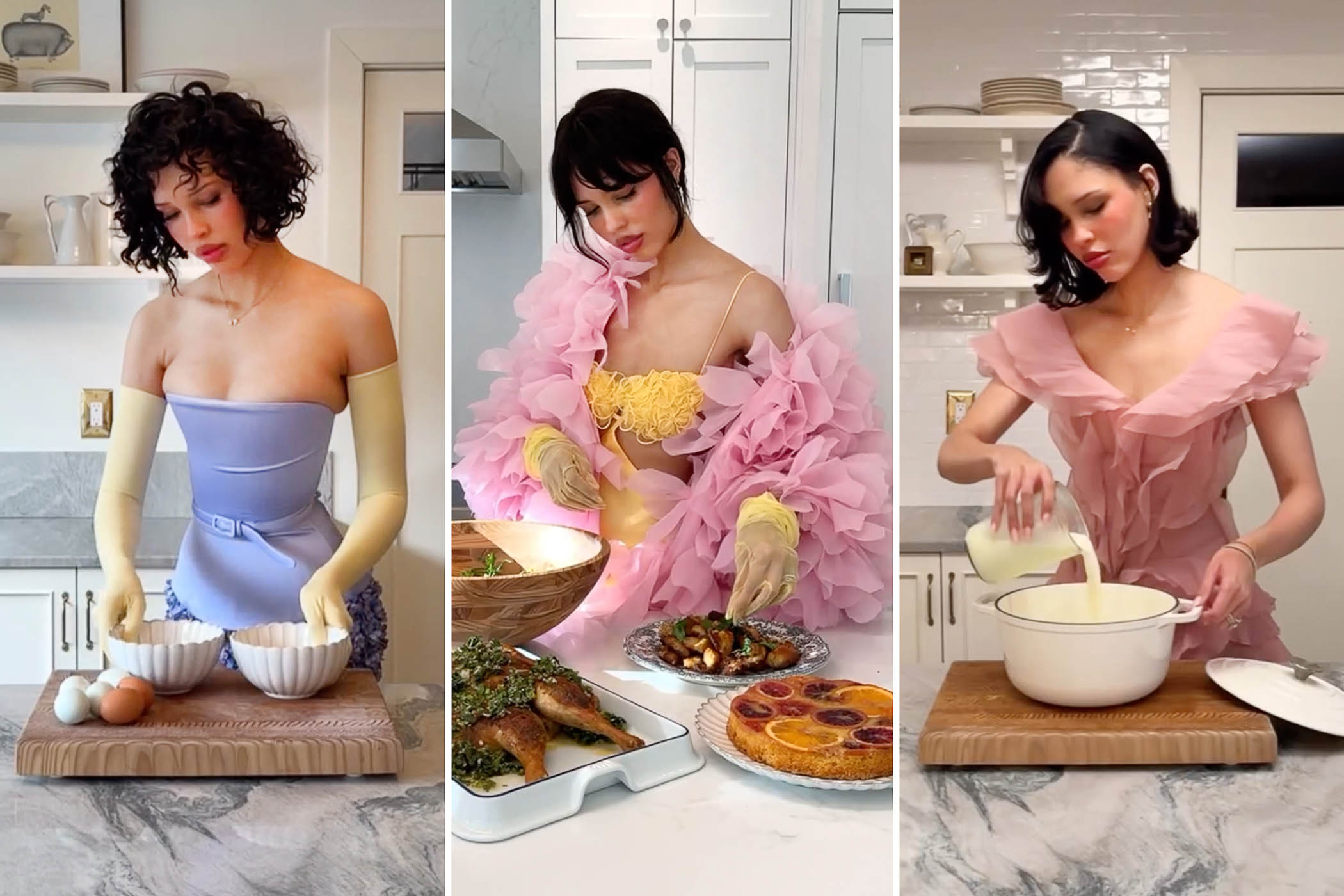


When I learned last week of new data showing that one third of my gen Z male peers believe that women should obey their husbands, my thoughts turned to “trad wives”. Since I was about sixteen, my social media algorithms have bombarded me with such content, telling me my true purpose in life is to serve my husband and children. My friends and I are in our early twenties, all, thankfully, still unmarried and childless. But we still crowd around to watch our favourite guilty pleasure, the “West London Luxury Mum” preparing her daughter’s elaborate lunches, or to ironically debate the practicality of fabulous outfits worn by the queen trad wife: Nara Smith.
While women’s politics haven’t shifted dramatically over the past few years, young men have become more conservative. In 2024 an Ipsos global survey found that nearly one in three gen Z men believes feminism has “gone too far”. Some studies have described this political shift as a backlash against recent progressivism, what the US columnist Charles M Blow calls “the age of too far.” But only those unexposed to the dystopian loops of social media could blame social justice movements. The real culprits are social media companies. According to Ofcom, British gen Z-ers spend an average of 6 hours and 20 minutes a day online, an hour of which is on TikTok. If my own feeds are propelling me toward a life of wifely servitude, I wanted to know: what exactly have they been showing these boys?
So I made a new email account, identifying myself as a 19-year-old boy named “Joe”, and used it to set up TikTok with the same age and gender details. Boys can go looking for obvious misogynistic abuse on Reddit, groups on Telegram or “looks-maxxing” communities on the online platform Skool. But on TikTok the algorithm just hands it to you, whether or not you’re looking, and no matter how old you are. That’s why the human rights charity Amnesty International considers TikTok “the worst offender” for online misogyny.
My test may not have passed rigorous scientific standards, but on the advice of the boys in my life, I decided to declare myself a straight man by following only the influencers “Sidemen” and the humour account “LADBible”.
The platform can begin reshaping a user’s feed within minutes of initial engagement, pulling them into an increasingly narrow content niche. Mine, as Joe, led me to porn. Within fifteen minutes I’d encountered school girls dancing sexually in their uniforms, which led to an 18-year-old girl miming a handjob, which led to the controversial porn star Bonnie Blue describing how she wanted it “raw, deep”. I didn’t engage (like or comment) with any of the content, but before I knew it I was shown a 19-year-old girl wearing a Tesco T-shirt, whose bio said “yes, I do have it,” with the name of her OnlyFans account.
The TikTok girls served to “Joe” were pliant, quite literally “for sale” – and sometimes not even real. AI-generated teenage girls were everywhere. Studies by Common Sense Media suggest the average boy now encounters online pornography around the age of 12, often because it is served up by algorithmic recommendations, not because they are actively searching for it. Emma Connolly, a social media researcher at UCL, told me “anything that triggers strong physiological reactions tends to perform best”.
Between the girls, I was interrupted by a young blond man called Jay Gomez. “If she goes out and drinks but doesn’t call or text you, that’s not really your girl,” he said. After watching just one of his videos, my algorithm shifted down a revealing rabbit hole of dating advice for boys.
Pino Kovacevic, a popular teenage influencer, shared a picture of himself with his head in his hands: "Explaining to a female what she did wrong is like trying to have a serious conversation with a 5-year-old,” he said. Shraeé, an influencer in his twenties from LA, filmed himself walking through the city. “My girl’s curfew this summer is 7pm,” he wrote, “5pm if her hair’s done.” A young woman called Piper Quinn offered her own advice: “If he’s always in a bad mood it’s probably bc you’ve told him no 7 out of the 7 days of the week lmao”, referring to sex.
A recurring AI-generated podcast, “SunShine vibes”, posted dating advice from women for men: “If she can pay every single bill without your help, she isn’t listening to you.” Boys in the comments agreed, “facts,” “true.” Then, ‘The Real Game’, a man in sunglasses, proffered: “If you don’t control her, she will turn EVIL.” A commenter called Mike said, “FYI this isn’t misogyny.” Another commenter agreed, “if you’ve ever had an unmarried woman as a boss – you know he’s right”.
Here, boys believed that women were misbehaving, ungrateful and wanted to be controlled. It was certainly misogyny, but it wasn’t quite the Andrew Tate brand I expected. This dating advice used familiar therapeutic words – “toxicity”, “boundaries,” “communication,” “love” – the language of the heart and mind.
Newsletters
Choose the newsletters you want to receive
View more
For information about how The Observer protects your data, read our Privacy Policy
Connolly at UCL called these algorithm tricks “the perfect storm”. For her research, she collected TikToks which used #AndrewTate and analysed their content. They ranged from obvious misogyny-linked terms such as “redpill”, “sigma” and “alpha” to much broader, innocuous tags such as “lifestyle”, “fitness” and “motivation”. This was very “worrying”, she said, because it helped this harmful content reach audiences who aren’t seeking it.
In Louis Theroux’s new documentary on the manosphere, airing on Netflix from Wednesday, he reveals the same process: men using the language of self-improvement, promising they can teach boys to “level up”, to “ascend”, to “maximise” their lives, all while demeaning and disparaging women with horrifically abusive language.
The use of podcasts and pseudo-expert commentary makes the advice feel authoritative. On TikTok, anyone can appear as a life coach, a relationship expert or a philosopher of masculinity.
Juliet Mitchell, the feminist psychoanalyst, has observed that ideology has a tendency to “reproduce the conditions of its own existence.” In the closed loops of algorithmic feeds, that process becomes almost literal. The misogyny circulating in these boys' phones is rarely delivered as open hatred. Instead it arrives in the pornographic sexualisation of their teenage girl counterparts, or disguised as advice, therapy, humour, or self-improvement, wrapped in the familiar language of relationships and mental health. The result is a steady drip of suspicion about women, delivered by algorithms that learn what holds a young man’s attention and feed him more of it.
If social media has become the place where many young men learn how relationships work, then it is hardly surprising that so many of them are coming to the same conclusion: that women are the problem, and the only solution is control. These algorithms are actively shaping a generation’s understanding of gender, intimacy, and power. They are teaching young men that suspicion and control are the natural responses to women rather than the product of a carefully engineered digital ecosystem, which no one seems willing or able to hold to account.
Photograph by Nara Smith/Instagram