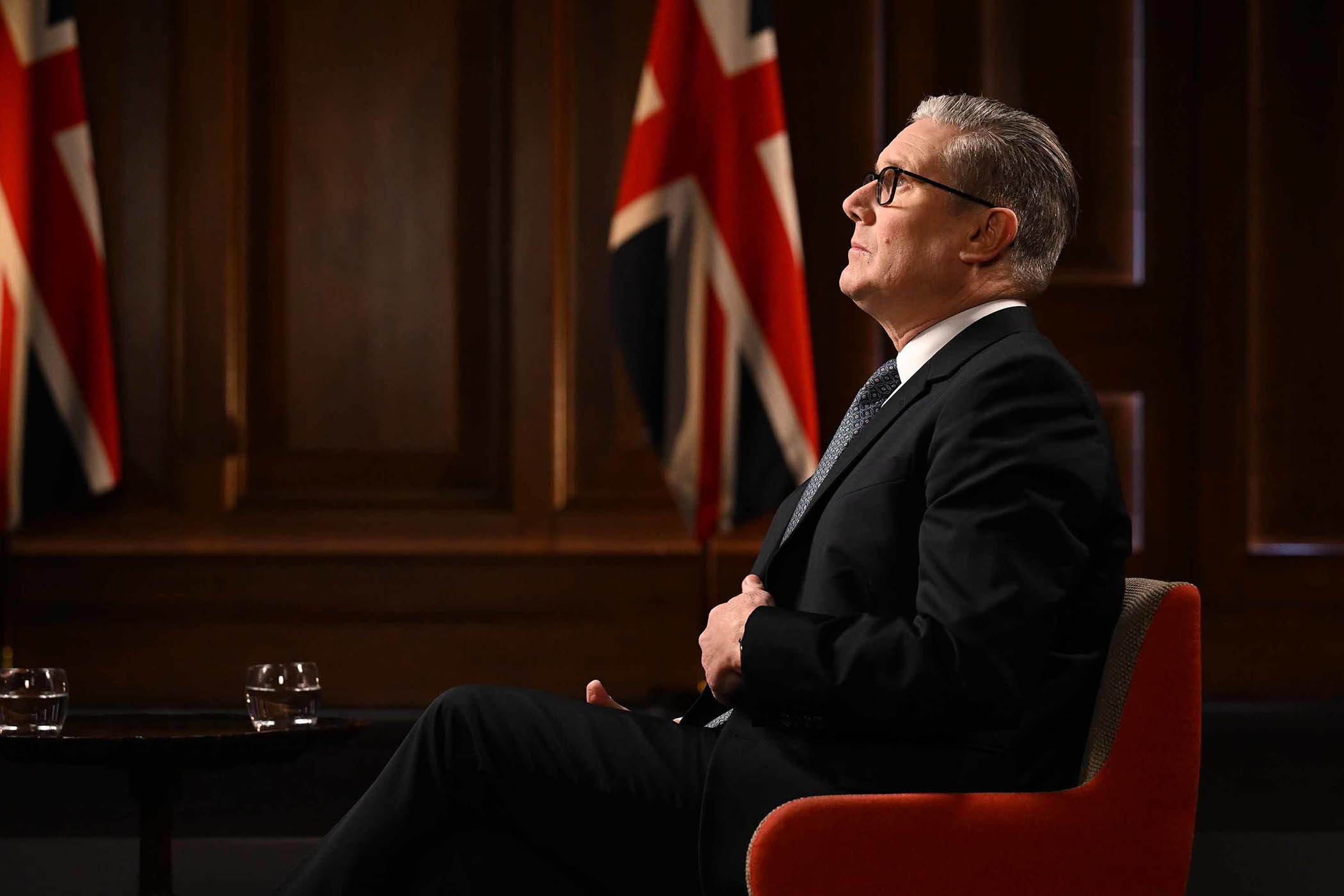

On Saturday morning, Keir Starmer was getting ready to make a public new year’s resolution: 2026 would be when his government and Britain “turned a corner”.
For weeks his aides had been planning their “strong start” to January with announcements and visits focused on improving living standards or tackling child poverty. At 11.30am, the prime minister would sit to record an unusually long interview with the BBC, designed to showcase his serious and substantial approach to delivering lasting change.
But at 9.28 that morning, Downing Street discovered – at just about the same time as the rest of us – that Britain’s closest military ally had attacked Venezuela and captured its president. For the next two hours there was a scramble to discover basic facts, such as whether US special forces were still in Caracas and the whereabouts of Nicolás Maduro, as well as to begin working out the consequences of the latest mayhem unleashed by Donald Trump upon the already creaking rules-based global order.
The prime minister’s immediate response to the BBC was to say that Britain had not been involved in any way and then to point out his lifelong support for international law. Those who thought this sounded like a holding position have really only heard more hedging in the days since. While insisting he would “shed no tears” over the belated removal of an undemocratic and corrupt leader, Starmer declined to opine on the legality of America’s military action or Trump’s apparently imperialist plan to take control of Venezuela’s oil supplies and subsequent revenues.
Yet reports that the UK had a few weeks earlier withdrawn intelligence support for lethal US missile strikes against drug boats leaving that country can probably be taken as a good indication that the former human rights lawyer in Downing Street knows full well that all these US actions lie outside international rules and conventions.
Newsletters
Choose the newsletters you want to receive
View more
For information about how The Observer protects your data, read our Privacy Policy
The foreign secretary, Yvette Cooper, hinted this week that the principle of complying with international law had informed conversations with her US counterpart, Marco Rubio, “where we agree and disagree”. Indeed, one Whitehall source later privately expressed relief that the UK had been kept in the dark about the Caracas raid because it meant that minister – much in the manner of football managers who claim not to have seen their centre-forward elbowing an opponent in the face – did not have to pronounce a public verdict on it.
All of which has left some of those who remember Starmer from his legal days wondering what became of the friend who once said the universal declaration of human rights was the “lodestar” that had guided him at every stage of his career. In the House of Commons on Wednesday, the Liberal Democrat leader Ed Davey quoted one of them – Geoffrey Robinson, the head of Starmer’s old barristers’ chambers at Doughty Street – who has said the US is in breach of the United Nations charter and guilty of “a crime of aggression which the court at Nuremberg described as the supreme crime”.
The prime minister replied that “the benchmark of all actions of all countries is, of course, international law, and it is for the US to justify its actions accordingly”. But he went on to say: “My focus is on the defence and security of the United Kingdom. Yesterday we were working with Nato allies, including the US, on security guarantees for Ukraine. It is only with security guarantees that we will have a just and lasting peace in Ukraine, which is vitally important for Ukraine, for Europe and for the United Kingdom.”
It is easy to interpret such remarks as a kind of realpolitik pragmatism, or to dismiss Starmer’s constant references to international law as ritual canting at a time when the temple of that dying religion is being trashed. But one lawyer who has remained close to Starmer says it is important the prime minister constantly reiterates the importance of international law because it’s “something that Britain, along with the vast majority of democratic nations in the world, is desperate to protect”. He says a good analogy is that the correct response in a street where there has been a recent break-in is not to remove all front door locks, but to reinforce them.
Indeed, the UK has taken a more robust position this week against America’s expressed ambition to annex Greenland, which Starmer, along with other European leaders, says would be a fundamental breach of Denmark’s sovereignty and threaten the future of Nato. There is an obvious distinction to be made between the democratic legitimacy of the Danish and Venezuelan governments, but British officials also point out that this is far from a fait accompli because so far the US has done nothing more than talk about Greenland, and it’s far from clear whether it really intends to take military action.
The thump of Trump’s footsteps across the global stage have once more ensured it’s impossible to hear the government’s efforts to reconnect with the British electorate
The thump of Trump’s footsteps across the global stage have once more ensured it’s impossible to hear the government’s efforts to reconnect with the British electorate
Another layer of complexity has been added by the assistance given by the Royal Navy and the Royal Air Force to the US in the north Atlantic on Wednesday, when it seized a tanker that had been linked to Venezuelan oil exports. The UK government has gone out of its way to say the action was in full accordance with international law because the vessel was falsely flagged and part of the sanctions-busting “shadow fleet” that helps fund the Iranian and Russian regimes.
Aides say the prime minister deserves much more credit than he gets for helping persuade the Trump administration to promise, as it more or less did this week in Paris, that it would underwrite any peace deal in the Russia-Ukraine war with “durable security guarantees”. Condemnatory language and posturing about an operation in Venezuela that Britain did not even know about let alone influence could, they emphasise, have destroyed this precious but “very fragile” progress to protect the future of Ukraine and perhaps the continent as a whole.
“There’s no contradiction between our national security interests and our values on this,” says one government source, “because we are dealing with a genuinely existential threat from Putin’s Russia to liberal democracy across Europe.”
For all that, no one is pretending this was the start to the new year that Starmer’s beleaguered government wanted. The thump of Trump’s footsteps across the global stage have once more ensured it’s pretty much impossible to hear the government’s efforts to reconnect with the British electorate. Many of those voters will have regarded the prime minister’s confusing and cautious response to Trump’s actions as weakness in the face of a global bully. In the short term, Labour strategists acknowledge that it may increase the flow of former Labour voters to the Greens, the Liberal Democrats, the SNP in Scotland and Plaid Cymru in Wales.
Downing Street, however, regards the “predictable outpouring of outrage” this week from parties such as the Greens or the Lib Dems as evidence of their fundamental “lack of seriousness” about governing. These are exceptionally dangerous times when “America First” isolationism threatens to leave Europe in a Russian “sphere of influence” and there has to be hard-headed pragmatism if you want Trump to protect the principles of international law in Europe.
Starmer is also frustrated that he continues to be attacked for devoting so much time to international issues, as if they are entirely separate from the bread-and-butter domestic agenda he intended to focus on this month. He has pointed out, to little effect so far, that the spike in electricity prices began when Russia invaded Ukraine four years ago. Similarly, war and climate change drive the numbers of asylum seekers and refugees, which has become an outsized issue for this government.
His team say they will do more in coming weeks to “make the link” between crises abroad and the cost of living crisis back home. But they know it’s not an easy story to tell. The lesson of this week is that, even as they try to “turn a corner”, there may simply be more danger lurking around it.
Photograph Jeff Overs/BBC/PA