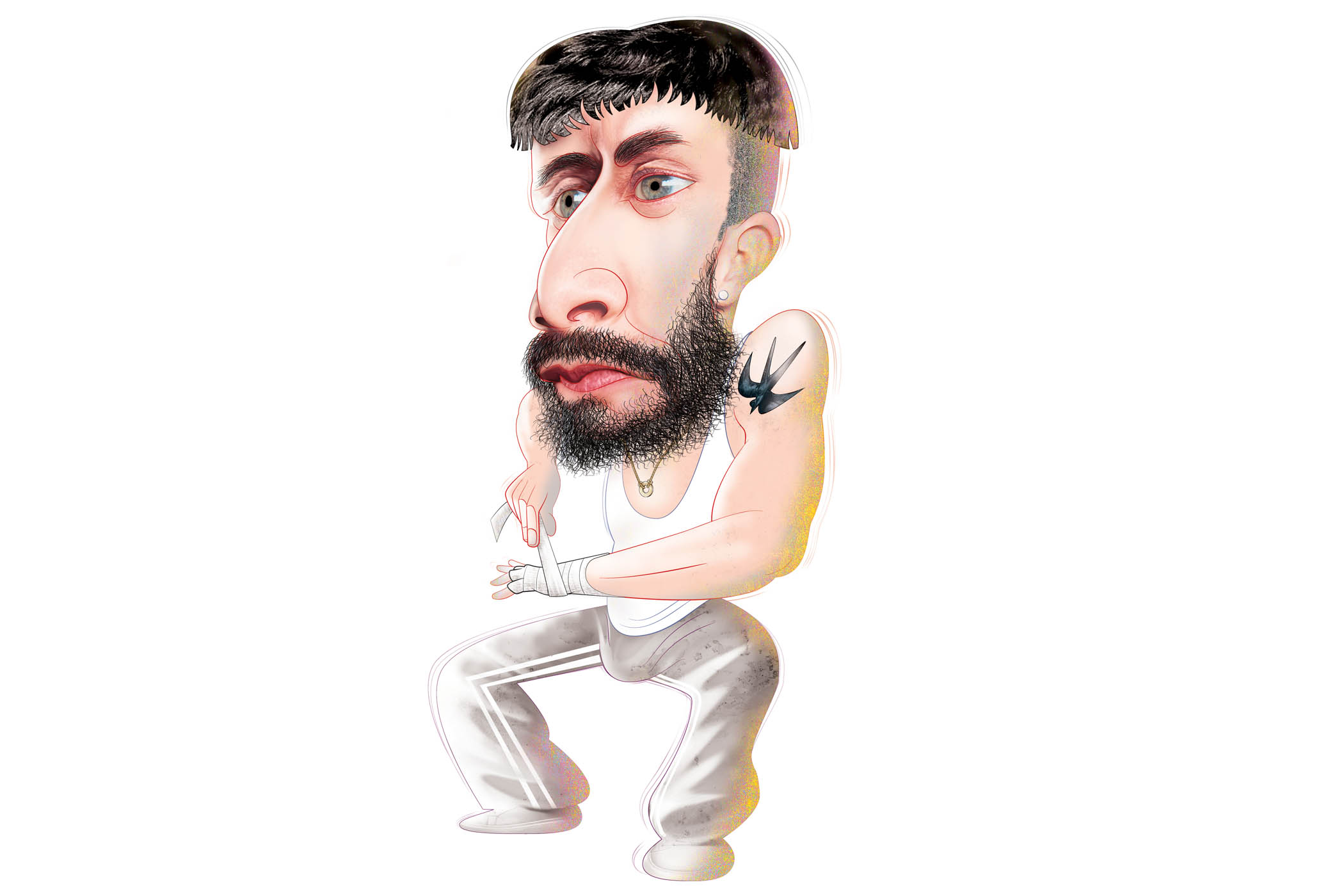

Illustration by Andy Bunday
Has Richard Gadd, Scottish creator and star of the 2024 global Netflix hit Baby Reindeer, rewritten the script on male vulnerability?
Half Man, his forthcoming decades-spanning BBC drama about two Glaswegian “brothers” (“not related by blood but the closest you can get”, the trailer tells us), stars Gadd as intimidating Ruben and Jamie Bell as meek Niall. Gadd, 36, has described the show as an exploration of connection, repression and “broken masculinity”.
Baby Reindeer was a fictional drama based on Gadd’s traumatic experiences. He played Donny Dunn, a comedian and bartender who is stalked by a woman, “Martha”, played by Jessica Gunning, and sexually assaulted by a male mentor. A Scottish lawyer, Fiona Harvey, who claims the character of Martha was based on her, has since filed a $170m (£126m) lawsuit against Netflix for defamation. The case is still pending.
A critical and commercial phenomenon, Baby Reindeer drew 88 million viewers, going on to win three Baftas, two Golden Globes and six Primetime Emmys, including outstanding writing and lead actor for Gadd. The male sex abuse charity We Are Survivors, for which Gadd is an ambassador, reported a 53% rise in referrals.
Baby Reindeer also opened a new cultural conversation on masculinity: about disempowerment, sexuality, stigma and imperfect victimhood. Damaged by the sexual assault, Dunn presented as flawed and complicit, initially enjoying the attention he received from Martha.
David Marchese is a New York Times correspondent and co-host of its The Interview podcast, who conducted an in-depth interview with Gadd.
Marchese feels Baby Reindeer resonated in the US because it was “funny, interesting, smart, disturbing” in a way that audiences might not have seen before, adding: “We see someone like Richard Gadd so publicly wrestling with his own contradictions, demons and struggles… Who among us can’t relate to that? But not everyone among us is willing to be the public face of that kind of struggle. I think that’s where a lot of the power and originality of his work comes from.”
From the outside, there would appear to be a strong cathartic element to Gadd’s work. He also uses physicality as a creative tool. In Half Man he’s bulked up — employing a nutritionist and following a strict regime – to portray the brutish Ruben, just as he lost weight — dropping from 96kg to 68kg – to convey male helplessness in Baby Reindeer.
Newsletters
Choose the newsletters you want to receive
View more
For information about how The Observer protects your data, read our Privacy Policy
This commitment seems evident in his early career. He was raised in the Fife area of Scotland, in a liberal, middle-class family; his father worked as a microbiologist and mycologist at the University of Dundee. Gadd studied English literature and theatre studies at the University of Glasgow, before attending the Oxford School of Drama.
Performing early standup, Gadd was a wacky anti-comedian, telling anti-jokes and using wigs and teeth as props; he would later describe himself as “the nichest of niche comedians”. He found some success in Edinburgh Fringe one-man shows known as the “grindhouse trilogy”: Cheese and Crack Whores (2013), Breaking Gadd (2014) and Waiting for Gaddot (2015).
Gadd was nervous about his next stage shows but went on to win the Edinburgh award for best comedy show for 2016’s Monkey See, Monkey Do, detailing his sexual assault. An Olivier award followed in 2020 for the stage play version of Baby Reindeer. Both shows formed the basis of Netflix’s Baby Reindeer.
He’s emerging as a new kind of mercurial, unfiltered masculine voice, a maestro of scar tissue
He’s emerging as a new kind of mercurial, unfiltered masculine voice, a maestro of scar tissue
Mark Boosey, editor of the British Comedy Guide website, saw Waiting for Gaddot, which involved multimedia screens — Gadd appeared on stage only after 45 minutes. “It was different: interesting, experimental and funny,” Boosey says. “That’s the mark of a great comedian – doing something you want to do, that’s your own path.”
Boosey confirms that male trauma confessionals weren’t common back when Gadd – a football and music fan – started doing them. “There’s that phrase, ‘honesty is important in comedy’. You can tell when you watch Baby Reindeer you’re getting an authentic story.”
James Barr has a one-man show based on his experience of LGBTQ+ domestic violence, entitled Sorry I Hurt Your Son (Said My Ex to My Mum), which is on this week at Soho Theatre, London and will be touring the UK this year. He calls Baby Reindeer “powerful, honest, and exposing”, adding: “It was interesting to see a man talking about being raped.”
He says Gadd opened up valuable discussions about abuses in different communities. “Men are told to be manly, to be masculine, even gay men have this toxicity we’re brought up with. The more we talk about things as people, the less these things are allowed to happen.”
Gadd is a self-avowed control freak who has had issues in the past with alcohol and drugs, and fame now seems enmeshed in his trauma. Post-Baby Reindeer, being recognised in public ramped up his natural self-consciousness – even the writer Stephen King was discussing his show. Last year Gadd told the Guardian that he had never wanted fame: “I just liked the idea that, one day, I would make a piece of art that was culturally important.”
Living in London, and single, he tentatively identifies as bisexual, though as he told Attitude magazine in 2024: “I feel like I’m constantly in a state of flux with my sexuality.” After Half Man, he seems undecided about his next career move: he’s interested in straight acting offers and has toyed with reprising the stage version of Baby Reindeer but rules out a return to standup.
It has been noted that Gadd’s trauma, paradoxically, made him a global success. Certainly, he seems to have achieved his aim of producing work of cultural importance. He is emerging as a new kind of mercurial, unfiltered masculine voice, a maestro of scar tissue, inconsistencies and grey areas, adding to the freedoms with which men can communicate onscreen and off.
Barr observes: “He’s allowing men to be vulnerable; to talk about their pain and wear it.”
Marchese adds: “In my reading of his work, he’s suggesting, through his experiences, we’re all kind of messed up. And seeing someone dealing with his stuff in a candid, artful way resonates in a way so much good art can resonate. There’s a feeling of connection, a sense of ‘we’re not all out here by ourselves dealing with our stuff. There are other people dealing with our stuff too.’”
Half Man is on BBC iPlayer from Friday 24 April
Richard Gadd
Born 11 May 1989, Fife
Alma mater University of Glasgow; Oxford School of Drama
Work Comedian, writer, actor
Family Single