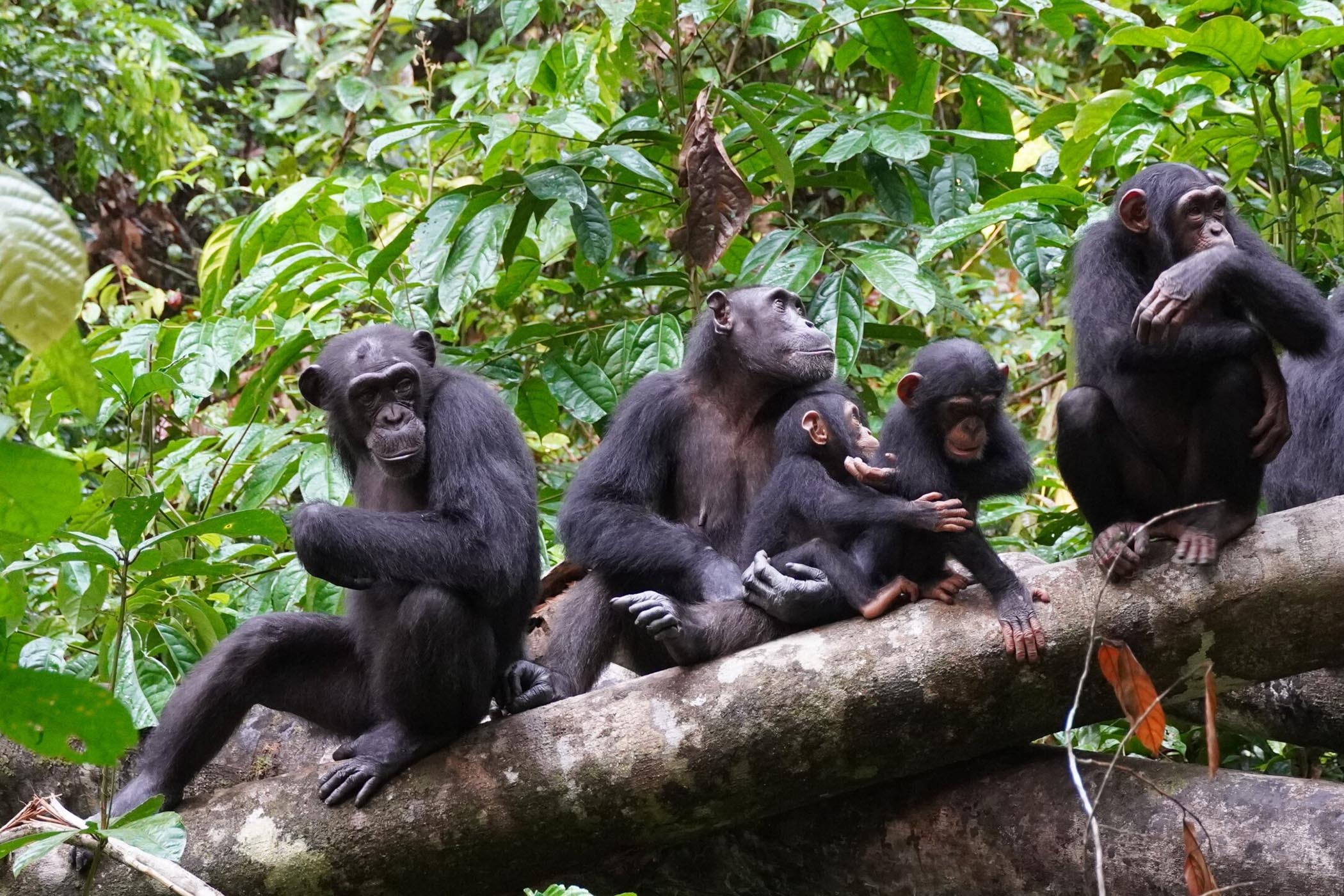

It was a shocking murder: the mother was trapped by six females while her two-year-old daughter was bitten and beaten by three males and left for dead in the forest.
In other chimpanzee territories, the killing of an infant is rare, but not shocking. But this was Taï, a national park in Côte d’Ivoire, where in the first 29 years of observations, its four competing groups of chimps had only killed three times.
The incident is fundamental to new research that shows chimps approach warfare in a remarkably similar way to human military doctrine. They go on patrol, plan ambushes, use deception and groom each other to create bonds of loyalty – like human army squads.
They also adhere to Lanchester’s square law, the formula created by the engineer Frederick Lanchester during the first world war, which states that one army should attack only if its soldiers outnumber the other by a proportion that is square to the number of their opponents: – for example, nine to three, or 16 to four.
The chimpanzee mother and her infant were from a much larger community, Taï’s north-east group, but they were surprised and surrounded by the north group, according to Sylvain Lemoine, assistant professor in biological anthropology at Cambridge University.
“There was a strong imbalance of power in [the north group’s] favour, giving them the conditions to kill at low risk,” he said. “The question is not why do they kill, but why do they not kill, when they have the chance?”
It is a question that is fundamental to the origins of warfare; a topic that has vexed philosophers and scientists. Could war be intrinsic to human nature, as Thomas Hobbes argued? Or have we been corrupted by society, something Jean-Jacques Rousseau believed, perhaps when humans stopped being hunter-gatherers and started farming, creating the conditions for conflict over territory?
Studying the closest evolutionary relatives to humans offers clues that war may be hardwired. Lemoine’s research, published in the journal Bulletin de la Société Préhistorique Française, shows that oxytocin, a hormonal system that humans and chimps share, is a defining factor.
“In chimps, the oxytocin system is co-opted for increasing group cohesion and to increase out-group hostility,” Lemoine said.
This physiological response means that when male chimps groom each other for ticks and insects, they develop a deeper bond that makes them more likely to back each other up in a fight.
Newsletters
Choose the newsletters you want to receive
View more
For information about how The Observer protects your data, read our Privacy Policy
So why is violence at Taï less extreme than in the Gombe national park in Tanzania, where the pioneering primatologist Jane Goodall charted six deaths in four years of conflict, or the Ngogo area of Uganda’s Kibale national park, where a decade-long “civil war”, recounted in the Netflix documentary series Chimp Empire, has seen the killings of 28 chimps, including 19 infants?
The nature of Taï offers one explanation: there are fewer vantage points than in Gombe or Ngogo, so fighting is riskier, as it is harder for a group to tell if it is outnumbered, and chimp patrols find it easier to eavesdrop on their rivals from high spots.
Chimpanzee social structures also play a role. Male chimps stay exclusively within one group, while females usually transfer to another group at least once in their adult lifetimes.
Chimpanzee warfare does not seem to be motivated by gaining access to females, Lemoine found. “There is no relationship between winning [fights] and attracting more females,” he said. Instead, controlling territory with better resources means that females reproduce more quickly.
In Ngogo and Gombe, only males hang out together, but in Taï there are mixed male and female groups. That means that when rival groups of chimps encounter each other, the violence is likely to be less extreme, Lemoine said.
It is the kind of behaviour more often seen in bonobos – humanity’s other close evolutionary cousin. They look like chimps, but there is no record of any bonobo war, and their social hierarchy is much less male-dominated. “In bonobos, females are co-dominant with males,” Lemoine said.
“Like chimpanzees, the females also migrate, so there is a high degree of familiarity between females and neighbouring groups. When bonobo females are young, they are used to mingling peacefully with neighbours and learn they are not a danger. When they become adults, they may move to that neighbouring community and continue this relatively peaceful relationship.”
Balance between the sexes appears to be important; in hyenas, for instance, females are highly dominant over males and rival hyena clans clash over territory. Even so, “chimps and humans are a bit of an exception”, Lemoine said.
“This escalation of violence – we are living in specific conditions that lead to that. Patriarchal societies are more associated with warfare than matriarchal societies.”
Photograph by Roman M Wittig/Taï Chimpanzee Project