

Like a prey species, a naturalist is hyperaware of anything that breaks the pattern. You don’t even have to be concentrating: I was writing something about rugby when I suddenly stopped, not entirely sure why. But no, there it was again: the sound of a distant bugle. I knew what that meant. The only snag was that it was impossible.
I abandoned my research into the night they played street rugby with the sacred Calcutta Cup, grabbed my binoculars – always by my desk – and peered out over the marshes that lie in front of the hut I work in. Nothing.
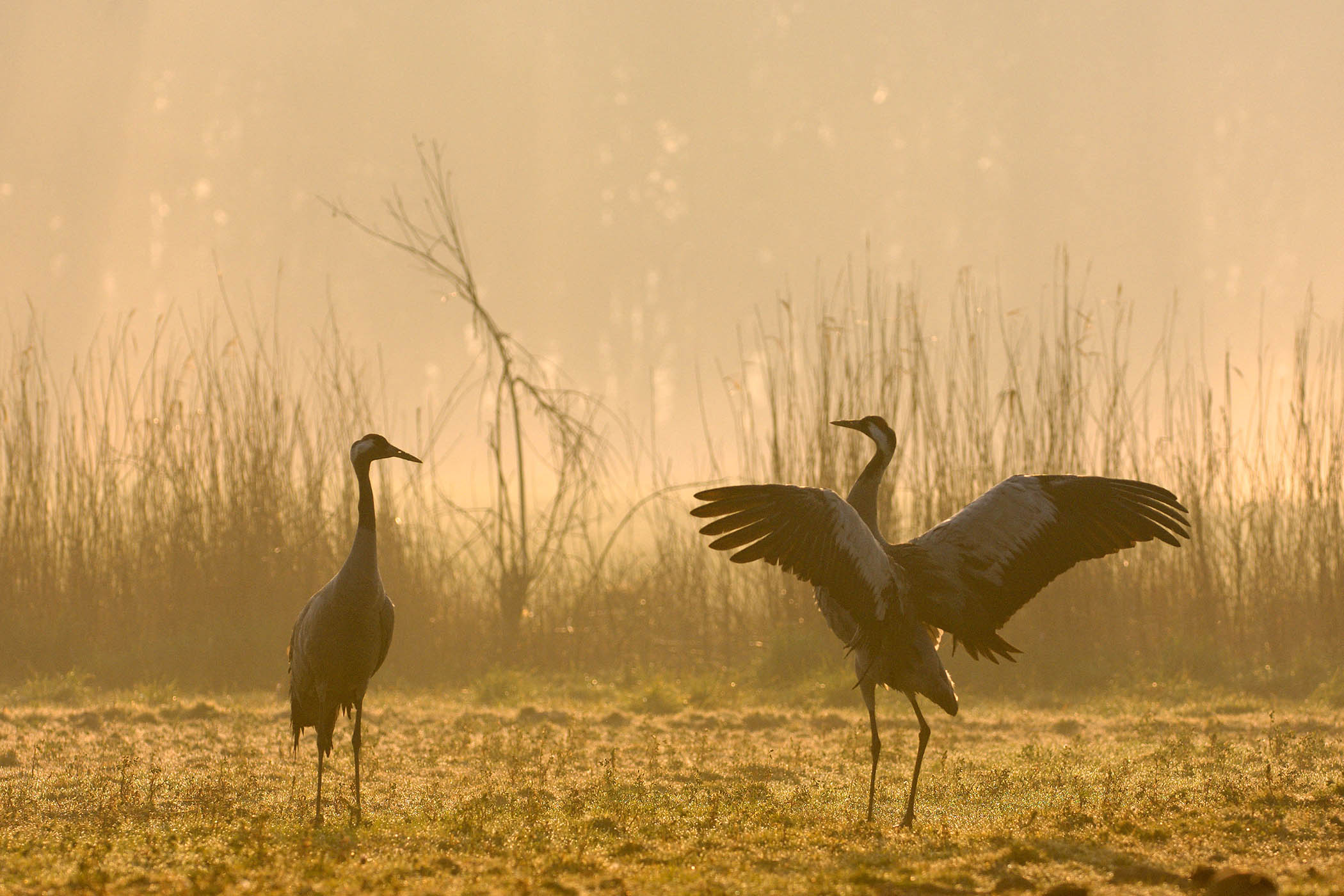
So I stepped outside – and there was the bugle again. Unmistakable. I wasn’t dressed for such a foray but I badly wanted to catch them before they left. And in a few minutes, I had a clear view. Cranes! A pair of tall, long-legged, hyper-elegant cranes on my neighbour’s land just a quarter-mile from my desk. It seems the age of miracle is not over.
And they have stayed. Birds that had once been extinct as a breeding species in this country for 400 years were now on my doorstep and threatening to settle down and make more cranes.
In 1465 George Neville became archbishop of York. To mark the occasion, he threw a banquet. They served 204 cranes, roasted on a spit and probably stuffed with pepper, cinnamon and nutmeg. Cranes were the most noble quarry a falconer could hope for. Overhunting and habitat destruction saw them vanish from these isles by the 16th century.
But they hung on elsewhere in Europe. I’ve seen them on migration in Sweden, filling the sky with their wings and their bugling, exactly as Homer describes in The Iliad. I’ve seen them on their wintering grounds in Spain – 40,000 of them round a frozen lake.
It was 15 September 1979 when a pair landed in the Norfolk Broads, about 20 miles (32km) north of my place as the crane flies. Another one dropped in a few days later. Two of them stayed and, in 1982, the first British crane for 400 years broke free from its shell. Since then – very, very slowly – the population has crept up and begun to spread from the heartland of Horsey Mere and Hickling Broad. By 2017, there were 10 breeding pairs of cranes. They were a British bird once again – and no archbishop was planning to feast on them.
Cranes summon awe and wonder even in the most committed non-naturalist. They stand a good 1.2 metres (4ft) high and look the most outrageous exoticism: surely they’re too big for modern Britain. They seem to have come from another world or another time. They’re big birds but they’re also dainty, seeming scarcely to touch the ground as they walk. The Chinese call them the “birds of heaven” –more like angels than sparrows.
They mate for life, reinforcing their togetherness by dancing; a stately gavotte with spread wings, performed as if the earth was repelling them in the manner of the like poles of a magnet. And, impossibly, in this country, they’re reclaiming their own.
Cranes are universally seen as special creatures; birds that can show any atheist what religious experience is like
Cranes are universally seen as special creatures; birds that can show any atheist what religious experience is like
There are 15 species of cranes and they can be found on every continent apart from South America and Antarctica. They’re birds that people make legends from. Valmiki discovered the verse form for his masterpiece The Ramayana after cursing a hunter who had killed a male crane in flagrante. Pliny the Elder nurtured the myth that, when cranes sleep, they always leave a watchman: a crane that stands on one leg with its free foot holding a pebble. Should it drift off, it will wake when it drops the pebble. The crowned crane of southern Africa calls: “Olwan! Olwan!” All one – every one of us united in fear. The west’s favourite piece of eastern art after The Great Wave off Kanagawa is Shen Quan’s Pine, Plum and Cranes of 1759.
Newsletters
Choose the newsletters you want to receive
View more
For information about how The Observer protects your data, read our Privacy Policy
If you make 1,000 origami cranes, the next time you see a real one, it will grant you a wish. Sadako Sasaki made her own thousand-strong flock. She died of leukaemia at the age of 12; 10 years earlier, she had been in Hiroshima on 6 August 1945, the day the atom bomb fell on her city. The origami crane became a symbol of our yearning for peace.
Cranes are universally seen as special creatures; with their stately walk and their grace, they’re almost honorary humans. They’re also birds that can show any atheist what religious experience is like. I once wrote about “the most numerous crane species” but the spellchecker preferred “the most numinous” – as if all cranes were bathed in the light of God.
The whooping crane of North America was shot relentlessly in the erroneous belief that nature is infinite. Habitat destruction meant that they were caught in a pincer movement and extinction seemed inevitable. By 1941, they were down to 21 wild birds with two more in captivity.
Back then, the idea of human-made extinction was new, and even newer was the idea that we could, or should, do something to stop it. But they were cranes, and cranes command our attention. So, as it were, by public demand, projects for habitat recreation and reintroduction were established. No one knew the best way to do it, but there was a pioneering determination to try.
The wild population of whooping cranes is still less than 1,000, but that’s a great improvement on none. The story shows three things; one, that conservation matters to people; two, that when you put your mind to it, conservation works; and three, cranes are a perpetual inspiration to humans.
Peter Scott founded what’s now the Wildfowl and Wetland Trust (WWT) at Slimbridge in Gloucestershire in 1946. One of his pioneering projects was the rescue of the nene, or Hawaiian, goose from extinction. He would have loved the Great Crane Project, a joint effort between the WWT, the RSPB and the Pensthorpe Conservation Trust in Norfolk. Parts of it were ludicrous – except they worked.
Eggs were taken from cranes in Germany and hatched at Slimbridge. The hatchlings then had to be raised to competent adulthood without any grownup cranes to show them how. So humans took on the job, but not in human form, or the cranes would identify with humanity. They set up the “crane school”, educating the birds while dressed in crane costumes that disguised their human form. The first graduates were released on to the Somerset Levels in 2010; others followed. Soon enough, they began to breed. Across the whole country in 2023, there were more than 250 cranes, with 80 pairs, 69 of which attempted to breed; 36 chicks were fledged.
A few days after the arrival of the cranes at my place, I was walking across small area of land that I manage for wildlife. There, on the far side of the gate, stood the two cranes: wholly exotic, wholly natural, wholly British.
They’ve been much quieter over the past few days, but I’m still hearing them now and again. The early bugling was both a challenge and a claim: this place is ours, all right? The subsequent silence could mean they no longer want to be found, because they have important business on hand. The world needs more cranes.