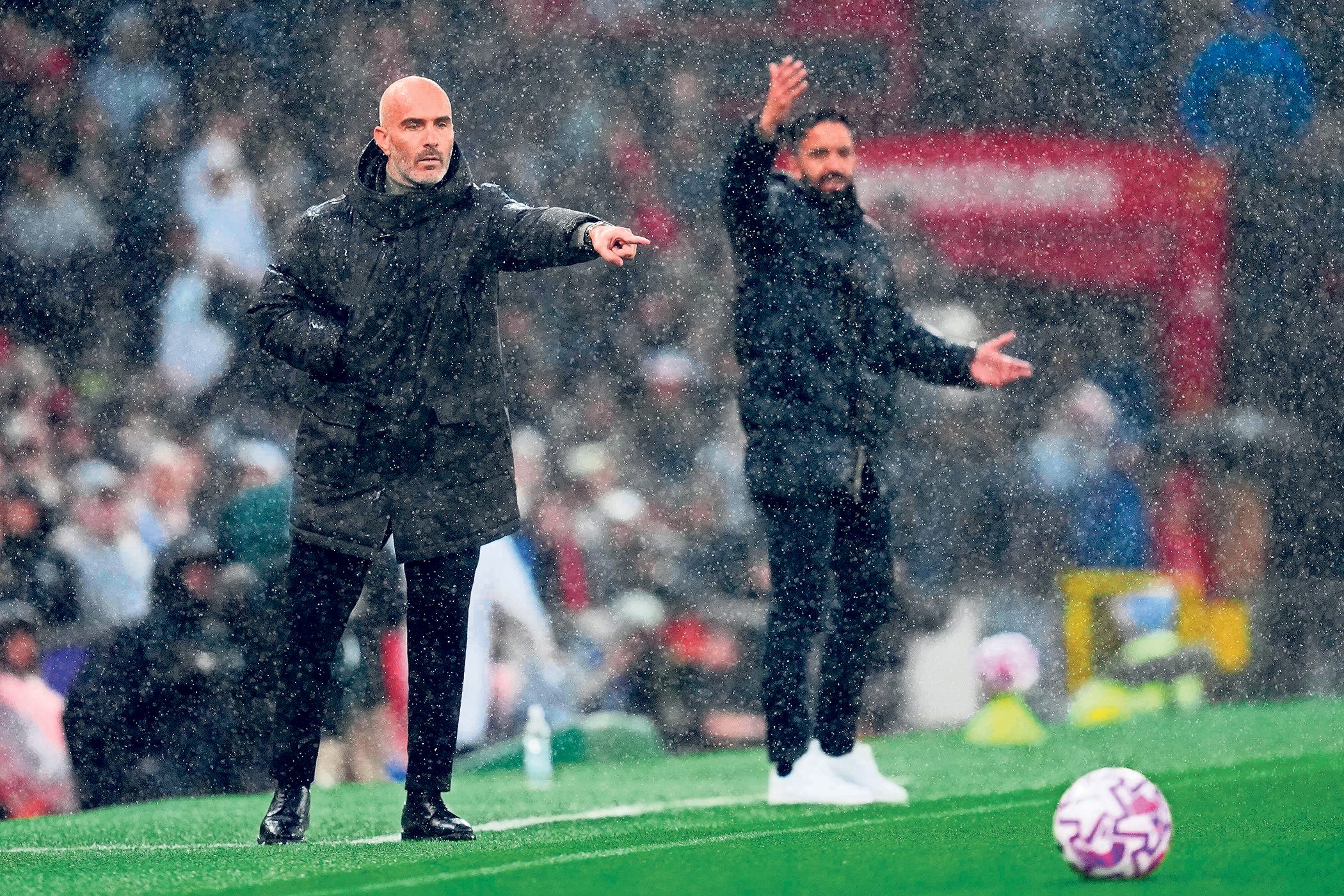

Ruben Amorim’s last stand as Manchester United manager was a tantrum, a power play and a settling of scores, all at the same time. Once he had been sacked, it would take on the quality of a valedictory address, too: the final act of a man with a few things to get off his chest before the curtain fell.
He alluded to the club leaking “selective information about everything”. He hinted that some members of United’s hierarchy could not “handle the Gary Nevilles, the criticisms of everything”. He suggested that “every department, the scouting department, the sport director” needed to “do their job”.
But most of all, he stressed that he saw himself not as the coach, but the manager. The distinction was sufficiently important that he drew it repeatedly. “I know my name is not [Thomas] Tuchel, [Antonio] Conte or [José] Mourinho, but I am the manager,” he said. And then: “I came here to be the manager of this team, not just the coach.”
It felt pointed, premeditated, and with good reason. In the aftermath of his dismissal, it emerged that Amorim had been involved in some sort of conflagration with Jason Wilcox, United’s director of football, a couple of days previously. Amorim had reportedly objected to what he perceived, rightly or wrongly, as intolerable interference in his work.
Given what followed – within 24 hours, Amorim’s employment status had been emphatically cleared up – those comments amount to much more than the end of a managerial tenure, the breakdown of a working relationship, the public airing of a private grievance. They serve as a lament for a world that, as of the first week of 2026, firmly belongs in the past. Nobody, in the rarefied air of elite English football, gets to be a manager any more.
Like Enzo Maresca at Chelsea, Amorim did not lose his job for what, broadly, might be thought of as football reasons. Neither manager was saved by results, or performances, of course, but nor were they damned by them. Chelsea were fifth and United sixth when they were dismissed. Both roughly where they expected to be.
Instead, both men lost their jobs because of their failure to understand the parameters of their role. Amorim, reportedly, could not stand for Wilcox suggesting that it might be about time for him to change his preferred system. Among Maresca’s myriad complaints, it has been suggested, was that he did not appreciate the power Chelsea’s medical department had over his team selection.
It has been some time, of course, since the idea of manager as absolute ruler – omnipotent, omniscient, the sun around which a club orbited – passed into the realm of anachronism.
The model under which Brian Clough (ventriloquised by David Peace) could inform the owner of Derby County that his job was “keep your opinions to yourself and start signing some fucking cheques” has not existed in the Premier League for about a decade. Sir Alex Ferguson, the great standard-bearer for the traditional approach, retired in 2013. Arsène Wenger, arguably the last example to exist in the wild, stepped down in 2018.
Both, even then, were exceptions. David Pleat had been made director of football at Tottenham in 1998. Frank Arnesen replaced him in 2004, before taking up the same role at Chelsea. Most clubs, in the years that followed, followed suit. A few talking heads aside, everyone accepts that it is no longer either practical or desirable for a manager to have control over every aspect of a team’s existence.
Newsletters
Choose the newsletters you want to receive
View more
For information about how The Observer protects your data, read our Privacy Policy
What the almost simultaneous downfalls of Maresca and Amorim illustrate, though, is that the idea of the manager and sporting director existing in a state of permanent tension is itself outdated. Instead, the past decade or so has given rise to a much more complex model. Chelsea and Manchester United are now run by what, in American sports, is known as a front office.
Though that is true of much of the Premier League, Chelsea’s is perhaps unusually well stocked. The club’s “sporting leadership team” includes two sporting directors, Paul Winstanley and Laurence Stewart, as well as Dave Fallows, Joe Shields and Sam Jewell, all of whom have some responsibility for recruitment.
It’s no concidence that the model has grown popular as US private equity money has arrived
It’s no concidence that the model has grown popular as US private equity money has arrived
Manchester United’s is a little more streamlined, but it includes Wilcox, Christopher Vivell – briefly of Chelsea and brought in as director of recruitment in 2024 – and now Kyle Macaulay, who started in his role as head of senior scouting on Monday. The 39-year-old Scot and Vivell worked together, fleetingly, at Stamford Bridge. All of them report to the chief executive, Omar Berrada.
It is not a coincidence that this model has grown in popularity as largely American private equity money has flooded into the Premier League. Not only is it familiar from the major leagues on the other side of the Atlantic, but it is close enough to how they might expect their other investments to be managed to offer some reassurance. They have simply decided that football would be better if it resembled their own C-suite world a little more closely.
But it should also not be a surprise that its introduction has created a little tension. In the front-office model, as both Amorim and Maresca acknowledged, the role of manager is defunct, replaced by a head coach: someone whose responsibilities, as Rafa Benítez once archly put it, extend no further than “training and coaching my team”. They may not be totally powerless, but they are relegated to being just one voice among several: just another workstream, just another line manager.
From the owners’ point of view, of course, that makes complete sense. It is far better to entrust decision-making to a board – one which takes into account the various demands and requirements across the club as a business – than to one figure. Managers, traditionally and understandably, think only about short-term results. That is, after all, how they are judged. But those who run clubs need to take into account the medium and long term, too.
Amorim and Maresca, though, would point out that the model puts managers in an invidious position.
Both, clearly, eventually came to chafe at the restrictions placed upon them by the structures in which they had agreed to work. That feels like a feature, not a bug: managers, after all, tend not only to be extremely self-possessed, but they are also products of an ecosystem in which they are actively encouraged to have an all-consuming, non-negotiable vision of how football should be played. That is not exactly an ideal character profile for someone who is expected to work by committee.
More immediately, both seem to have sensed that while the power once concentrated in the manager’s office is now diffuse, the same cannot always be said of responsibility. Sporting directors in England do not see the need to justify their decisions; they are not compelled by broadcast agreements to do so. Managers are; they are, somewhat illogically, often a club’s only public-facing figure.
Worse still, as Maresca in particular seemed to note, they seem to bear a disproportionate amount of criticism. When Celtic fired Wilfried Nancy, not long after Amorim was put out of his misery, the man who was held to be responsible for his hiring, Paul Tisdale, was also dismissed.
It was Berrada who was so convinced of Amorim’s virtue that United fired Dan Ashworth, the club’s expensively acquired sporting director. Chelsea are now on to a fifth permanent manager since the BlueCo consortium bought the club. None of the people who made – or at least executed – these decisions seem to operate under the same scrutiny as the head coach. Credit, in this new vision of how a club should be run, is increasingly collective. Blame, though, remains staunchly individual. It is not hard to see why some might feel that, as managers have degraded into head coaches, they have lost many of the rewards, but none of the risks.
Photograph by PA Images/Alamy