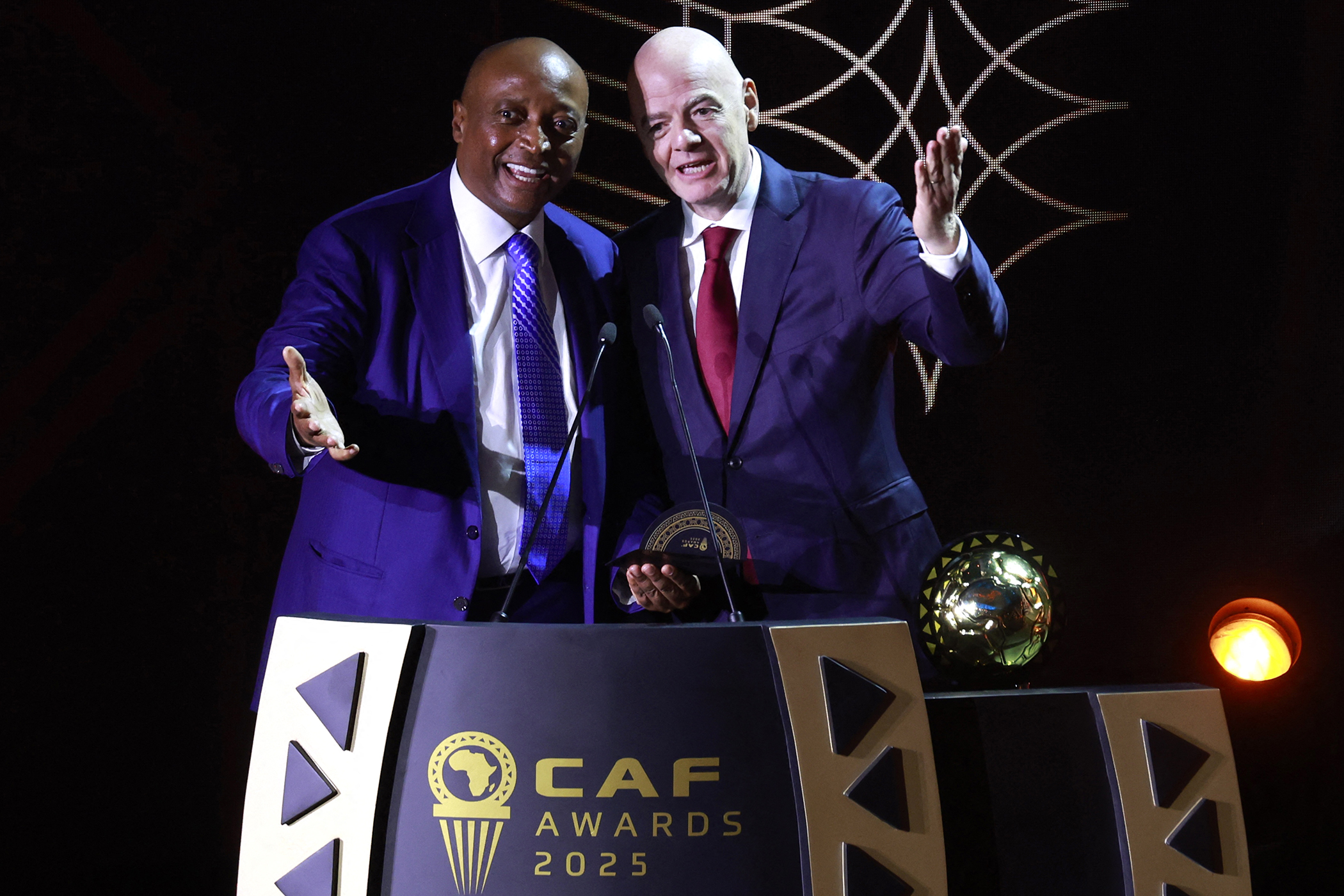
When Patrice Motsepe, president of the Confederation of African Football (Caf), spoke to the South African National Editors’ Forum in Johannesburg in June 2022, he emphasised the importance of a functional democracy in forging societal cohesion. “In every democracy, you need regular elections and free speech,” he said.
“You also need the legislature and the judiciary… the function of the judiciary is to ensure that the executive and the legislature behave [properly] in terms of the constitution.”
But have his words been Caf’s guiding principles since taking up the presidency of African football’s governing body in March 2021 – and re-elected in March 2025 – without any electoral opposition and a competitive poll in either?
Motsepe’s unexpected announcement on 20 December on the eve of the Africa Cup of Nations’s (Afcon), that the tournament, staged biennially since 1957, will now be organised on a four-yearly basis, starting from 2028, has raised furore within the African football community.
How Caf threads that scheduling needle, with the Los Angeles Olympic Games slated for the same period, is the unanswered question.
“African football should not, once again, have to bow to demands from elsewhere. The Africa Cup of Nations is not simply a fixture on the global calendar; it is the soul of African football, its economic, cultural, and identity-forming engine,” said Gérard Dreyfus, former sports editor of Radio France International, who covered African football for several decades.
“It is an attempt to reduce the visibility of African football, to make it more discreet, more docile, more compatible with European agendas and commercial interests that benefit only a select few. They want Africa to be content with crumbs, to renounce its own rhythm, its own dynamism, its own celebration.”
“This is not right. There needs to be respect for Africa,” said Tom Saintfiet, Mali’s Belgian manager at the ongoing tournament, who led The Gambia at Afcon 2023 in Cote D’Ivoire.
A change in the frequency of the Afcon was neither proposed nor put to a vote at Caf’s last General Assembly (GA) in Kinshasa, the capital of the Democratic Republic of the Congo, despite the confederation’s statutes clearly stating that the GA, which is the legislature of the organisation, “shall be the supreme authority of Caf and shall define the general policy”.
“I was very shocked when I heard of the decision,” a former member of the Caf executive told The Observer. “How can a decision of this nature be taken, knowing the importance of the Afcon to Africa?” the source said.
Newsletters
Choose the newsletters you want to receive
View more
For information about how The Observer protects your data, read our Privacy Policy
“I spoke to one of my former colleagues, still a Caf executive. He said he cannot understand the direction in which African football is going.”
Andrew Kamanga, the former president of the Football Association of Zambia (FAZ), shares the view that wider consultation should have taken place, considering the profound consequences of the decision. “The Exco should have taken the decision and the General Assembly should have voted on the proposal,” he said.
A former member of Caf and Fifa’s finance committees, Kamanga says the financial implications of an Afcon cycle change need to be looked at.
“Revenue from the new format should include the opportunity costs from the previous two-year cycle. This is a matter of the sponsorship opportunities, which will come from the change in the timing cycle. It will be nice to evaluate the financial benefits that would accrue from the new four-year cycle.”
In addition to a rescheduled Afcon, Motsepe announced a new competition, the African Nations League, to be played between September and November every year.
“Since this tournament will be played during the Fifa window, we shall have the top African players participating in it,” he said.
The presence of Mattias Grafström, Fifa’s general secretary, who sat beside Motsepe as he made the December 20 announcements – with the Swede admittedly involved in the deliberations leading to the announcements the Caf President made – serves to enhance suspicions within African football that Caf has lost its autonomy to make decisions and is instead tele-guided by Zurich.
“The proof of Motsepe’s impact on African football is not based on rhetoric or slogans. It is there in the balance sheet of Caf,” said Caf’s communications director Luxolo September. “It is there in the bank accounts of member associations that received a 100% increase in their annual subventions. It is there in the Afcon winner, who will now earn $10m.”
Véron Mosengo-Omba, Caf’s general secretary, was Fifa president Gianni Infantino’s classmate at Fribourg University in Switzerland, where they became friends.
Several FA presidents and members of the Caf executive committee privately express frustration to The Observer over what they describe as Infantino’s “overbearing influence” in Caf’s affairs and policy-making.
In February 2020, a year before Motsepe became Caf president, Infantino told Caf’s executive committee that the biennial Afcon was “useless” and recommended that it be played every four years, which finally happened last week.
“It is very clear that Africa is no longer in control of its football destiny. It is what Infantino wants that Caf does. As a result, people stay quiet. This is the governance culture,” a Caf executive committee member told The Observer.
A spokesperson for Caf said: “Claims that the president is a stooge of Fifa or Europe or panders to their interests, at the expense of Africa, are just false. Anyone who says this about Dr Motsepe has no idea about his character.”
Fifa said: “The Fifa president cares passionately about growing football in Africa and around the world. The decisions made by Caf regarding their top men’s national team competition is a matter for the Caf Executive Committee. Africa has been and will remain a top priority for Fifa.”
Photograph by Abdel Majid Bziouat/AFP via Getty Images