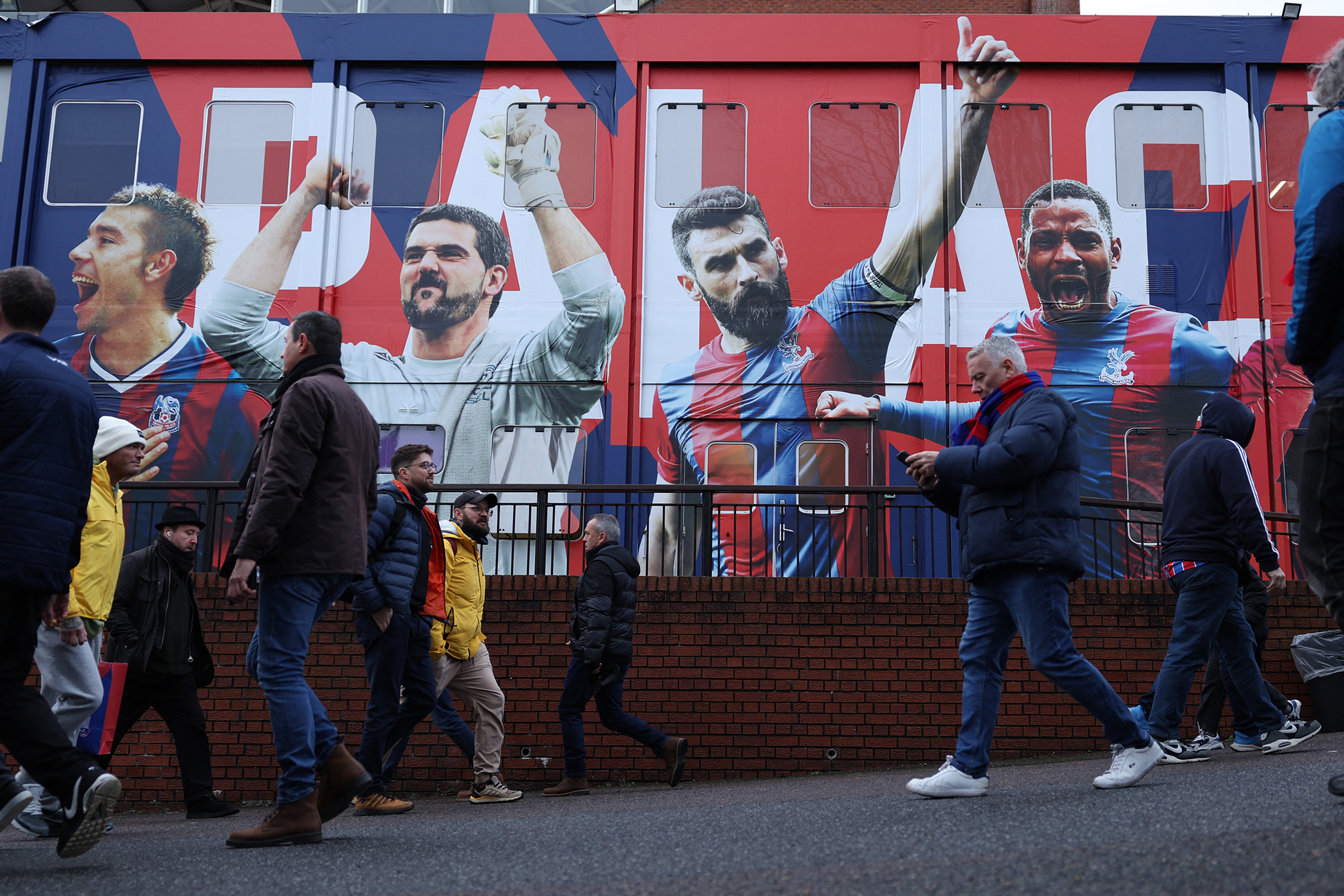



By this stage, Crystal Palace know not to assume the worst of it is over. Perhaps being eloquently, brutally and publicly excoriated on social media by Megan Sharpley, Dwight McNeil’s partner, for “dragging” the winger on “an emotional rollercoaster” on transfer deadline day will be as bad as it gets. Or, bitter experience suggests, perhaps not.
Palace have, after all, spent much of this season discovering that nadirs can prove surprisingly hollow. They might have assumed that they had reached rock bottom when their defence of the FA Cup ended at sixth tier Macclesfield, statistically the greatest shock in the competition’s history, or when Oliver Glasner staged a one-man mutiny against the board.
There are more, a litany of low points in the souring and curdling of Palace’s great feelgood story: the press conference in which Glasner confirmed, in the space of just a few minutes, that Marc Guéhi, the captain, was being sold, and that he would soon be following; the 12 games without a win; the slow but ominous slide toward the relegation battle; the sale of Eberechi Eze. Perhaps there is another round the corner: Brighton host Palace on Sunday, eager to twist the knife.
Things have reached a point, now, where it feels like Crystal Palace cannot even sell a player successfully. Jean-Philippe Mateta, having decided that he wished to abandon ship, too, was due to be sold to AC Milan on Monday. Palace had already signed his replacement, agreeing to pay a club-record £48m for Jørgen Strand Larsen, proud owner of one Premier League goal this season. Mateta duly failed his medical. He will now have to wait out the season at Selhurst Park.
These are bleak days for English football’s fairytales. Late on Thursday evening, the Premier League and the EFL confirmed that – close to 10 years after they became the unlikeliest champions in English football history, forever proof of the vitality of the pyramid – Leicester City would be docked six points for failing to comply with the top flight’s financial regulations.
The verdict, related to breaches committed in the three seasons up to 2024, leaves Leicester perilously close to relegation to League One. Leicester have already fired one manager, Martí Cifuentes, this season; their owner, Aiyawatt Srivaddhanaprabha – Khun Top, more commonly – acknowledged in an interview last month that the club will have to cut costs in the near future.
In hindsight, it is tempting to read both the slow demise of Leicester and the rapid unspooling of Palace as fables about the dark heart of English football, a glimpse behind the curtain of the Premier League’s marketing spiel.
This is what happens to those clubs who seek to improve their station, who dare to disrupt – however briefly – the game’s strict economic hierarchy. It does not pay to fly too close to the sun.
The problem is that interpretation does not really stand up to scrutiny. The only key member of Claudio Ranieri’s title-winning team that left immediately was N’Golo Kanté. He was, admittedly, the side’s cornerstone, but still. Danny Drinkwater remained for another year, Riyad Mahrez for two. Jamie Vardy only left last summer. The vultures might have descended, but they did so sufficiently slowly for the club to respond.
Palace have a more compelling case for pointing the finger of blame at their domestic rivals. Eze helped Glasner’s team win the Community Shield and left for Arsenal. Guéhi was sufficiently convinced he was moving to Liverpool that he said goodbye to his teammates after Palace beat Aston Villa in August.
Newsletters
Choose the newsletters you want to receive
View more
For information about how The Observer protects your data, read our Privacy Policy
He remained only because Glasner made it clear that he would resign if any such deal was sanctioned. The club duly turned down Liverpool’s £35m offer; two months later, the Austrian told them he would not be renewing his contract anyway. In January, with little or no reason to placate their time-serving manager, Palace sold him, at roughly half the price they had anticipated, to Manchester City.
As destabilising as all of that has been, it is not exactly unfamiliar territory for Palace. The dynamics are no different to those which have enabled the club to embark on what is, by their standards, an “unprecedented” period of success, as Dan Cook, of the HLTCO podcast, put it. Palace’s model has long been to “bring in players of genuine potential who can improve and build their resale value,” he said. Eze and Guéhi were, in that sense, simply the heirs to Michael Olise; Adam Wharton will presumably at some point follow in their footsteps. The club has implicitly accepted, in Cook’s words, that “these players aren’t going to stay with us for life.”
That is not something to be celebrated, of course: it is a shame that Guéhi ran his contract down, conscious that he wanted another challenge, just as it was a shame that Olise – now a genuine star at Bayern Munich – would only sign a new contract if it contained a £50 million release clause. It would, obviously, be preferable if Palace had been able to construct a team around them, rather than with the proceeds of their sales.
But it does not explain why the club, which had been so adept at navigating around its circumstances, that seemed to have mastered as well as anyone the treacherous currents of the Premier League, has run aground quite so damagingly this time.
The most obvious varying factor, of course, is success. Leicester had a plan to meet its ambitions, and it worked: first with the title in 2016 and then, almost as important to the club’s self-identity, in rebuilding to win the FA Cup in 2020. The financial problems that have followed would suggest that the club did not have a clear idea of what came after that glory.
It feels a little as though Palace might be the same. Winning the FA Cup in the bright, brilliant sunshine of May remains the finest day in the club’s history; despite all that has followed, Cook can still feel that warm glow, even now. What the club did not seem to know was how to handle what came next: how to maintain their altitude, or even how to manage the descent, once they had flown quite so high.
Photograph by Adrian Dennis/AFP/Getty Images