


The Gabba has long acted as a leech for England cricketers, slowly sucking their confidence from them until they are bled dry, as Jamie Smith quickly discovered last week. After he dropped an early catch to reprieve Travis Head, Smith spent the rest of the second afternoon listening to the sarcastic cheers of Australian fans every time he caught the ball – even gentle return throws from the outfield. With every schooner of mid-strength lager consumed as day turned to night, the noise from the stands grew gradually louder.
Clearly, it was enough to plant a seed of doubt in Smith’s mind: when Alex Carey flashed hard at Gus Atkinson late in the day, his edge flew into the small gap between wicketkeeper and first slip. It was the keeper’s catch, but Smith was unmoved. Instead, Joe Root saw it late, flung himself low to his right, and snatched at the chance. Already dropped first ball, the counter-punching Carey now had another life on 25, and went on to make 63 off 69 balls. Smith is discovering just how lonely, isolating and cruel a job keeping wicket can be on an Ashes tour.
It was a moment that highlighted the contrast between the two keepers in this series: Smith, a 25-year-old still making his way as a Test cricketer, and experiencing his first real dip; and Carey, in his third Ashes series, at the peak of his game at 34. He delivered a virtuoso performance in Brisbane, standing up to the stumps while keeping to Australia’s fast bowlers. “England like to use the crease, they like to advance out,” said Andrew McDonald, Australia’s head coach, explaining the logic. “It did keep them at home.”
Carey nearly pulled off an outrageous leg-side stumping in England’s first innings, when Harry Brook missed a tumbling scoop shot off a ball from Michael Neser clocked at 85mph, and held on to a steepler after running back then diving at full stretch to dismiss Gus Atkinson, narrowly avoiding a collision with Marnus Labuschagne. Fittingly, it would not have looked out of place on an Australian Rules pitch: Carey has a multi-sport background, and only turned his focus to cricket after missing out on playing in the AFL for Greater Western Sydney Giants.
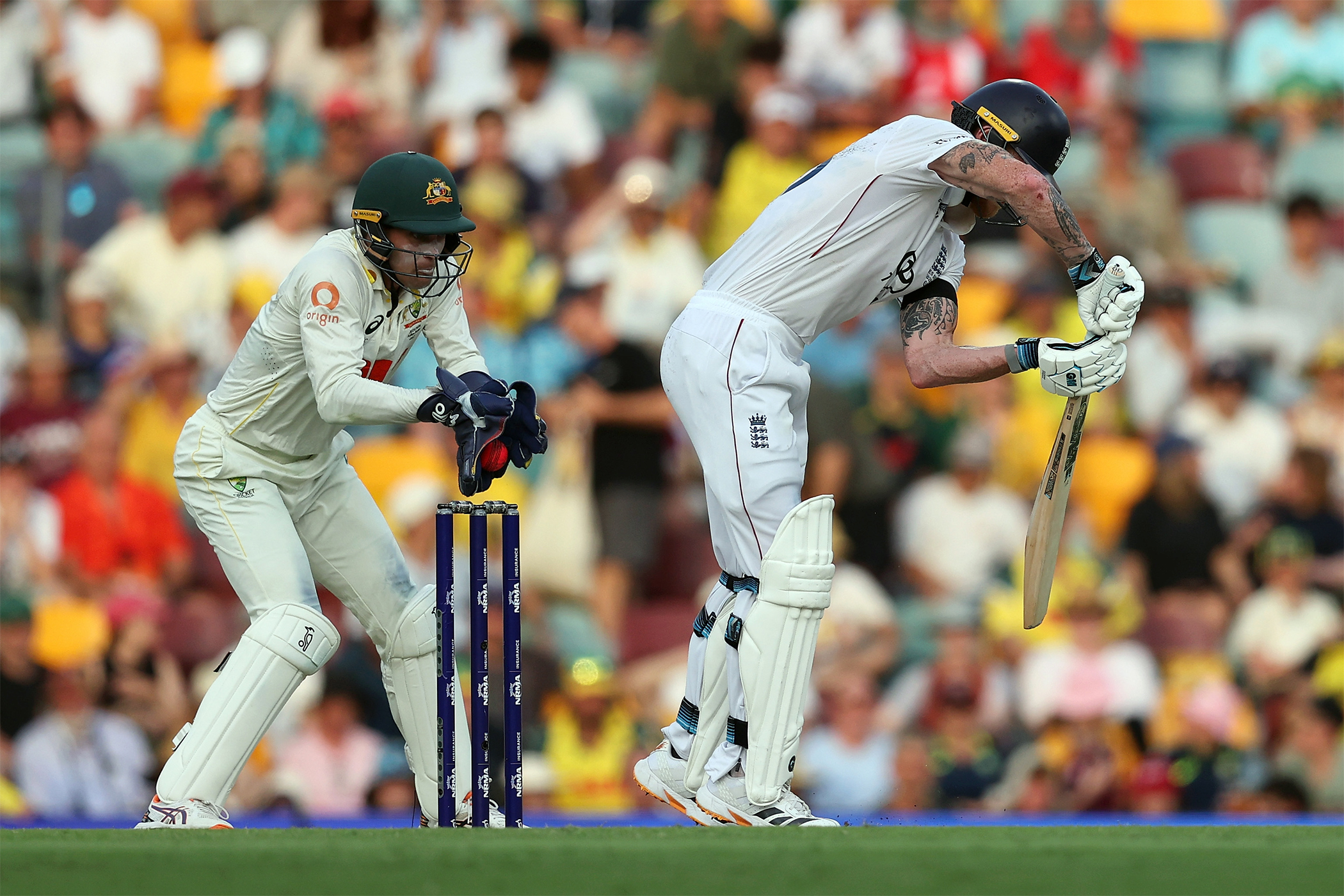
But his crowning moment arrived in the second innings: Carey spent much of the fourth day standing up to Neser and Scott Boland, and took an instinctive catch when Ben Stokes edged behind to end England’s resistance. “That performance behind the stumps was something else,” said his captain, Steve Smith, who also praised Carey’s batting. He has outscored his opposite number 89-52 in half as many innings, and is threatening to put together the sort of series that Brad Haddin managed in 2013-14, slamming the door shut on England whenever it creaks open.
Given how comfortable he looked standing up to bowlers capable of hitting 87mph, it was a surprise to learn that Carey does not specifically practise the skill. “I won’t go up to the stumps to someone bowling 130[km/h, 80mph] in the nets,” he said this week, ahead of his home Test at Adelaide Oval, citing safety concerns. “I train the basics and the fundamentals and then hope for the best… Once you’re in that game intensity, your instincts take over a fair bit.”
While Carey works extensively with Andre Borovec, one of Australia’s assistant coaches, on his keeping, Smith does not have an equivalent in the England set-up: he does most of his technical work with Brendon McCullum, his head coach, but England do not have a specialist fielding or keeping coach on tour with them. Smith has struggled with the extra bounce of Australian pitches, never having played a senior fixture in this country until last month, and had never previously kept in a pink-ball match: the two keepers’ preparation really was like night and day.
Carey is unusual among modern Australian keepers: unlike his predecessor Tim Paine, or Haddin before him, he rarely says a word to England batters. He can empathise with the pressure that Smith found himself under from the crowd at the Gabba. Two and a half years ago, his infamous stumping of Jonny Bairstow at Lord’s put a target on his back for the rest of the series, and his performance dipped markedly. The wicketkeepers’ union has been in overdrive this week, with ex-players queuing up to praise Carey, and he offered Smith some support when prompted: “Jamie is a fantastic young player. As athletes, we sometimes make mistakes and that’s nothing new.”
Smith is similar to Carey in his public personality. He is an introvert who is near-mute behind the stumps. He has openly admitted that he finds Test cricket mentally and physically exhausting, and faded badly against India this summer: following 184 not out and 88 at Edgbaston, his scores in the final three Tests read 51, 8, 9, 8 and 2. He has even been dragged into the Australian media’s faux outrage on this tour, when he was photographed riding an e-scooter without a helmet in Brisbane.
McCullum has backed him to respond, describing him as a “flair player” who would benefit from a slower pitch at the Adelaide Oval, but Stokes’s repeated references to “weak men” after England’s heavy defeat felt like a direct prompt for Smith to show his resilience. As Carey can attest, the next four weeks will be a test of Smith’s character, as much as his skill.
Newsletters
Choose the newsletters you want to receive
View more
For information about how The Observer protects your data, read our Privacy Policy
Photograph by Cameron Spencer/Getty Images