

Mitchell Starc is having a moment. He has filled the vacuum left by his absent cronies Pat Cummins, Josh Hazlewood and Nathan Lyon with compressed achievement. He has achieved the same ubiquity in these Ashes as Timothée Chalamet in popular culture. Sooner or later someone will call him an icon.
In Perth, Starc bowled the house down; at the Gabba, he has combined his wickets with runs. Entwined them, actually. On Saturday he scored 77, and more importantly batted 141 balls and 154 minutes – each minute pushing England’s second innings deeper into the day, into that treacherous sub-tropical twilight. Then, in the last half hour, he struck twice at top speed, disposing of Joe Root and Jamie Smith to send the visitors spiralling.
Not perhaps for 12 years has a single cricketer so pervaded Tests between England and Australia, when it was another Mephistophelean left-arm Mitch – Johnson of that ilk.
At 164 balls, bizarrely, Starc’s partnership of 75 with Scott Boland was the longest and calmest of this bish-bosh, stop-go series. It sometimes seems that others take his batting more seriously than Starc. He enjoys a slog. He hardly practises. Today, however, he sized the situation sweetly. Every now and again, he swung his bat in that handsome golfer’s arc of his; otherwise he remained watchful, while Boland defended with his familiar staccato backlift. The pitch was flat and unresponsive. Against a pink ball gone soft, and a soft attack turning pink, prudence almost guaranteed security.
This was batting with intent – intent to tire, to frustrate, to thwart, and to delay, shortening the time that Starc, Boland and their colleagues would need to bowl in an enervating heat. It also, as they say, put work in the legs of England’s attack, and dismay in the hearts of England’s fielders. Ben Stokes’s beard surely greyed a little; his cap assuredly went dark with sweat.
When Starc drove Brydon Carse to take Australia’s lead into three figures, Stokes’s unavailing dive took the pace off the ball but still it ran to the rope. One’s overriding memory of this Test match, in fact, will be Carse walking back, over and over, in preparation for pounding the ball halfway down an unyielding surface, and the fielders jogging to retrieve it from the boundary. To be fair, that happened on only 18 occasions – 15 fours and three sixes. It simply seemed like more, as it seems like there must have been more than a dozen episodes of Fawlty Towers, and more than one Sex Pistols album.
On and on it went, England perspiring, daylight expiring – the visitors almost cost themselves Starc’s eventual wicket when Stokes and Ben Duckett converged on a miscue at mid-off, nearly colliding. The fields were leaky; the bowling was uninspired; Will Jacks delivered his second over 78 overs after his first. The innings’s duration was reinforced by the snug uniformity of a scorecard of 11 double-figure scores, on only the 17th occasion in Test history.
At 6.10pm, Australia were in position on the field. Starc’s first ball was pitched up, perchance to swing, menacing the stumps, forcing Zak Crawley to defend. See? It’s not that hard. Every ball of Starc’s opening over, in fact, compelled the batters’ attention – an object lesson in how to bowl in Australian conditions even if, for once, he went without his almost customary throat-clearing wicket. Starc’s first three overs, in fact, were a little sore – Crawley picked off three boundaries in four balls. Then a ball a metre shorter, and Crawley narrowly failed to nick it. A spell from Starc recalls the IRA’s notorious threat to Margaret Thatcher: the batter has to be lucky always, Starc only needs to be lucky once.
The beneficiary of bowling in the evening turned out to be Michael Neser who, as Nathan Lyon chafed in the dugout, was offered no fewer than three caught and bowled chances by batters fretting to take the initiative as though time was running out rather than stretching two days into the future. He missed Duckett (8), but accepted the hard-handed pushes of Ollie Pope then Crawley.
There have been poorer England No3s than Pope, but few so frankly difficult to watch – he exudes anxiety, like that of someone hearing a phone ring or a kettle boil in another room. His average in 14 Ashes innings has, in this match, shrunk to 18, even as he passed the Test caps of Ted Dexter and Robin Smith. He walked off shaking his head. Really that should be us.
Newsletters
Choose the newsletters you want to receive
View more
For information about how The Observer protects your data, read our Privacy Policy
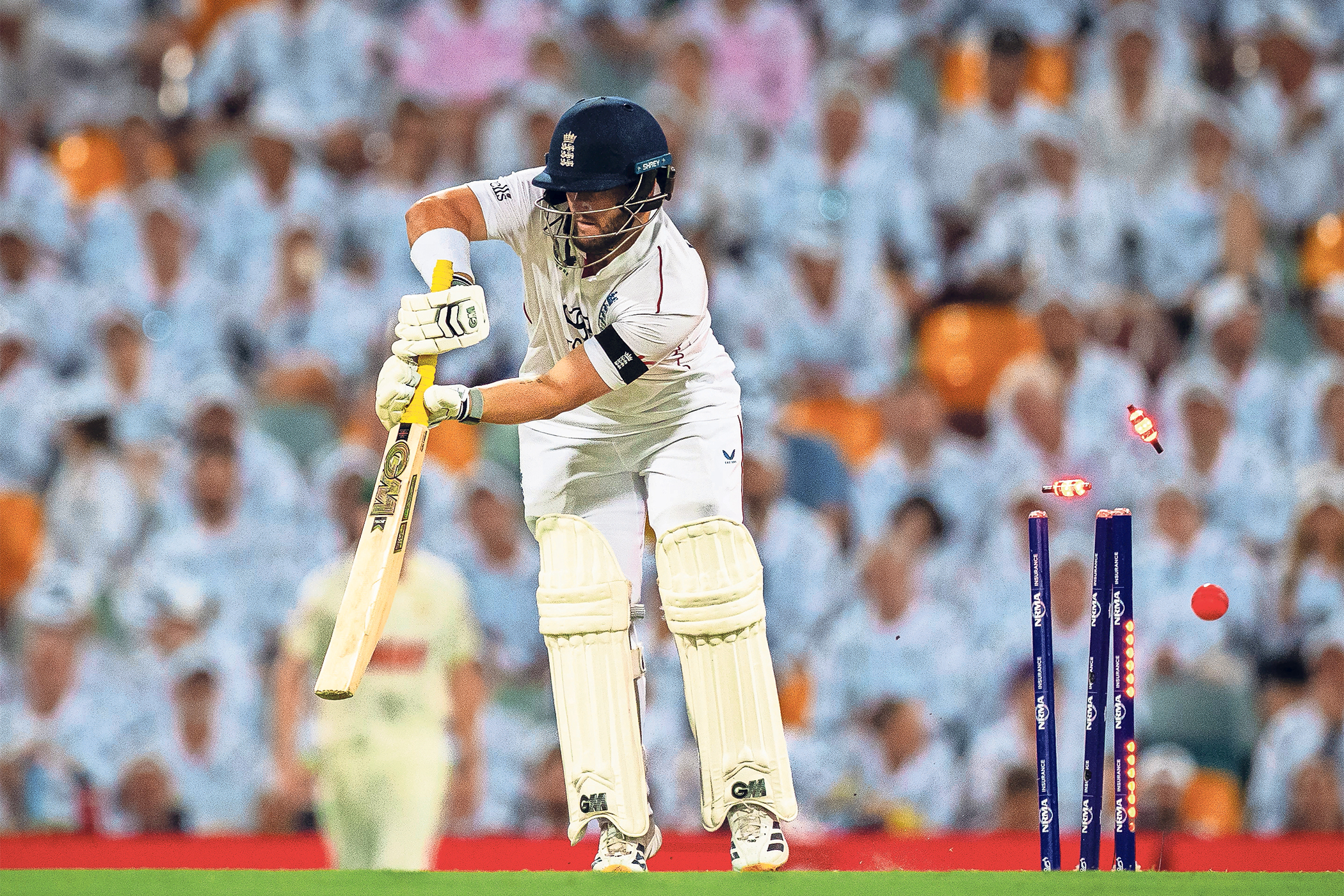
This set up the day’s critical confrontation – best against best, Starc v Root, under the lights, with a pink ball barely 20 overs old. The ground staff came out with the tamper to flatten the return crease ahead of Starc’s attack from round the wicket. Root maintained a careful off-stump vigil, pushed for a couple to cover, a couple to square leg. The eighth delivery tailed away late, not far but just enough, to draw an almost involuntary jab – a nick revealed on review, and Starc had disposed of his old Yorkshire team-mate for the 11th time in Test cricket.
Starc and Boland were now both benefiting from the circumstances they had helped create. The speed gun clocked the former in the mid-140s kmh; the pitch map underlined Boland’s automaton’s precision; the ball nibbled round, and carried healthily through to Alex Carey. Stokes edged Starc just short of slip; Harry Brook edged Boland behind; Jamie Smith edged Starc behind; Bazball had shrunk to a memory, a rumour. It must have seemed, to England’s supporters, like the night would never end – the camera focused on a doleful spectator, who was magnified on the big screen to the jubilation of the home crowd. The fielders ran end to end to squeeze in the maximum action. The bowlers felt no pain – least of all Starc, who must feel like he can play for ever.
Photograph by Santanu Banik/MB Media/Getty Images