
It was always going to be agony. Deep down, Arsenal would have known that from the start. Not just because of the stage, or the stakes, or the quality of their opponent, but because all of their bitter experience of the Champions League has taught them that there is no other way. This competition has made Arsenal suffer. But it has never made them suffer like this.
The torture that Mikel Arteta’s team endured in Budapest was so cruel as to be exquisite. Everything that has gone before – the dismay of Paris, 20 years ago, Robin van Persie’s red card in Barcelona, the increasingly ludicrous exits in the last 16 that marked Arsene Wenger’s great white whale definitely slipping from his grasp – will, in time, pale in comparison. This will always hurt the most.
It will hurt because Arsenal took the lead inside five minutes, thanks to Kai Havertz, now ranked as a Champions League final specialist. It will hurt because they held it for almost an hour, keeping Paris Saint-Germain, the team that could not be held back, at arm’s length. It will hurt because they started to hope, because they had seen enough to believe.
The memory that will hurt the most, for the fans, might be Cristhian Mosquera tumbling into Khvicha Kvaratskhelia, granting PSG the penalty that wiped out Havertz’s opener, ushering the cold light of day into their blissful reverie.
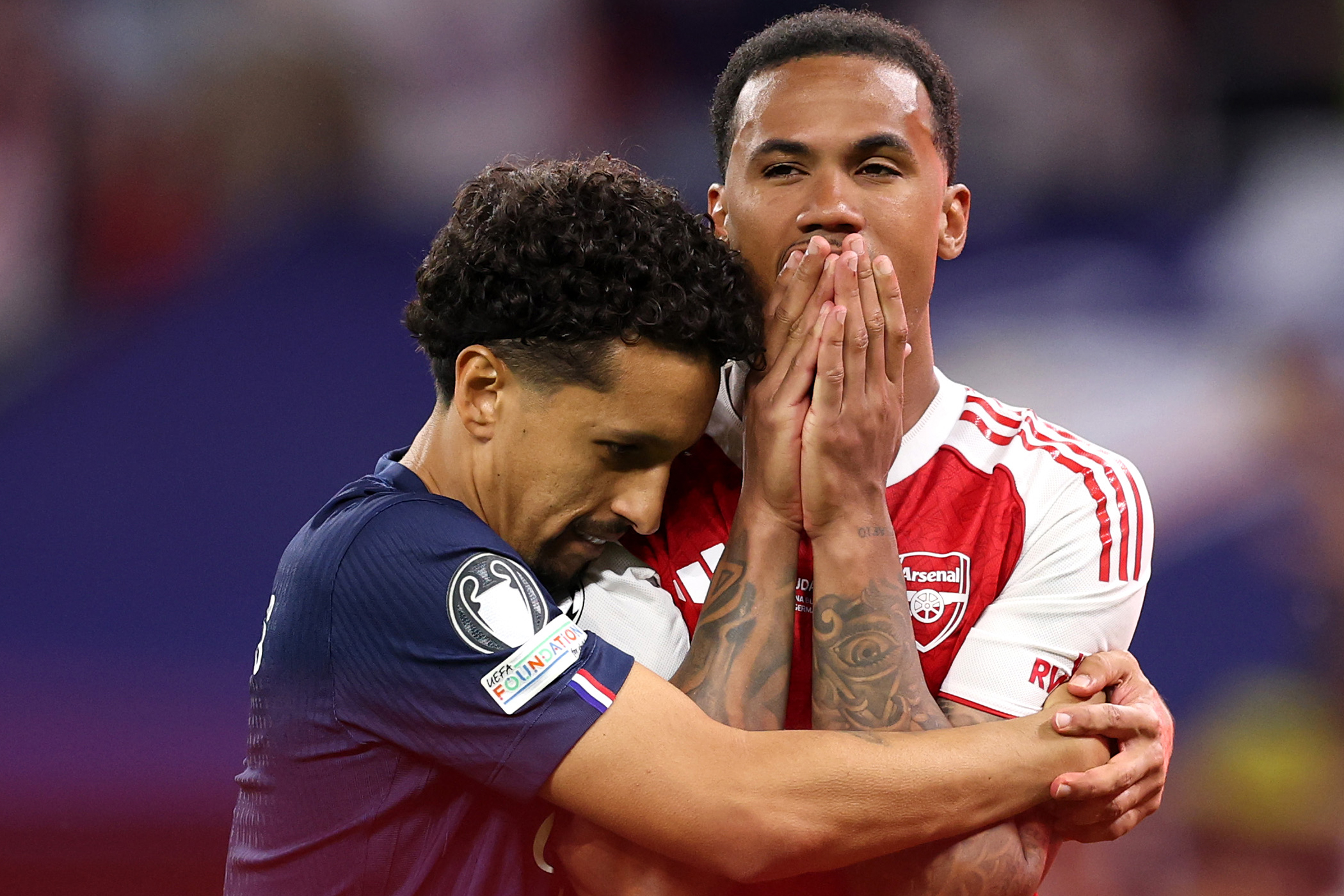
Or, more likely, it will be the moment that the dream ended, when the Champions League once again twisted the knife. Gabriel Magalhaes – the player that has, more than any other, come to symbolise this team – strode forward, took a deep breath, as the psychologists instructed him to do. Fine margins. Every detail attended.
And he blazed his kick high into the night sky, confirming that PSG had, by the skin of their teeth, become the first team since Real Madrid in 2018 to retain the Champions League. A fusillade of flares had been lit by PSG’s ultras by the time the ball landed again, the smoke wreathing around Gabriel, shrouded in his desolation.
But what will stay with the players may be something else, a much quieter, much more private moment, a few minutes later. Having collected their medals, Arsenal’s squad had gathered together a few steps away from the podium. Glassy-eyed and devastated, they watched as their opponents bounced and jigged and skipped towards the trophy.
That they stayed to see it being lifted is commendable, but understandably they had no intention of hanging around for any longer than necessary. They trooped off, sneaking around the back of a phalanx of photographers, all of them aiming their lenses at PSG’s jubilant players, barely casting a backward glance at Arteta’s vanquished team. The line between universes is thin, but it is unyielding.
And yet none of that should detract from what Arteta’s team has achieved this season. A million people are expected on the streets of London for the parade to welcome the champions of England on Monday. There is no reason for anyone involved to feel even slightly abashed. Arsenal ended their 22-year wait for a Premier League title. That is worth celebrating. That they could not overcome PSG, effectively on the toss of a coin, does not diminish that.
Indeed, it is hard not to think that this might – not immediately, but in time – come to be a source of fuel just as much as regret. The story of this Arsenal team has been one of patience and perseverance, of enduring disappointment and going again.
Newsletters
Choose the newsletters you want to receive
View more
For information about how The Observer protects your data, read our Privacy Policy
Arsenal finished second in the Premier League three years in a row, only finally to clamber to the summit in the fourth. Falling narrowly short to this PSG team will, doubtless, be deployed in much the same way. As one banner, fluttering among the Arsenal fans inside the Puskas Ferenc Stadium read, adorned with Declan Rice’s stylised face: It’s Not Over.
This game had been presented, to some extent, as less a final and more a chance to settle a philosophical conundrum. What happens when an unstoppable force runs into an immovable object?
It was an understandable framing, if not a flattering one for Arsenal, or the Premier League, for that matter. Arteta’s team has been depicted as an avatar of football’s lower virtues, those proletarian qualities that should be compliments but come across as insults: industry, organisation, possession of the largest central defender, all of the things that have come to define English football’s current grindset.
PSG, by contrast, have spent the last couple of seasons establishing themselves as the very definition of continental beauty and sophistication and élan. Under Luis Enrique, a club that had long served as a halfway house between laughing stock and morality play – all money, no sense, not just foolish but gauche – has been transformed into the team that stands at the game’s very cutting edge.
Watching PSG has a liquid quality. There are times when the full-backs, Achraf Hakimi and Nuno Mendes, find themselves operating as a good old-fashioned strike partnership, and when it is difficult to remember where exactly Desiré Doué and Ousmane Dembélé and Khvicha Kvaratskhelia are nominally playing, and when it is very hard to believe that there is not more than one Joao Neves.
They swept all before them last year; this season, they obliterated Chelsea and swatted Liverpool aside with an ease that bordered on contemptuous. In the semifinal, they pummelled Bayern Munich one week and then palmed them off the next. It cemented them as the high watermark for how a modern super-team should play, should feel, should look. They are European football’s final boss.
That Arsenal stood tall is not irrelevant. It is something that Arteta can work with, something that should help the players – if not the fans, not right now – overcome their disappointment.
It was not, by even the broadest definition, pretty. That is no surprise: Arteta has not shown the slightest interest in aesthetics for several years. For the tens of thousands of Arsenal fans in Budapest and the millions more watching from behind sofas around the globe, it is unlikely it even met the bar for enjoyable, at least not while it was happening.
But it was, by any standard, masterful. Arsenal’s grit and vigour was admirable, unstinting. The fans recognised it was that kind of occasion: midway through the first half, Cristhian Mosquera scrabbled back to block off Fabian Ruiz, deflecting the ball off the Spaniard’s legs to win a throw-in. The cheer that rippled in its wake would have suited a last-minute winner.
Their discipline, in particular, was extraordinary. Bukayo Saka sacrificed his attacking instincts in order to help Mosquera nullify the threat of Kvaratskhelia, depriving him of the space to stretch his legs and wreak his havoc. Doué, too, seemed asphyxiated, unable to break free from Arteta’s tactical stranglehold.
This is not what we might habitually call dominance, admittedly, but it is still dominance: the ability to stop the other team playing. The game was played on Arsenal’s terms, to Arsenal’s liking. They set the tempo: staccato, interrupted, discordant. They determined the rhythm. They did not have possession, but they had control.
The problem that PSG pose, though, is that their threat is permanent. They require just a single slip. Luis Enrique’s gamble is that his team will force their opponent to make it.
Until the 63rd minute, Mosquera had been one of the best players on the pitch. And then, for no more than the briefest instant, he found himself in the wrong position. Not by a metre, not by a yard, but by a fraction. And that was enough: Kvaratskhelia slipped in, ducked past him, and fell under his flailing attempts to rescue the situation. Dembélé equalised from the subsequent penalty.
In those final few desperate minutes, the control that both teams seek – in their own inimitable ways – proved elusive. Both might have won it, Kvaratskhelia hitting the post and Vitinha skimming the top of David Raya’s net, Leandro Trossard and Havertz triggering panic in the French side’s penalty area as Arsenal abandoned all pretence and broke out the trebuchets. Bradley Barcola should have won it deep into injury time.
Extra-time, ragged and disjointed, came and went. The suffering lasted as long as it could. There could be no other way. Arteta’s players collapsed to the floor, exhausted, drained of every joule of energy they had to give. Once again, all the Champions League had in store for them was pain. A pain that contains within it no small measure of pride, and honour, and defiance. But pain, livid and exquisite, nonetheless.
Photograph by Michael Regan/Getty Images