
Even for him, the greatest of them all, there could be no fairytale ending. For an entire generation, Lionel Messi has exerted absolute control over his own destiny. He possessed a rare, magical gift for shaping his reality, our reality, to his liking. For six weeks, this World Cup had felt like his glorious final act. But that is not how this works. Even he could not choose how he said goodbye.
In the end, at the end, he could not fulfil his dream, his country’s dream, of retaining the World Cup, of claiming what they call the fourth star. A player who has always been the ultimate protagonist was rendered entirely powerless by a Spain team that proved impervious both to his aura and Argentina’s relentless provocation. This was not, as it turned out, his World Cup. It had been Spain’s all along.
Given all that Messi has done, not just over the last six weeks but across his extraordinary career, the sight of him standing, his head bowed, at the final whistle felt cruel, almost anticlimactic. All around him chaos was breaking out, Argentina’s players letting their fury and their despair loose on their victorious opponents. Messi stood apart, lost in his own world, beaten at the last.
But that is football. It is capricious and it is wild and it is ruthless. We interpret it and understand it as a story, a way of making sense of what would otherwise be disconcertingly random, but there is no guiding hand, no matter how much it might have seemed at various points in Argentina’s run to the final that there might have been.
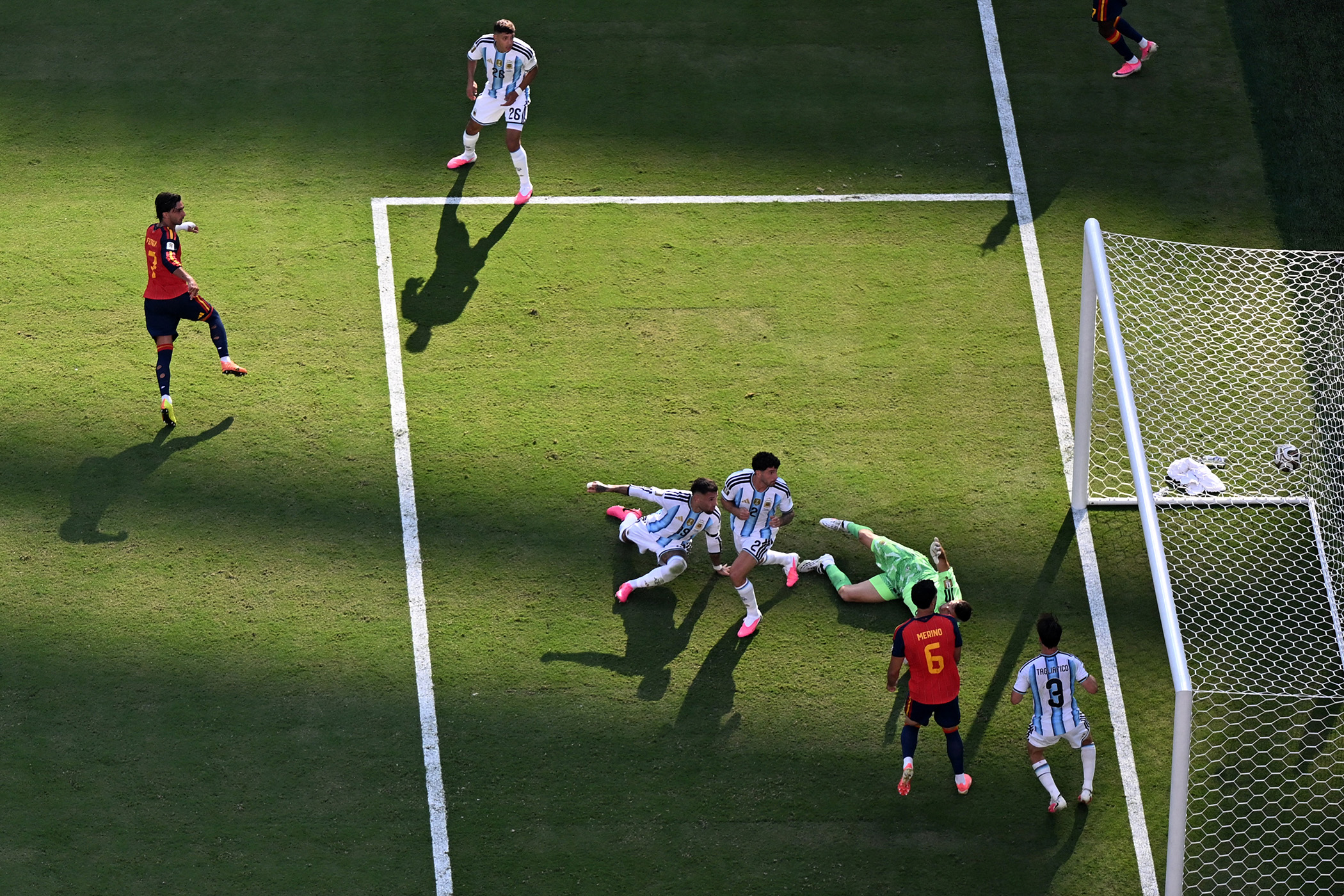
A World Cup final, then, that had been billed as a showdown between Messi and Lamine Yamal – a meeting of today and tomorrow, a clash of generations, a passing of the torch between the king and his bathtub-anointed heir – finished with both as supporting characters. Ferran Torres, the Barcelona forward who had faced lacerating criticism for most of this tournament, delivered the goal that brought Spain their second World Cup. This is not how you would script it, but the game is all the better for it.
The same could be said for the nature of Spain’s win. This game was supposed to be the apex of Fifa’s luxury World Cup, the tournament that marked football’s transition from a sport into just another form of commodified entertainment, a suitable climax to what Gianni Infantino – without a hint of irony – had called “the most incredible event in human history. Not just the biggest World Cup. It has been the greatest sporting, social and cultural event in humanity.”
That was why the game’s governing body had tinkered with its own rules to allow first Cristiano Ronaldo and then Folarin Balogun to play; it was why they had crowbarred in a lurid, inchoate half-time show into the middle of the game; it was why they felt enabled to set ticket prices at close to $3,000 and watch them rise from there.
What they seem to have forgotten, in their goldrush mania, is that there is a difference between sport and entertainment, and it is a crucial one. Sport, at heart, does not have a duty to be entertaining. The ticket price is not supposed to bring with it a guarantee of enjoyment. Sometimes games are boring. Sometimes they are snarling and staccato and deeply, gnawingly frustrating. Football does not owe you a good time.
That is especially true of World Cup finals. The fact that the last one, Argentina’s defeat of France in Qatar, might also – at the risk of being just a little Gianni – have been the greatest game ever played was very much the exception. Aside from occasional mismatches, the vast majority are described as finely-poised, or closely-fought. These are euphemisms for what they really are, which is somewhere between a grind and an outright ordeal.
That is not to say they are not absorbing, fascinating, or fraught. They are. It is just that what lends them those qualities is not their content but their meaning. All other knockout games, as Hugh McIlvanney wrote of the 1970 final, offer sudden death; it is only the final that can confer instant immortality. These games are not defined by what they are but by what they mean.
Newsletters
Choose the newsletters you want to receive
View more
For information about how The Observer protects your data, read our Privacy Policy
That this edition was particularly hard to love, that Argentina set out to spoil as much as they could, that Spain – for all their possession and their shots and their very obvious technical supremacy – lacked the cutting edge to punish them much sooner will not have stopped nerves fraying in Buenos Aires and Madrid. The World Cup final is not about generating usable clips for iShowSpeed. It is not about artistic impression. It is about winning. Hearts and minds do not really come into it.
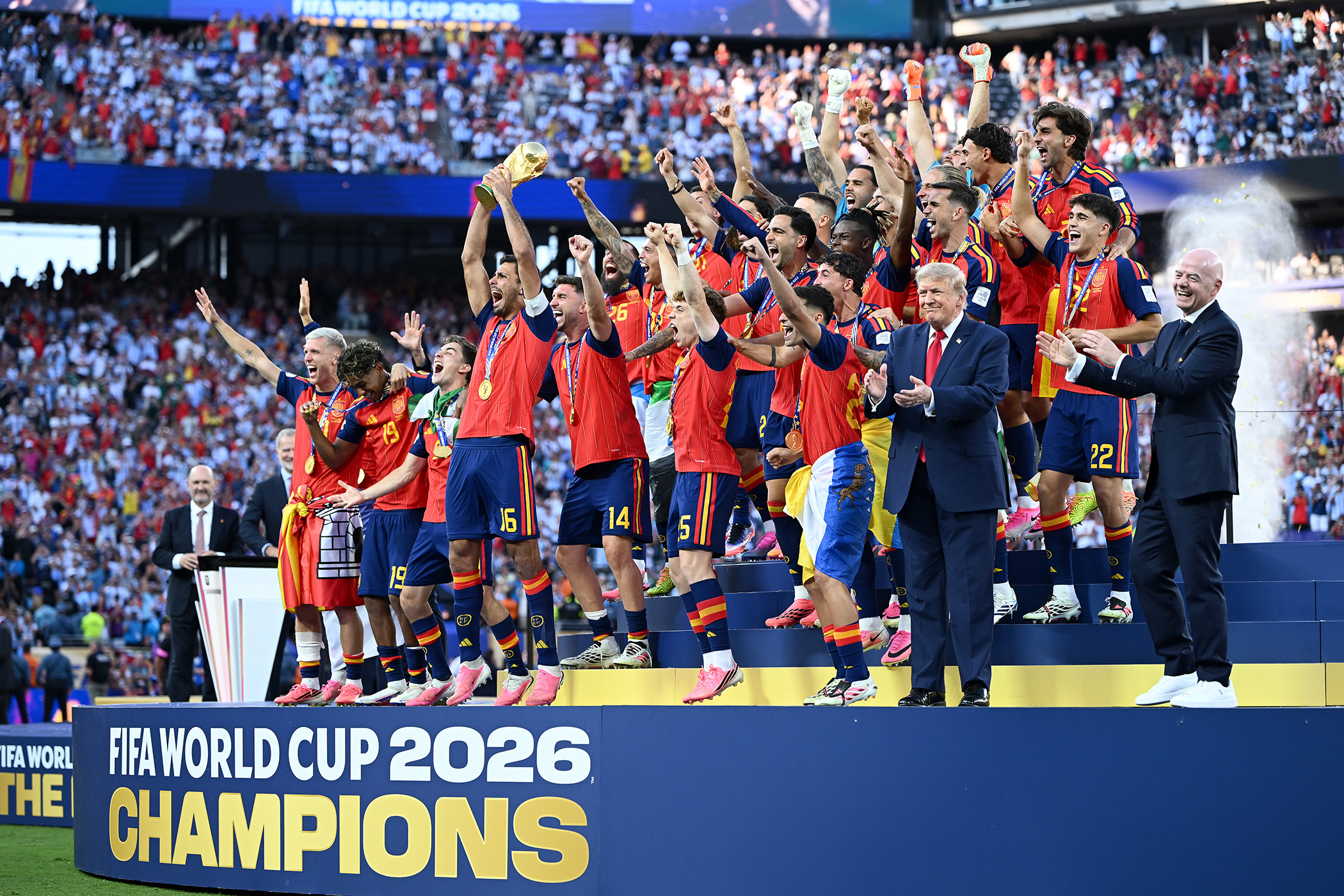
And Spain, ultimately, deserved to win. They have not been the most thrilling team to watch over the last six weeks; that honour belongs to France, or perhaps, given their taste for the dramatic, to Argentina themselves. But they have risen to every challenge. They have conceded just one goal. They have now not lost for 38 consecutive games. They have amply demonstrated that they are, as Luis de la Fuente said after the semi-final, the best team in the world.
They proved that definitively in the wilds of New Jersey not so much through their coruscating brilliance, the hypnotic metronome of their “passing carousel,” in Alex Ferguson’s words, but in their ability to resist Argentina’s attempts to drag them into a streetfight. They were not thrown from their rhythm. They did not lose their cool. They did not take the bait.
Instead, they relied on the fact that the numbers – the cold, unfeeling data – was on their side. Spain are, in many ways, a mirror image of Argentina, a team built on process and system and science against one weaved from magic and instinct and virtuosity.
Throughout the game, Spain had more of the ball, more of the territory, all of the chances; Argentina did not have a single shot in a normal time, an unwanted record for World Cup finalists. Even when the goal did not come, Spain trusted in what had brought them this far. This is the way every single one of these players has been taught to play since childhood. They knew it would work, eventually.
Quite how long it took will, admittedly, have tested that patience just a little. Argentina had been reduced to 10 men before the goal arrived, Enzo Fernández sent off for a second yellow card on the cusp of full time, Argentina abandoning what little pretence they had of wanting to score and now very obviously playing for penalties.
They could not get that far: Nico Williams won a header many might have given up as lost and steered the ball back to Torres, in the wide open space of the penalty area. He swept the ball past Emiliano Martínez and raced to the corner, Spain’s bench emptying as the pressure – at last – released.
Argentina, as they have throughout the tournament, found themselves staring at the abyss. This time, though, they could not conjure a reprieve. There was, it turned out, no magic left. Messi had no more left to give. He and his teammates stood on the edge one more time and, at last, they fell.
At the final whistle, a parade of Spanish players made their way to Messi to shake his hand, to offer their commiserations, to pay obeisance to a player who has been, who still is, an inspiration to all of them, a former colleague of some, and a friend to a few. He accepted their sympathy gracefully.
He still had a few duties to attend to. He would have to collect his silver medal, fighting to hold back the tears; he would have to hear his name chanted by the whole stadium, when Rodri was announced as player of the tournament; he would have to stand, shellshocked, with his teammates in front of the unmoving ranks of Argentine fans, defiant to the end, as Spain lifted the trophy they had called their own behind them. It would, he knew, be an agony, every minute of it.
For now, though, he had a moment. Once the final opponent had been greeted, thanked, embraced, the air seemed to leave Messi’s body. He looked at the turf, and sat down. More than anything, in that moment, he looked tired. So, so tired. He had arrived at the end. This was goodbye. It was just not the one he wanted. That is, he knows, not how football works.
What are your thoughts on this? Send us a letter to letters@observer.co.uk
Photograph by Michael Regan – FIFA via Getty Images