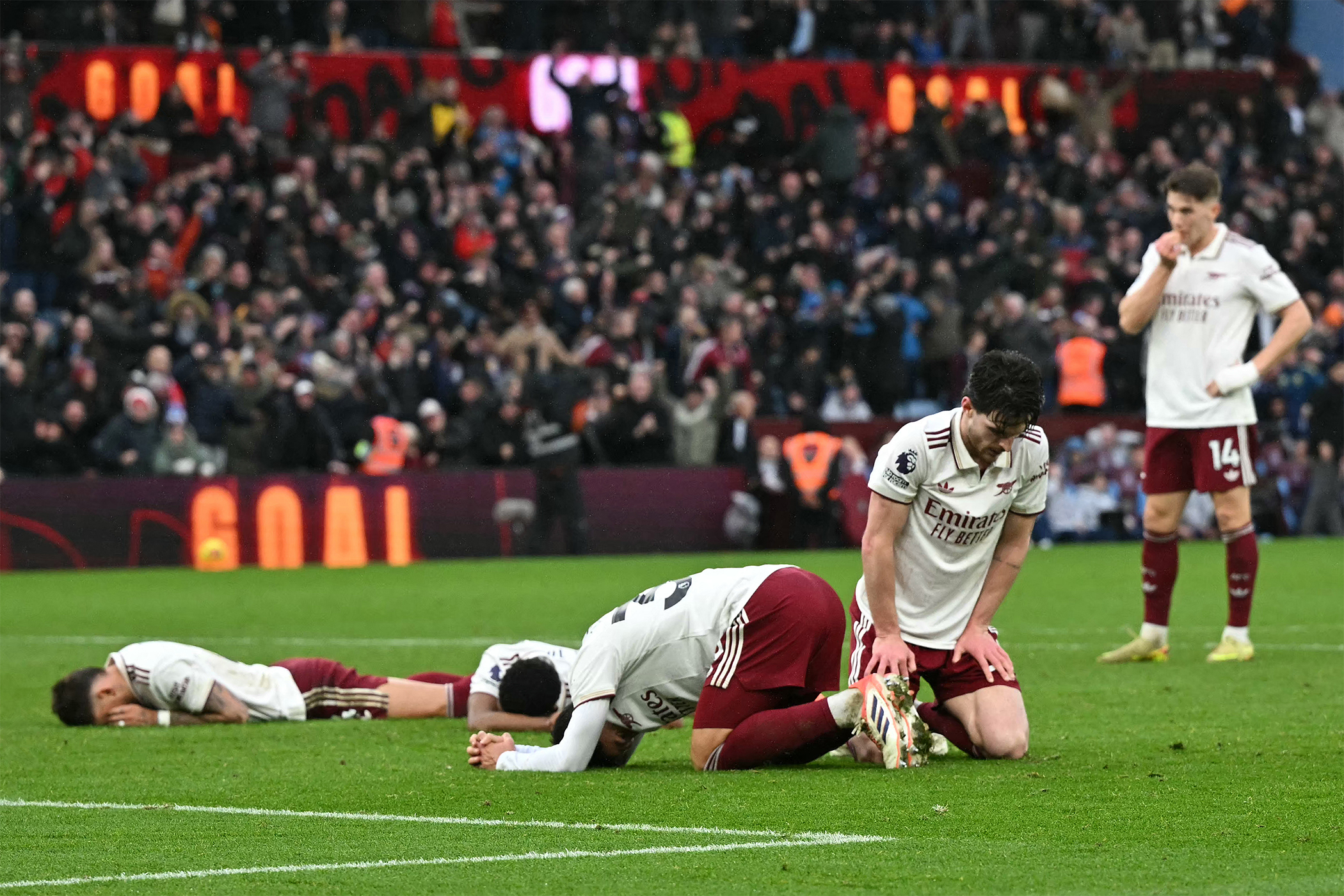

It’s here, it’s happening, this is not a dream. Crisis is not only knocking at the door but kicking it in, calling for one of those battering rams loved by FBI sadists. Arsenal had the Premier League title in their overpaid and well-manicured hands, and they blew it. Heads must roll, ideally violently and publicly. Make them walk home from Villa Park.
What was that? They are actually still top, two points clear of a field in which all still have gaping frailties and thinner squads? They still have a slither of daylight between them and a Manchester City side who appear to consider defending an optional luxury. Maybe we might just about stave off the end of days.
The entire Mikel Arteta project is a victory for long-termism in a mire of myopia, and losing that perspective, becoming trapped in the same game-by-game chaos cycle as their peers, is their greatest threat. They have to survive the discourse machine, the league of extremes, a world of extremes. Every day brings a fresh referendum and the primary challenge now is holding your nerve as the tornado approaches. Get away from the windows, don’t run for your car.
Arsenal are a noisy, self-destructive and parochial club at the best of times, but only in 2025 could two injuries to first-choice players constitute a season-threatening crisis, and only now could there be decisive matches in a title race after 15 games.
“You have to keep winning and winning and winning and everybody’s ruthless and the level is so high that we know we will have to maintain it for 10 months,” Arteta said pre-match, which is both untrue and unhelpful. Liverpool won last season having not won 13 of their 38 matches, City didn’t win 10 in each of the two seasons prior. Losing a game in early December will not define your season, especially this year, virulent tumult spreading like wildfire.
For all the league’s masterful narrative advertising, no single match should ever define a league season. Arsenal were missing their two starting centre-backs, an issue soon to be resolved. Villa have now won seven matches in a row and taken 27 points from 30 in the league. This was a game Arsenal could afford to lose, the end of an impressive 18-match unbeaten run. It is not some sign of hidden rot, the first lump of a terminal decline. They are still the strongest team in the country, perhaps the world, with the fewest weaknesses, most impressive useful depth and the highest peak. Two winless away games does not change that. They scored the most set-piece goals in the league between August and October, then the most open-play goals in November. Perhaps best of all, Wolves visit next, a glorious palate cleanser, footballing sorbet.
And contrary to popular opinion, improving in the second half of a season is not only reserved for Manchester City. Three of their four most difficult away games of the season are behind them. Only a visit to the Etihad remains, and not until 18 April. All of their poor results have come against teams currently in the top six. They are yet to slide to a sloppy defeat in any competition and have a perfect record in games they should be winning. They might not stave those off for ever – vanishingly few do – but this is good.
At Villa Park, Arteta loitered in the technical area looking, as he so often does, like an MI5 operative on his day off, wound up like a toy soldier, trying and failing to look in control. He made mistakes in his squad selection, most obviously starting Eberechi Eze and Mikel Merino in the front line. Eze’s concentration slipped to allow Matty Cash to ghost in to score Villa’s opener. Leandro Trossard attempted to save them once more. Despite not even being selected in the matchday squad for the opening game of the season, the Belgian Army Knife now has more Premier League goal contributions this term than any Arsenal player.
‘If you think that you’re going to be 10 points clear in this moment, I think we live in a different world’
‘If you think that you’re going to be 10 points clear in this moment, I think we live in a different world’
Mikel Arteta
This was a day which strained the credibility of Merino’s reinvention as a bona fide striker, losing the ball with wanton abandon and finishing without a shot or chance created, having completed just 11 passes. Martin Ødegaard was more effective but still does not look wholly himself, stunting attempted counter-attacks as he overthought his next move. Despite having a goal disallowed, Eze was hooked at half-time. Arsenal’s twin creative hubs are yet to learn how to co-exist effectively, and Eze is far more effective when afforded a free central role, rather than condemned to and restricted by the left wing. But ultimately this is a good problem to have, as so many of Arsenal’s supposed problems are. Even their great misfortune – losing their league-leading centre-back partnership simultaneously – is only short-term, William Saliba returning imminently and Gabriel Magalhães back by Christmas.
After the match, Arteta was far more circumspect and pragmatic than he had been two hours before. “If you think that you’re going to be 10 points clear in this moment, I think we live in a different world. They have given me all the right reasons to think that we are going to continue to perform at the same level. Move on.” These are the right noises to be making, evidence that he has learned how to handle the bad days in a way he has never successfully managed before.
Newsletters
Choose the newsletters you want to receive
View more
For information about how The Observer protects your data, read our Privacy Policy
For all the obvious gags about Arsenal’s recent penchant for collapse, their experience in these scenarios can only help. Being here before can only help. This is the benefit of longevity, of growing together – you learn not only how to navigate these moments alone, but also in relation to the same team-mates. Perhaps most importantly, you learn what crisis really feels like, and how to know whether it’s knocking at your door, or kicking it in.
Photograph by Justin Tallis/AFP/Getty