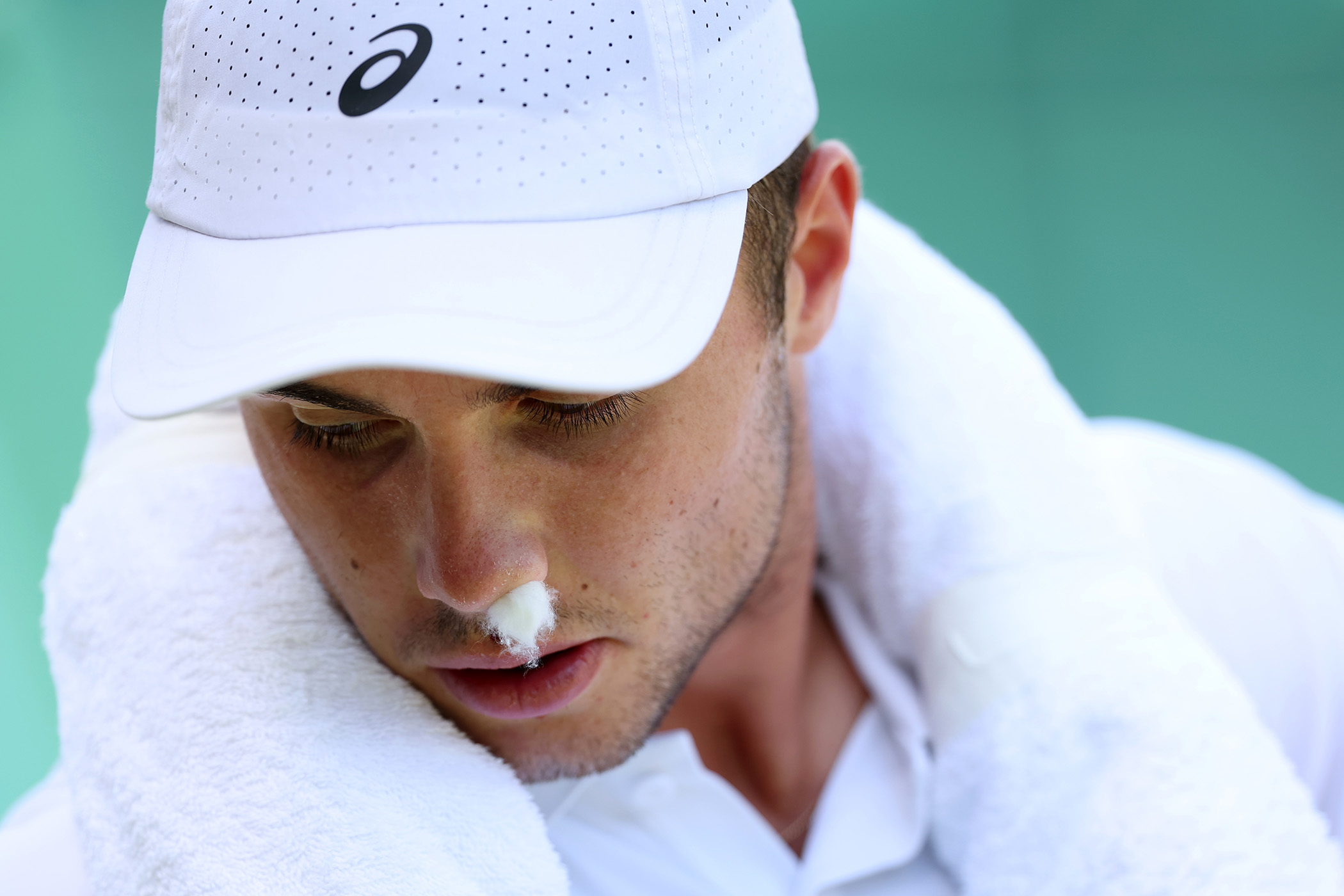
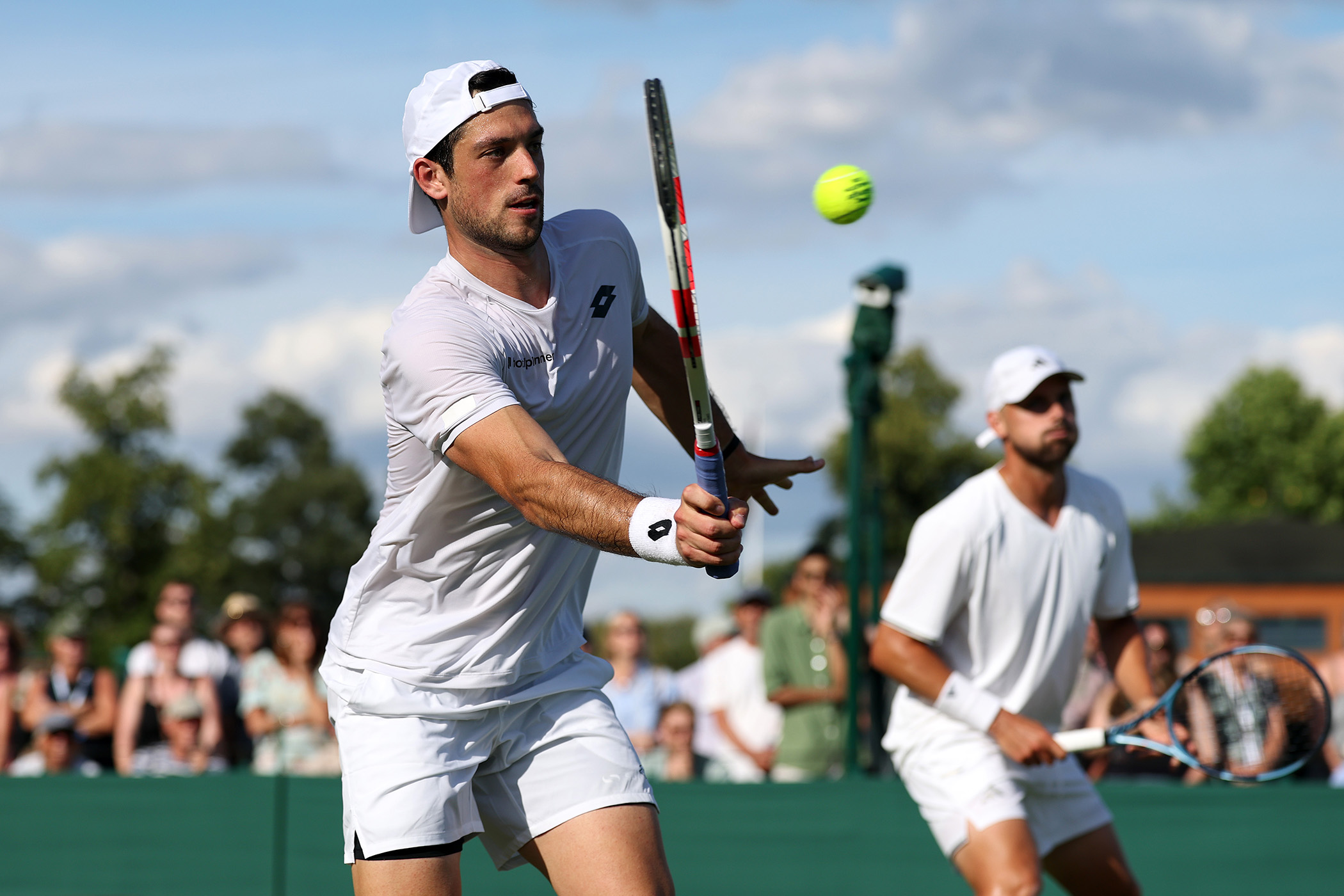
Arthur Fery’s regular nosebleeds might have been a reaction to being the only Brit to reach the last 32 of the singles. The Azteca Stadium isn’t the only place where altitude causes strain.
After a 4hr 38min melodrama of three Fery nosebleeds, implosions and blisters on Zizou Bergs’s side of the net, and two ferocious fightbacks from Britain’s last survivor in singles action, a lone home flag is planted in Wimbledon’s second week.
Throughout the desperate final stages Fery was distracted by the possibility of blood dripping all over his shirt. It took a fifth set-tie break to separate them, with Bergs complaining about Fery’s sportsmanship, and then smashing his racket on the turf. Fery earned it, but Bergs also threw it away, not least with 14 double faults.
You’re in a lonely place when everyone else from your country has been knocked out of Wimbledon by round-two. A myth is that these highly tuned pros dash around these courts to represent the nation. Most do it chiefly for themselves – and the money. Lose in the third round and you go home with £185,000. Survive to round four and you leave with £300,000.
Restoring British honour will have been on Fery’s to-do list as he faced the world No 37, Bergs, on Court 18, a modest stage compared to Centre Court or No 1 Court, and one overlooked by blocks of flat – a reminder that there’s a world beyond the All England Club’s dreamscape.
Just beyond Court 18 is ‘The Hill’ where Tim Henman ultras and Andy Murray fanatics built a British stronghold – or, at least, a nice place for a picnic and some cheering.
But the last Brit standing was entitled to think mainly of his own livelihood. Singles tennis is a lonely business. It’s enough to have to deal with the threat on the other side of the net without having to paint gloss on a faltering system.
Fery said as much on Thursday in a distinctly cautious response to questions about him taking on the job of national redeemer. “We’d love to have as many Brits as possible in the third round. There’s no pressure attached to it,” he said. “I play for myself. Yeah, I want to win just for myself.”
Fery wasn’t responsible for the structural failings that’s causing British tennis to squander the Andy Murray dividend. Britain’s first Wimbledon men’s singles winner since Fred Perry in 1936 lifted the curse but so far there has been no renaissance. Emma Raducanu’s 2021 US Open win hasn’t generated much success either for her or young women players wanting to follow her steps.
Fery did his bit by saving British tennis from its first second-round blow out since 2007. To take pressure off himself he indicated that he was happy to stay on Court 18 for his third match of the week rather than take his rear-guard action for the British game to one of the show courts.
Newsletters
Choose the newsletters you want to receive
View more
For information about how The Observer protects your data, read our Privacy Policy
That meant the first week passed without British players hitting a single ball on Centre Court – for the first time this century.
Fery was born in Paris and played for France when he was “10 or 12” but grew up “five minutes from” from Wimbledon. He sees himself as a product of the British player development system, via the National Tennis Centre.
The Lawn Tennis Association (LTA) and All England Club needed a body – any body – to reach the second week of a championship that lost Emma Raducanu and Jack Draper before a ball was struck. It’s only fair to place Britain’s poor showing at these championships in the context of that double injury blow. Then again there aren’t many people here rushing to say a new wave of British talent is about to crash across the game.
Eighteen British players went out in the first two days. The four wildcards handed to men (Fery was one) and the six granted to women didn’t do much to improve the balance sheet. Nor did it please Dan Evans, the 36-year-old veteran denied a singles wild card in his retirement year. Evans called the LTA’s decision “nothing short of a shambles” and “a total piss-take.”
Fery’s duet with Bergs, ranked 37 in the world, was his story in miniature: a 5ft 9inch intuition player against a 6ft 1inch high server and ground stroke hitter. Bergs blew Fery away in the first set after Britain’s last hope had needed a medical time out for his first nosebleed of the afternoon in the fifth game, with Bergs 3-1 up.
Fery stuffed cotton wool up his nose until a physio and doctor came to help. With the match tied at two sets each Fery’s nose gave away again.
Only the third British male wildcard since 2000 to reach round three, Fery, 23, displayed his finest qualities after losing the first set 6-2: tenacity, stubbornness and tactical cunning. His counter-attack knocked Bergs out of his rhythm and showed his own resilience.
In Fery’s thrilling fourth-set fightback was the most promising hint that he has a future at this level. Bergs was so discombobulated by it that he started screaming at his coaching team. No wonder the top brass of the LTA’s coaching staff were huddled together to watch Fery assert his character and give them something to cling to next week.
But it was a bloody business. The third halt for Fery’s nose to be treated came when Bergs led 5-4 in the third set took more than eight minutes, while Henman was saying on TV that Fery has now proved himself as a Grand Slam level player. Nobody though could recall a match being stopped so many times for a recurring problem that had nothing to do with muscles or bones.
The slaughter of the Brits was averted. Fery came of age. Sometimes there is no elaborate tactical or psychological thesis to be attached to one player prevailing over another. The answer here was uncomplicated. The 2026 Eastbourne winner was outfought by the British survivor ranked 77 places below him.
Crisis suspended.
Photograph by Jan Kruger/Getty Images