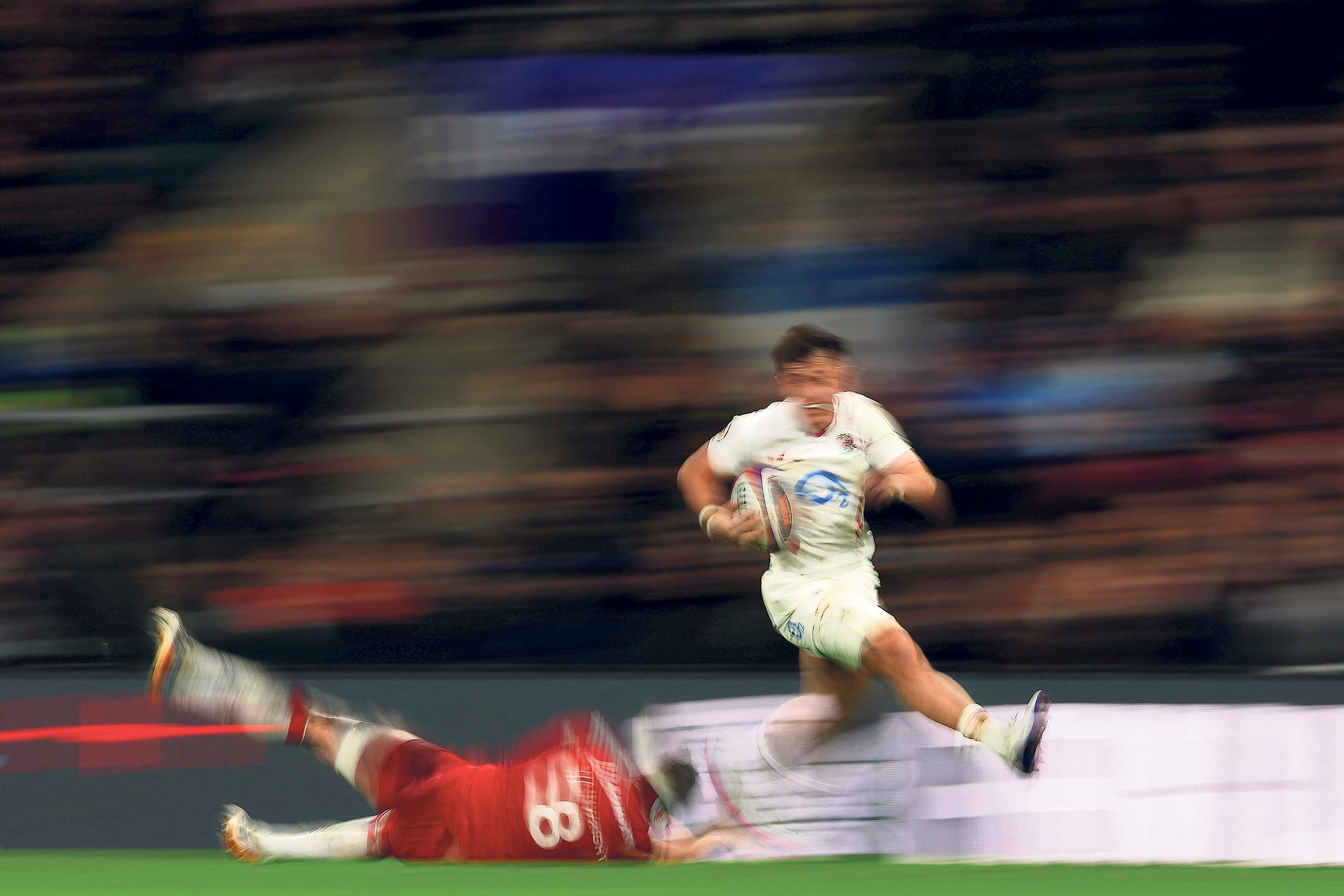



England’s golden retriever of a flanker, Henry Pollock, has been reading The Courage to be Disliked, a book about not being a people pleaser, not living for external validation.
Pollock’s doing a good job of being himself, and plenty outside English rugby dislike him for it. But the England team who reached 12 consecutive wins here by crushing Wales 48-7 have a bigger task than ignoring the antipathy of their opponents. It’s indifference in their own land they are working hard to overcome.
England’s rugby union team need to be recognisable and relatable again. If they carry on like this, occasional rugby watchers will come flowing back.
Pollock came on and created a try within minutes, with his tackler Taine Plumtree the fourth Welshman to be shown a yellow card, this time for swinging an arm into Pollock’s jaw. The courage to be disliked. Henry Arundell’s 35-minute first-half hat-trick in his first start since 2023, meanwhile, was a reminder of the time he was hailed as the next superstar. He may yet be, but it’s been harder for him than predicted.
Pollock, Arundell, the usual rash of big-name replacements: England were as irrepressible, outside of a brief mid-game lull, as Wales were indisciplined and desperate.
Since the Eddie Jones years of rolling auditions, England players have come and gone with unsettling frequency. For this team to achieve anything like the lustre of the 2003 World Cup winners they will need a consistent and reliable identity – in personnel and playing style. Wales are in crisis, but England’s eagerness and confidence will have caught the attention of the people they need to get back onside.
Even the England set-up has acknowledged over the last two decades that the team have lacked a definable character or self beyond sheer physical subjugation.
“The sky is the limit for these players,” Steve Borthwick, the head coach, said before this tournament. He also challenged his players to make their concluding game against France a Grand Slam decider. He doesn’t usually speak that way. After 12 straight wins talk of rebuilds ends. By then you’re into the furnishings.
This is a welcome transformation that feels more authentic than the many false dawns Twickenham has seen before
This is a welcome transformation that feels more authentic than the many false dawns Twickenham has seen before
Yet last year was a stellar one for English rugby. The women’s team, the Red Roses, won the 2025 World Cup. The men ran up 11 straight victories, beating Australia. New Zealand and Argentina in the autumn.
While the Red Roses delivered brilliantly on the biggest budget in the women’s game, the men snipped off the tag of being a side in permanent “development”. Meanwhile the RFU talks of a £660m revamp of Twickenham and of trying to persuade the local council to allow up to 15 concerts a year to pay for it.
Newsletters
Choose the newsletters you want to receive
View more
For information about how The Observer protects your data, read our Privacy Policy
Talk to anyone in this England camp about last year’s upswing and they enthuse about the quality of the players queuing for Borthwick’s extended gang of “starters” and “finishers”. We have been here before, of course. Jones's side won 18 in a row between 2015 and 2017 but world domination eluded them and the development mantra returned on a loop.
To the rugby cognoscenti and Twickenham diehards, the churn will have been less frustrating than it is for floating viewers of the national team – people who don’t watch club rugby but always gather for the Six Nations, as an earthy late winter ritual, a respite from endless football.
But to turn a national team into a national attraction you need the players to put on a show, take risks, summon a bit of swagger and verve; to have a way of playing. Pollock prides himself on being annoying, and therefore interesting. From watching football he has persuaded himself that “personality” is a kind of service to the sport.
Maybe he has a point, though several pundits here chastised him for delaying his dive for his try, to add to the theatre of it. They also noticed the fierce battle for places in this England team as big names flew off the bench to remind Borthwick they are more than just good subs.
Welsh rugby’s great tradition was no impediment to England’s growing conviction. Even with Louis Rees-Zammit back at full-back, they could only impersonate their distinguished forebears. They were already 36-0 down when they finally broke their duck with a Josh Adams try. Wales had lost their previous 11 Six Nations matches and stumbled to a 12th, this time 48-7. At least it was less painful than England’s 54-point win over them last year.
Wales are in a horrible reductionist phase. Their regions are being cut from four to three and their national team was chopped from 15 to 13 by two early yellow cards, which opened the gates to England, who played fast and furious. Wales dropped to 13 men again in the second half as England regained their momentum and sent on their famous finishers.
If Borthwick’s side want to be popular outside their own sport, this is the way to get there: not with forward attrition – endless phases of physical bullying – but pace, ingenuity and ambition.
All of which France paraded against Ireland on Thursday night. The beauty of the Six Nations is its unpredictability. Already, though, Paris on 14 March has the feel of a contest between French rhythm and exuberance and the new, less mechanical, more expressive England. It’s a welcome transformation that feels more authentic than the many false dawns Twickenham has seen before.
Photograph by Adrian Dennis/AFP/Getty Images