

What I see defies comprehension. Beneath my feet is a football pitch as green as Oz. Above me are holograms of players swiping the eyeline like giants or gods. At every turn are modular cubes, tiered and iridescent, creating an LED wall built in a Tetris-fuelled haze. I am meant to be looking at the future but instead I am flung back into the past. Here at the Prince Mohammed bin Salman Stadium, under construction for the 2034 World Cup, I am transported to the city of Fritz Lang’s 1927 film Metropolis: hypermodern, geometric, canyoned by skyscrapers, bereft of birds. That city – this city? – exists only thanks to a drudge of invisible workers.
When I remove the virtual reality goggles, it takes a couple of seconds to readjust to my surroundings. I am not in Qiddiya City, Saudi Arabia, but in an air-conditioned exhibition centre in Paris. Next to me is a cheerful woman who encourages me to complete the other “challenges” to receive my “gift”. These include watching a video about the stadium and getting a picture in which I am superimposed on to a backdrop of the stadium. Between each task I scan my phone, something I am asked to do nearly every time I leave or enter a building. The gift is a 50 Saudi riyal (around £10) voucher for Steam, a gaming platform reportedly used by the crown prince, Mohammed bin Salman. The person who gives me the voucher asks if I will be visiting Qiddiya City. She tells me that she has couples discounts. I take the voucher and tell her I’ll check my schedule.
This is the third edition of the Esports World Cup, run by the crown prince’s Esports Foundation, and the first outside Saudi Arabia. It is in Paris this year because of the war in Iran, but the arrangement has benefits. Lots of what fills the 169,400 sq metres of Paris Expo Porte de Versailles seems designed to get people to go to Saudi Arabia or to imagine its unimpeachable future. The inclusion of a hospitality section called the Embassy may have the opposite effect. Quibble about the difference between an embassy and consulate, but it’s hard not to think of the journalist Jamal Khashoggi, who was murdered at the Saudi consulate in Istanbul in 2018.
I am in Paris to experience in person a phenomenon that has mystified me from a distance: the world of professional gaming, with all of its bells, whistles and lucrative prizes. I am also here to understand why Saudi Arabia, as it withdraws funding for LIV Golf and reconsiders other investments, is moving full steam ahead when it comes to esports. What does this phenomenon offer the kingdom?
It is steam that comes off me when I exit the Métro at Porte de Versailles to broil in the Parisian heat. As I walk towards the tournament site, I pass billboards that herald the mononymic stars of esports, with elusive names such as Knight, Caps, Faker and ZywOo. Magnus Carlsen, official chess ambassador of the Esports World Cup, and Cristiano Ronaldo, global ambassador for the tournament, also feature on posters. They are not the only big hitters associated with professional gaming. Kaká, Lando Norris and Tony Hawk made cameos in last year’s competition. Diogo Jota, the late Liverpool footballer, has an esports trophy named in his honour.
Saudi Arabia can never be accused of minimalism. The $75m of total prize money on offer for winners exceeds the pot for the French Open tennis ($70m), which takes place a few kilometres away. This serves to reiterate how empty the Esports World Cup venue is compared with Roland Garros. Staff at the gates wear T-shirts emblazoned with “crowd control”. I am one of 20 people within sight.
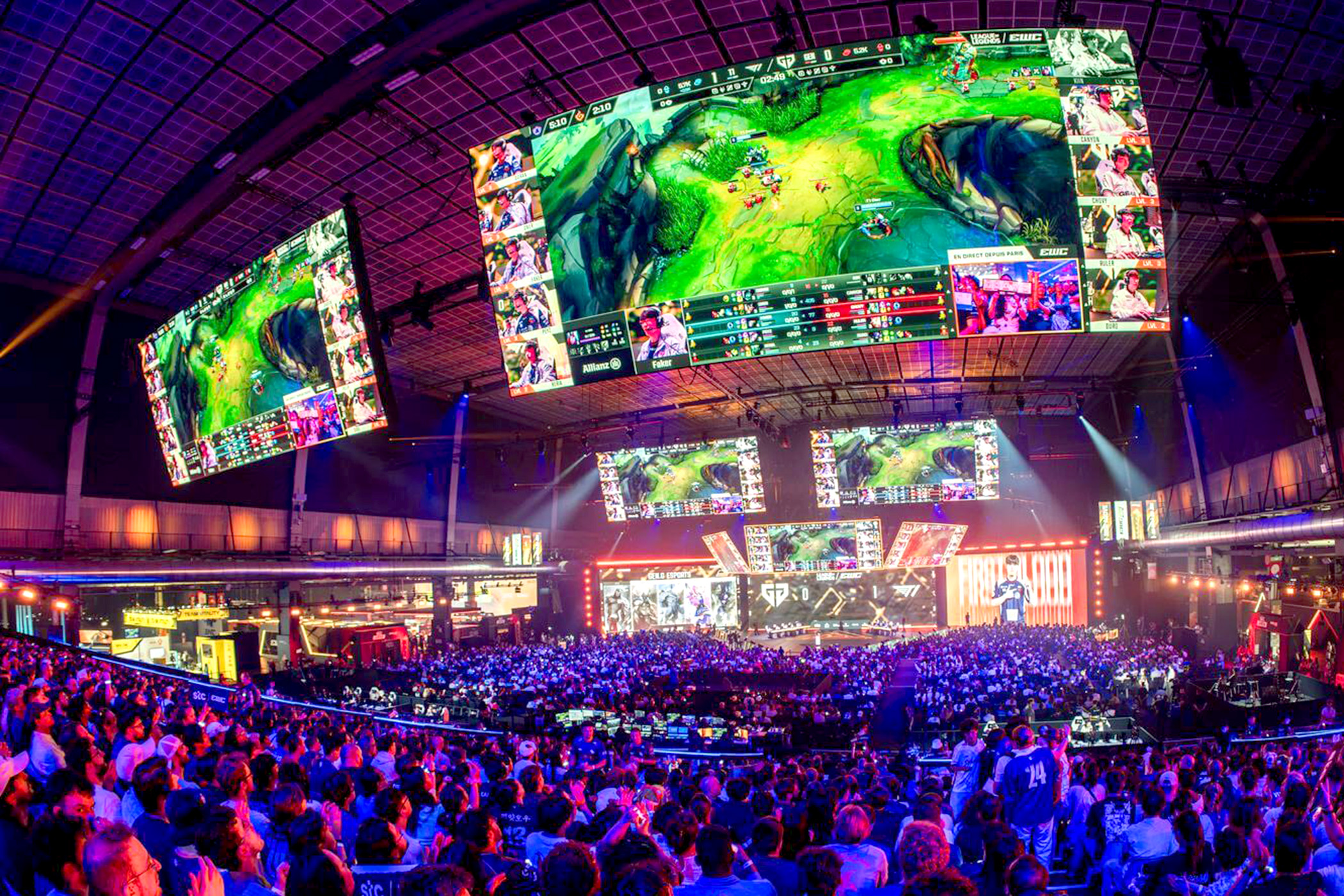
Inside the main hall, one of several giant pavilions hosting the tournament, there are gaming arenas, a basketball court, a Paul bakery, an interactive manga installation, a glitzy trophy wall, dedicated team mix zones, and numerous advertising stands and merch stores. It is how Dave & Buster’s or Hollywood Bowl might expand if they stumbled upon untapped oil reserves. My press pack includes two pages on esports growth in Saudi Arabia and some unsourced stats to convince everyone of the wisdom of the venture. There is nothing about the energy cost of powering seven weeks of industrial-scale air-conditioning, hundreds of top-of-the-range gaming systems and countless jumbotrons. 1984? Blade Runner? Planet Earth in the late Cenozoic era? Pick your dystopian poison.
Some of my doubts dissipate over the day. People do come to watch, though in fairly paltry numbers compared with the acres of space dedicated to them. Apex Legends Global Series, one of 24 Esports in this year’s tournament, which features more than 2,000 players, draws a capacity audience, which means I am relocated to a spillover zone for “superfans”. There I am given an inflatable cheering stick and a bird’s eye view of the action, which, if you ignore the screens, consists of a group of young people getting repetitive strain injury.
EA Sports FC, a football game, is more in my wheelhouse. But it also requires dispensing with the real world for anything close to an entertaining time. Although the fans are nominally “ringside”, sitting around players at rows of computers, the only way to see what is going on is through the screens right in front of us. Why, then, should I pay to watch GoatMoh versus Yas SFC in person at all?
I need to park my cynicism for a moment. I have been to football matches in the rafters of Wembley where the visual spectacle is inferior to watching at home. I know that I go to Wembley for everything else: the chance to feel, to sing and to be part of a shared experience. In that sense, I understand the appeal of esports. People at the tournament get behind their favourite teams. They gasp and groan and queue for autographs. Even without the theatrical commentary over the PA system, I am left in no doubt about the tension. With millions of dollars on the line, competitors face many of the same pressures as athletes, and need to possess an array of physical and mental skills to get anywhere near the podium.
Newsletters
Choose the newsletters you want to receive
View more
For information about how The Observer protects your data, read our Privacy Policy
The problem with the Esports World Cup is the vaulting ambition of the thing. Like the Line, Saudi Arabia’s 170km linear acropolis, which has been put on pause until 2030, or the Cube, an aborted structure designed to hold 20 Empire State Buildings, the Esports World Cup has been created for a society that does not exist. For a society that may never exist. The bright lights and cacophonous noise of the tournament generate some headiness, but the lasting effect is vertigo.
The problem, fundamentally, is Saudi Arabia. Its Public Investment Fund (PIF) has poured tens of billions of dollars into the video game industry. Savvy Games Group, a company funded by PIF, owns roughly 40% of the global market. Last September a consortium spearheaded by the PIF agreed to buy Electronics Arts for $55bn. Saudi Arabia is now the dominant force in gaming – and especially esports.
It makes sense that Saudi Arabia continues to bank on esports if you see what it has done in the past few months as a recalibration and not a retreat. Mohammed bin Salman, an avid gamer, wants to be seen by his people as a moderniser. About two-thirds of Saudis are under 35. More than two-thirds of the population play video games. Golf? Snooker? They don’t really sound like the future. But Counter-Strike in the age of AI, high-tech chips and 3.4 billion gamers? Now we’re talking. It is notable that Lenovo, a major sponsor of the Esports World Cup, is currently producing Saudi-made laptops. What is up for grabs in the gaming world is more than a piece of the pie, as it might be in football or tennis. It is an entire ecosystem.
So that is what gaming has become. Not something you play in the lounge with your mates, but a bloodless strategic push for a petrostate. Another form of entertainment in which every choice begins to feel like a moral choice; even if no one is doing any moralising in Porte de Versailles.
Metropolis, Lang’s film, is preceded by an epigraph: “The mediator between head and hands must be the heart.” Looking out from the superfan zone at the teeming crowd below, I see plenty of heads and plenty of hands. But the heart is all but gone.
Photograph by Esport