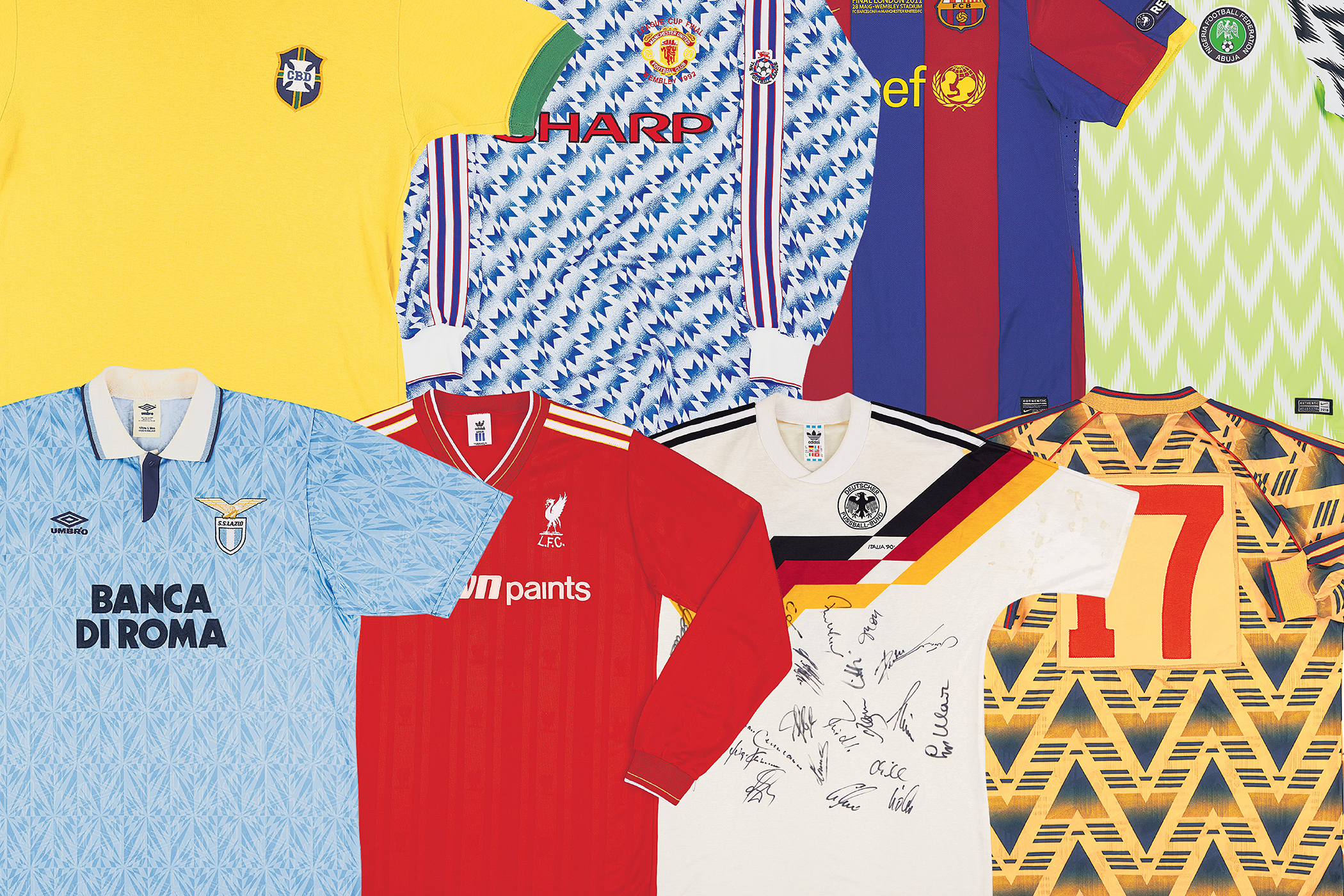

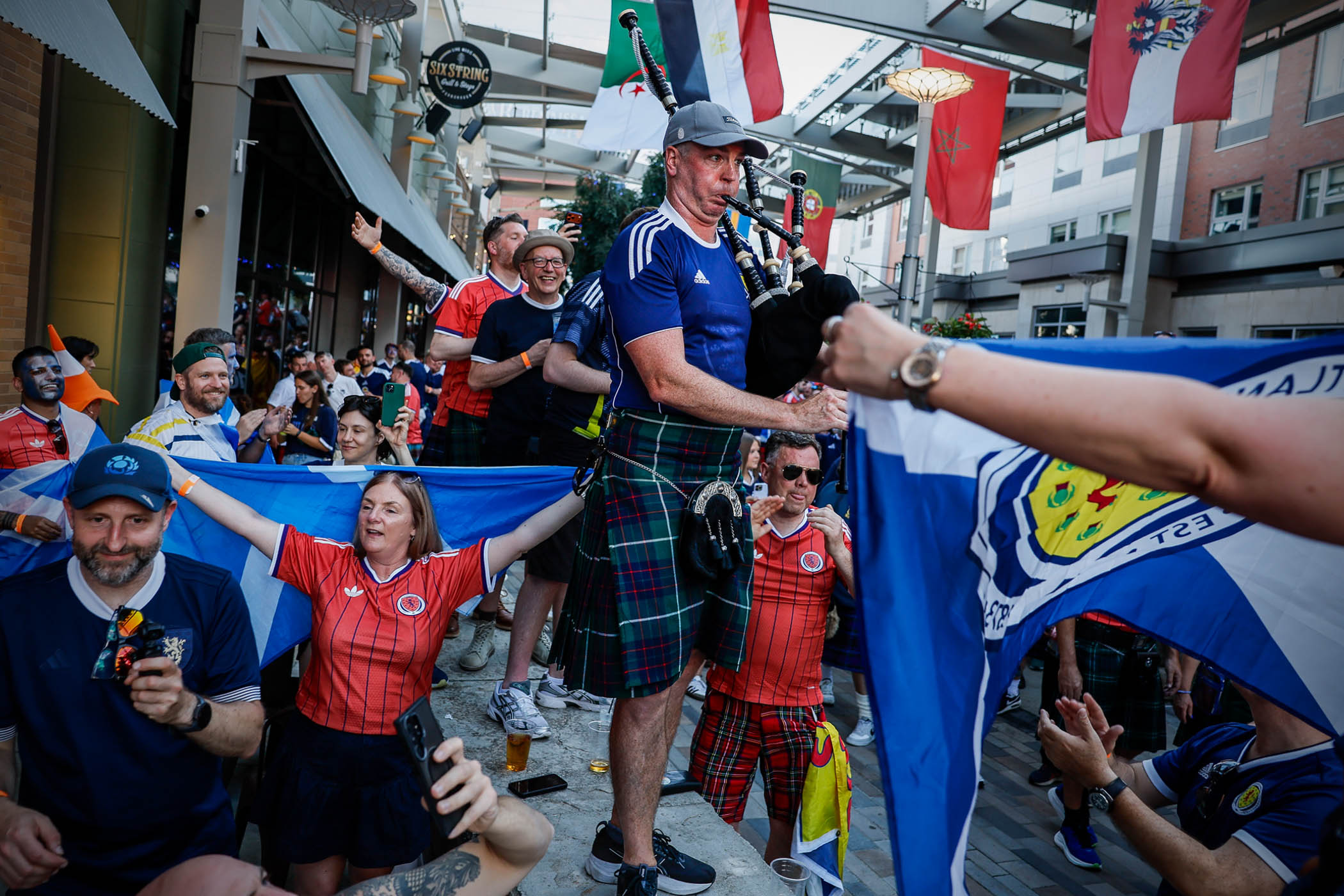

For a month in that heady, wild summer of heartbreak and hope, the fans wore their years of hurt on their backs. During England’s ultimately futile run to the final of the European Championship in 2021, it was hard not to notice the sheer volume of vintage shirts on display in bars, on the streets and, most of all, in the crowd at Wembley itself.
The national stadium, over the course of those four weeks, had the character of a time machine. There were plenty of fans wearing the most recent England shirts, skin-tight, crew-necked, emblazoned with the names of one of the heroes of the team hoping to end the country’s long wait for an international trophy. (It was 55 years, then, and 60 now.)
But there were many, too, who had opted for something a little more classic. In the stands at Wembley, there were ersatz versions of shirts from 1966, as there always are, but there were echoes of less pleasant memories, too. Some went for the sky blue of the third kit from Italia 90, some for the grey away shirt from Euro 96, others still for the red of the alternate jersey from 1998. That all three of those should have been so popular is, on the surface, curious. After all, they are a reminder of opportunities missed, etched with the pain of the past.
Italia 90 ended with Stuart Pearce’s penalty saved and Chris Waddle’s blazed into the night sky of Turin, Paul Gascoigne crying on the pitch. It was in that grey shirt that Gareth Southgate failed with his penalty against Germany, preventing football from coming home. The World Cup in 1998 ended with David Beckham kicking out at Diego Simeone, and yet another agonising defeat by an arch-rival.
And yet, a generation or more on, all of them were considered the very height of fashion: not just by those fans attending games, but by the millions more following the tournament remotely. Depop, the online vintage bazaar, reported that searches for retro football shirts surged that summer; eBay and Google found the same.
Several explanations were offered for the phenomenon. One was cost: a new shirt, whether for England or another team, generally costs rather more than a second-hand one, with due exception made for particularly valuable vintage editions.
Another was the broader trend in fashion, which veered at that point towards the late 1980s and early 1990s — a manifestation of what the writer Hadley Freeman refers to as the “30-year rule”, the period of time it takes for a generation to grow up, occupy positions of cultural power and decide that the things they liked when they were teenagers are, as it happens, due a reboot. Modern England shirts were increasingly laced with references to the kits of that period; it made sense, then, simply to wear the originals.
And then there was the political significance; or, rather, the apolitical. “In many ways, [wearing a retro shirt] evades any potential identity pitfalls of more contemporary kits,” The Independent wrote, pointing out that the concept of English national identity was – at the turn of the 2020s – “anything but straightforward”. By wearing a vintage shirt, the newspaper suggested, fans could transport themselves to “what increasingly feels like a simpler era, when Britannia was, just for a split second, cool”.
All of these explanations were valid, of course, but among the crowds on Wembley Way it felt like none of them quite captured the dominant message. The shirts were worn not just as fashion statements but as badges of honour. They were a way of indicating that the wearer was not a neophyte, attaching themselves to the England bandwagon for a single tournament; they were, instead, a way of communicating a lifetime of suffering.
To wear a vintage shirt is not only to date yourself as a fan, to prove how long you have suffered. It is to pay homage to what has been lost.
To wear a vintage shirt is not only to date yourself as a fan, to prove how long you have suffered. It is to pay homage to what has been lost.
The fans wearing the shirts of Italia 90 or Euro 96 or France 98, evoking the pain of those moments, did so in order to date themselves, to prove their credentials, to advertise the length of their own private years of hurt. Even those too young to remember those tournaments, those heartbreaks, used the shirt to express sympathy, to confirm that despite their youth, they understood what it was to follow England.
Newsletters
Choose the newsletters you want to receive
View more
For information about how The Observer protects your data, read our Privacy Policy
That a football shirt is a mechanism for expressing identity is both apparent and inherent. The primary purpose of a replica kit is to assert membership of a specific group, to pledge loyalty to a particular team. They are a tribal costume. Fandom is something you wear on your sleeve, and on your chest.
But that is not the only message they can convey; a shirt can express far deeper meanings than simply who the wearer supports. To bastardise a line from the animated sitcom Family Guy: clothes can be a great way to express opinions.
Most obviously, vintage shirts serve almost as a sporting equivalent of carbon dating: they are a way of outlining not just the nature of support but the length of it, too. As fans, we retain special affection for the shirts of our youth, the ones that the team we cherish — be it a club or an international side — wore in that first flush of affection and loyalty, when to be a fan was a simple act of love and adoration.
They serve, in effect, as watermarks of authenticity. They showcase a depth of understanding, indicate a sincerity of affection: they are a way of communicating, instantly, that the fandom we espouse is not fleeting or superficial. It expresses a degree of empathy, of fellow feeling, to other members of the tribe.
Their significance extends beyond the chronological. The rules over which shirts fans are allowed to wear are individual. Some would consider it taboo to wear anything other than a jersey of the team they support. Some might accept a slightly broader church, stopping short only at sporting the colours of direct rivals. And sometimes, a shirt is nothing more than a shirt.
On those occasions when the choice is more deliberate, though, shirts do convey a message. They can be used, at times, to broadcast a signal across the boundaries of culture and language.
On the most basic level, the bright, canary yellow of Brazil acts as a universal indicator of not just love for football, but for the style and romance and sexiness that is intricately entwined with the Seleçao. The blazing orange of the Netherlands hints at a certain cool; the sky blue and white of Argentina a counter-cultural, vaguely iconoclastic glamour.
All of them, when worn by a non-national, suggest an engagement with the sport that runs just a little deeper than might be expected; they are a way of signifying not just a refined palate but knowledge, too. Wearing the shirt of a foreign club team can have much the same effect. In Britain, that might most commonly be Barcelona (cool, artistic, pure) or Real Madrid (power and wealth and élan) or, increasingly, driven by the profile of their phalanx of star players, Paris Saint-Germain. But foreign is an elusive concept. In continental Europe, the same effect might be had by a fan wearing an Arsenal or a Chelsea or a Liverpool shirt.
Vintage is also a shifting idea; what counts as retro depends entirely on an individual’s age. The message, though, remains essentially the same. To wear a Valencia shirt from the early 2000s or a Norwich jersey from the 1990s or a Sampdoria effort from the 1980s serves, deliberately or not, to highlight not just the wearer’s sense of style but to signal authenticity, to claim status in the hierarchy of fandom of the game.
The same applies with shirts from further afield. The distinctive shirts of a number of South American club sides — including the twin poles of Argentina’s superclásico, Boca Juniors and River Plate — have always held a particular allure to a certain stripe of fans. The shirts themselves are immediately recognisable: Boca’s sumptuous blue and vivid yellow, River’s blood-red sash.
And so, too, is their effect. There is a passion, a frenzy, a wildness that is inherent to Argentinian football, one that stands at odds with the often sanitised and increasingly corporate feel of the game in Europe in general and the Premier League in particular.
To wear a Boca or a River shirt as a European or as a North American is not necessarily to choose a side in one of world football’s most pernicious rivalries.
It is, or at least it can be, to associate yourself with the fervent spirit of Argentinian football as a whole. It is to indicate a sympathy with a form of the game that is seen to be brighter and purer and less compromised than its equivalent in Europe.
The surge in popularity of vintage shirts over the last two decades or so has tangled roots. It can, to some extent, be traced to football’s gradual transformation into a billion-dollar industry. It can be attributed to a more general pattern of globalisation. Satellite broadcasting and video games and the sheer marketing power of Lionel Messi and Cristiano Ronaldo have all played their part.
But perhaps, at the same time, it is a reaction to all of those things, too. Perhaps it is not just nostalgia for a specific time, for a specific game, that drives fans to wear vintage or unusual or exotic shirts.
Perhaps, more than anything, it can be traced back to a yearning for a different sort of football, one that is less polished and less popular but, particularly in the soft light of hindsight, feels more authentic, more real.
To wear a vintage shirt is not only to date yourself as a fan, to prove how long you have suffered. It is to pay homage to what has been lost.
Classic Football Shirts, which includes essays by The Observer’s Rory Smith, is available to buy now at classicfootballshirts.co.uk