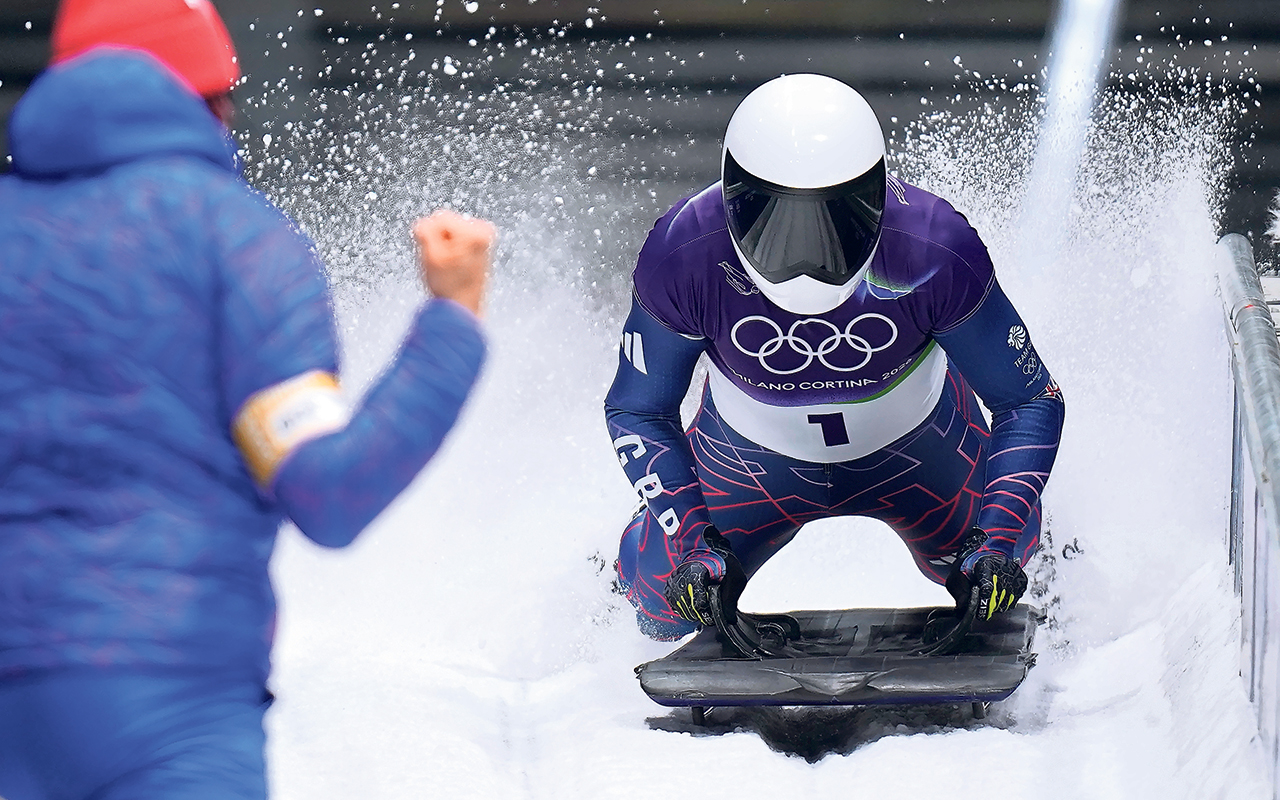
To understand how Great Britain became the most successful nation in Olympic skeleton history, despite not having an ice track, you have to go back 30 years. In the early 1990s, Kristan Bromley was embarking on a PhD in Materials Engineering and designed a sled for the British skeleton team. At the time, the team was made up of soldiers and none of them wanted to risk riding the newfangled sled.
Bromley, needing data for his studies, decided to have a go himself. By 1996, he was British champion in skeleton.
Twelve years on, he was world champion and had garnered the nickname “Dr Ice”. It was through his designs, which changed global sledding forever.
Initial British success at the Olympics came when the sport was reintroduced after a 54-year hiatus in 2002 with Alex Coomber winning bronze at Salt Lake City.
Bromley admitted that he had little idea what he was doing with his new design with his background actually being in aircraft design. He described that original sled as “bolted together with bits of metal”.
He went on to set up Bromley Technologies with his brother Richard, combining Kristan’s aerodynamic and racing experience with chassis design and vibrational research carried out by Richard at the University of Leeds.
Richard now works with the Belgian and Brazilian skeleton racers whilst Kristan coaches with the Netherlands.
Twenty years after that first medal, Great Britain’s streak of a skeleton medal at every Winter Olympics came to a shuddering halt in Beijing. The disappointment was palpable. Matt Weston, who had finished in 15th, considered retiring from the sport he was so embarrassed.
“I can’t sugarcoat the Olympics,” he said in 2023. “It was tough. It hit all of us hard, at different times and in different ways.”
Weston had come to the sport, like most British skeleton racers, through a talent identification scheme. With a background in rugby and taekwondo – the other Team GB skeleton racers come from backgrounds in tennis, American football, and long jump – Weston took up skeleton in 2017 after his weightlifting coach suggested he tried UK Sport’s “Discover Your Gold” campaign, and made his first World Cup appearance in 2020.
In the 30 minutes after Weston won gold on Friday night, the British Bobsleigh and Skeleton Association (BBSA) had 1,000 athletes sign up for their talent identification campaign.
Six years from his World Cup debut, he became Great Britain’s first medal winner at the 2026 Winter Olympics. He is the first Team GB men’s single gold medallist at the Winter Olympics since Robin Cousins in figure skating in 1980. Skeleton racer Lizzy Yarnold, who won gold in 2014 and 2018, was in tears watching on.
What happened in 2022 led to a considerable rethink from the BBSA. Skeleton is one of the best invested winter sports when it comes to UK Sport with around £6m ploughed into the programme for every cycle since 2018.
This funds specifically coaching and facilities, with separate Athlete Performance Awards given to fund the athletes themselves. For the Winter Olympics, athletes were allocated £5m in total.
The conclusion in Beijing was that the sled design – the failsafe on which much of British sledding has been based – was not right.
“The fundamental constraint for Beijing was the pandemic,” said Dr Kate Baker, UK Sport’s Director of Performance, ahead of the Milan-Cortina Games.
A number of athletes were unable to leave the country ahead of the Beijing Winter Olympics. “Even if we were building the greatest innovation, we weren’t able to get the athletes in contact with it soon enough. That has radically changed this cycle,” said Baker.
That did not mean it was all plain sailing with equipment. On the eve of the Olympics, the International Bobsleigh and Skeleton Federation ruled that they could not use their newly designed helmets due to their shape.
An appeal to the Court of Arbitration in Sport was unsuccessful, with the court concluding that the helmets were designed in a way that enhanced their aerodynamics.
‘Our ability to work with a sport, identify an opportunity, get onto it quickly and fund it in an agile manner has given us a real competitive advantage’
‘Our ability to work with a sport, identify an opportunity, get onto it quickly and fund it in an agile manner has given us a real competitive advantage’
Kate Baker, UK Sport’s Director of Performance
Helmets were just one element that the British team were trying to tweak. They also now have their own wind tunnel in Manchester to allow them to test out designs, and have worked with partners from both cycling and Formula One.
They also added the “GOAT” of skeleton in the form of coach Martins Dukurs, a two-time silver medallist for Latvia and his sled builder Matthias Guggenberger. But Weston believes that one of Team GB’s greatest strengths is their lack of equipment – more specifically, the lack of ice track.
“When you go to the Olympics, it’s usually a brand new track,” Weston told the BBC prior to the Games. “You have to learn it very quickly. It’s all about being thrown in at the deep end and then performing, which is basically what we get taught to do from day one.”
That ability to pick up a track almost immediately was clear in Weston’s racing across Thursday and Friday as he set four consecutive track records en route to his gold medal. In the end, he finished in 3:34.33, 0.88 seconds ahead of German Axel Jungk in second. It was the second biggest winning margin in Olympic skeleton history.
Team GB’ssuccess in skeleton at the Olympics is a triumph of a holistic sporting programme that draws on engineering talent, other sports and proactive talent identification.
“Our expertise is not only in the kit and facilities,” Baker said. “It’s the expertise we have.
“It’s the people. It’s the ability to take something, rapidly test it and rapidly iterate it. We’re world-leading in doing that.”
“Our ability to work with a sport, identify an opportunity, get onto it quickly and fund it in an agile manner has given us a real competitive advantage.”
Weston himself paid tribute to the funding that has come from the British public, speaking after his gold.
“If you play the National Lottery, you’re supporting me as well so thank you so much. Hopefully I did you proud.”
There will be a further opportunity for Weston to bring home another medal today as he races in the mixed team.
In 2006, Bromley expressed scepticism about his moniker. “Let me get a medal and you can call me Dr Ice as often as you like,” he said in an interview with the Guardian.
Bromley never managed to win a medal at the Winter Olympics but the nickname is firmly deserved. His legacy has delivered them in spades.
With the collective wobble in Beijing firmly forgotten, British skeleton is back on the frozen track.
Photographs by Ezra Shaw/Getty Images, Aijaz Rahi/AP
Newsletters
Choose the newsletters you want to receive
View more
For information about how The Observer protects your data, read our Privacy Policy