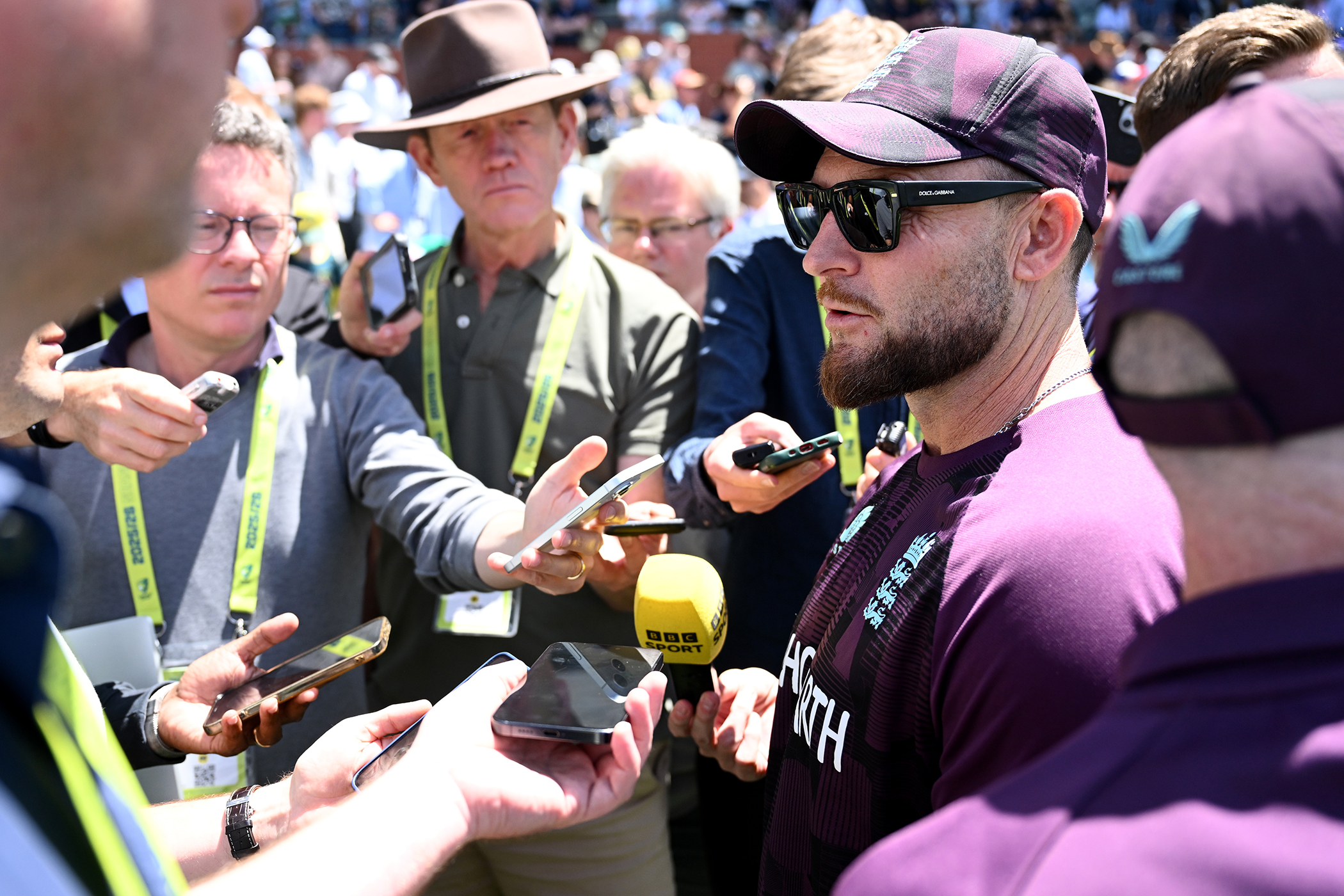



Now is the time of monsters, of reproach and retribution, of stories about England captains in nightclub scraps. It’s “thorough review” time, baby. Bazball is dead, brains splattered up the wall, except it actually isn’t, all the ringleaders still in post, the same players largely certain to keep their places. If it walks like Bazball and talks like Bazball, is it still Bazball?
Of course, jobs being lost after this series is not a requirement. Blood-letting is not the only viable form of accountability. England won their first Test in Australia for almost 15 years, even if this defeat hurts more than any of the previous three. There is a legitimate argument that this is where Test cricket is going, run-rates rising and defences falling, that in a country and sport rooted in repression and self-loathing, positivity and openness and a licence for occasional enjoyment don’t hurt.
The England and Wales Cricket Board reportedly plan to keep Rob Key and Brendon McCullum under the proviso they just do things completely differently, bring back the nerds and nutritionists and play warm-up games, neuter the Bazdog. Learn from your experiences, learn that everything you believe and hold dear is wrong. If you, Brendon McCullum, could just stop being Brendon McCullum, that would be ideal. Have you considered being Andy Flower for a bit?
“I am not against assistance but have a firm belief in how to get the best out of these players,” McCullum said after the defeat in Sydney. “Am I for being told what to do? Of course I am not. But at the same time, I’m not pig-headed [enough] to think there’s not some areas that we can improve on.”
Somewhere in here emerges the key question: why should McCullum keep his role? What are the potential gains, marginal or otherwise? Stokes effectively admitted they had been worked out, that teams knew how to beat them, on a downward trend for a while. What more does McCullum coach have to offer? His ideas have been espoused ad nauseum, to the extent any self-respecting chatbot could probably replicate them with remarkable accuracy. Don’t look back. Dream big, hit bigger. Nothing means anything. God is just dog backwards.
“Sacking him would be expensive and inconvenient” is not a valid reason, it’s an excuse to avoid doing the difficult thing, to admit that the Wizard of Baz doesn’t have any magic powers after all, he’s really just Jeff Goldblum with some levers and a big mask. And it’s worth pointing out that it would only be so expensive and inconvenient because the ECB appointed him multi-format head coach, a spectacularly uninventive and blinkered decision. It has laid out the obstacles, electrified the doorknobs and installed the trapdoors. It can’t now say there’s no way out.
As Stokes said after the fifth Test, a generation of talent risks being wasted here, sport’s greatest crime
As Stokes said after the fifth Test, a generation of talent risks being wasted here, sport’s greatest crime
We’re supposed to presume that the sight of McCullum with his feet ever higher on a balcony railing provides these players more than, say, deep data and adequate preparation and nutritionists. If the medium is the message, the medium constantly looks like it doesn’t give a shit, an illusion made even more frustrating by the fact it clearly is not true, just performative nonchalance. This is not the result of some overarching laziness. At worst it is industrial-scale incompetence.
There is a point at which hands-off management becomes a dereliction of duty, where an adherence to freedom at all times actually becomes restrictive, where constant positivity for positivity’s sake just removes all substance and benefit. Praise doesn’t mean anything if criticism isn’t an option, just vibes-noise that jars with what everyone, players included, can see in front of them. Relax, or else! No, Shoaib, you haven’t wasted two months of your life being here. You were so close to being picked. Will, that was actually a great shot, just poorly executed, which really represents how the leadership trio seemingly view everything that’s gone on: a great plan, great vision, just poorly executed. But by who, Chris Kamara?
If you sell enough of a dream that everything you do is part of some grand project with no fixed goal or endpoint, then you can always argue that everything is for the greater good, for some indeterminate future. And, of course, if you create a culture where there are no consequences, then consequences can’t get you either.
What do England gain from him and Stokes agreeing on everything? If your primary aim is to help this team excel under pressure, what happens when they collapse like a gingerbread house in the rain? Dread it, run from it, but pressure arrives all the same. At some point you just need to confront the beast head on. The challenge is learning to deal with it, not attempting the impossible job of removing it entirely.
Newsletters
Choose the newsletters you want to receive
View more
For information about how The Observer protects your data, read our Privacy Policy
And then, like death and taxes, we inevitably have to get on to accusations of a “stag-do” culture in the England team. A drinking culture? In cricket? Well I never. Harry Brook was fined £30,000 after being punched by a bouncer in a New Zealand nightclub the night before England’s final ODI, three weeks before the Ashes started. Ben Duckett was filmed seemingly not knowing where he was while in Noosa, on the team’s post-Brisbane break, which was in principle a completely reasonable way to spend their time. This is bad, but more a failure of leadership, a failure to properly protect the group from themselves, to set adequate boundaries.
As Stokes said after the fifth Test, a generation of talent risks being wasted here, sport’s greatest crime. England have some of their finest players since the 2010-11 side, genuinely elite batters from at least No3 to No7. Duckett, Jamie Smith and Brook have actively regressed. There is more than enough bowling skill to thrive if handled right, Josh Tongue the new attack leader having taken 18 wickets in three matches at 20.11, a similar rate to Mitchell Starc.
McCullum heads to the T20 World Cup next month, an early exit almost certainly meaning he will lose his job across all three formats. But reach the semi-finals or further, and it is hard to imagine him budging, content to return to the well, consider changes, and decide he was right all along. As is always the case in English cricket, accountability is just something that happens to other people.
Photograph by Gareth Copley/Getty Images