
There’s a story about a team meeting at Geelong, the Aussie rules football club, ahead of an early outing against Sydney at the Sydney Cricket Ground in the 1980s. Contoured for cricket, the ground was short but wide for football, and coach Malcolm Blight threw open the floor: “How do you think we should tackle the SCG?” Centre half-forward Billy Brownless had an idea: “Pick two spinners?”
That was the legend, back in the day. Slow bowlers have seldom had it easy in this country: since 1980, visiting tweakers have paid almost 50 runs a wicket here. Yet it was always possible to look forward to something at least mildly conducive in the final Test. No longer: only a vestigial reputation, sustained by the ground’s resistance of the trend to drop-in pitches, remains. Since 2018, spinners have paid more per wicket here than any other Australian ground; in the corresponding Test last summer, only ten overs of spin were bowled. That trend today reached its cruel conclusion, with neither team choosing a specialist slow bowler – Will Jacks being a part-timer, Beau Webster a part-time part-timer.
This despite an easy-paced surface with grass tonsured to 6mm and a five-day forecast warming from today. The year 1888 is being bandied round as the last time Australia leaned exclusively on speed, although that might depend on exactly what you imagine JJ Ferris to have bowled – Max Bonnell’s fine biography Something Uncommon In The Flight suggests a bowler of rather less than express pace, perhaps in the Derek Underwood category. Whatever the case, this can hardly be deemed a precedent; nor is it a coincidence, given that Australia have dispensed with slow bowling in four of their last half dozen Tests, while England toil not, neither do they spin.
The diminishing returns of spin in Australia are a story of long-term, broad-based decline, in inverse proportion to the ascendant of pace since the 1970s. In the 1960s, 40% of overs in Australia were delivered by slow bowlers; in the 2020s, it has been closer to a quarter. The retreat has been uneven and punctuated, but worsened by the reinforcement of the Kookaburra ball five years ago and the growing efficacy of wobble seam. As recently as the Ashes of 2017-18, the veteran Nathan Lyon was bowling 50 overs a Test; last season it was barely half that. This summer, even before Lyon was injured, it was less like he had been fired; more that his position had been made redundant. Thus, perhaps, the one-and-a-half-dimensional nature of these Ashes; thus, certainly, the insipid over rates.
Outside south Asia, spin bowling is in trouble. Cricket’s acceleration has made for fewer fourth and fifth days: games are expiring too quickly for spinners to have an impact. It is also a specialist occupation in an era that accents versatility, athleticism and deep batting. This leaves Jacks, a batter who could probably fill a top six position, as England’s uneasy steward of spin; it may tell against Matthew Kuhnemann, Lyon’s wing man in Asia these last few years, that he bats a little like his elder. Though he did not make the cut here, Todd Murphy does appear to have batting upside, averaging 18 in first-class cricket. He’d do well to work on it.
Going forward, it could become standard, as it has with wicketkeepers, that they must also be capable of scoring runs: India already provides multiple examples.
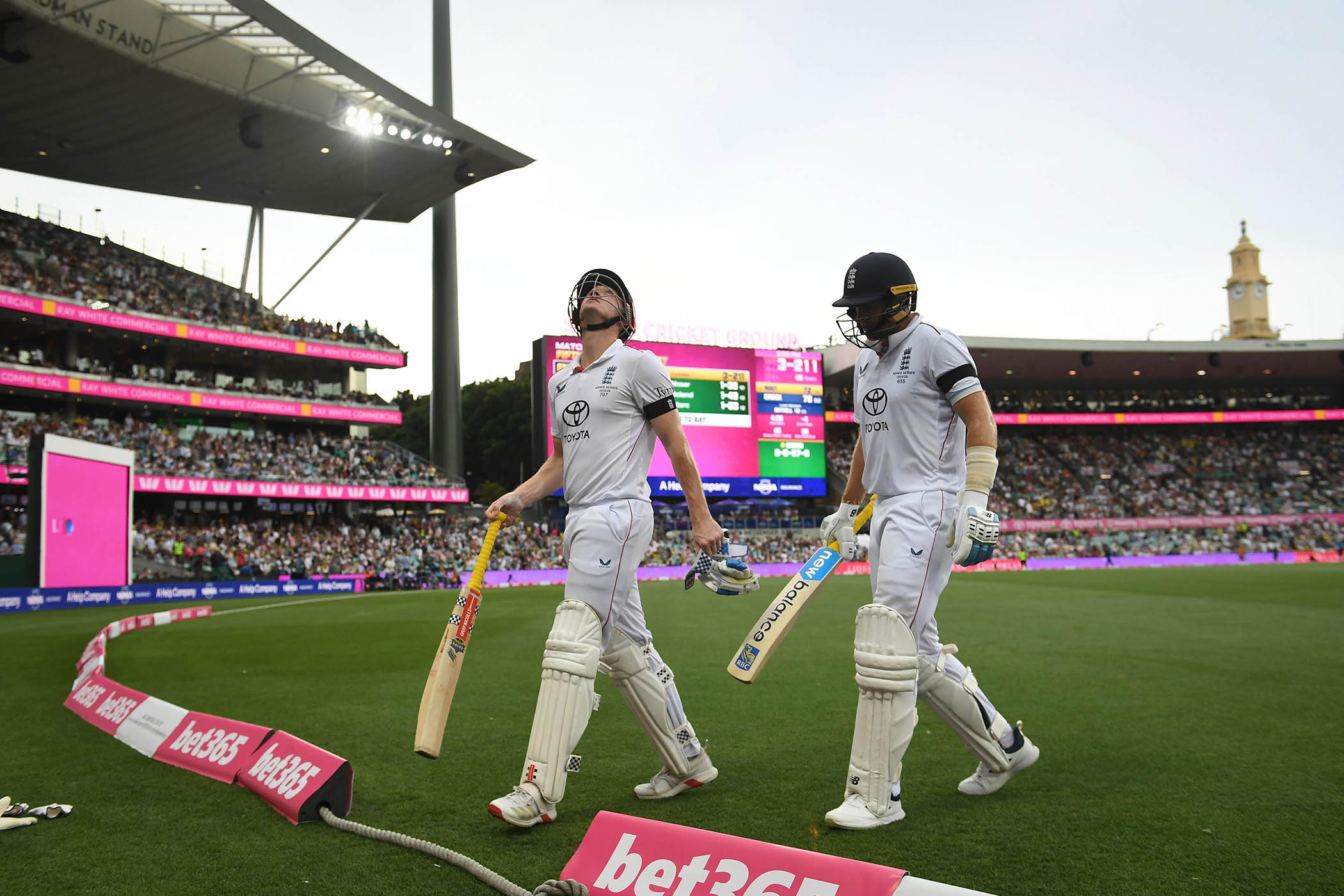
A spinner would certainly have been handy for Australia today after they lost the toss and conceded to England the opportunity to build an imposing first-innings score – an opportunity which, for once, the visitors took, even if Harry Brook at stages seemed determined to hand it back before the forecast storm took a hand, meaning only 45 overs were played. Everything competent England does in this Test will be inscribed with a sense of the belated in nature and the limited in impact. But it was a pleasure to watch Joe Root so smoothly in control against even Mitchell Starc, running in determinedly on a home surface offering him very little.
The willingness with which Steve Smith defaulted to a short ball policy, and the George Clinton funk levels of his field placings, cast further doubt on Australia's selection. For once this summer, all the bowlers will have their work cut out over the next few days; for once, captains may regret the lack of variety at their disposal.
Photograph by Philip Brown/Getty Images
Newsletters
Choose the newsletters you want to receive
View more
For information about how The Observer protects your data, read our Privacy Policy