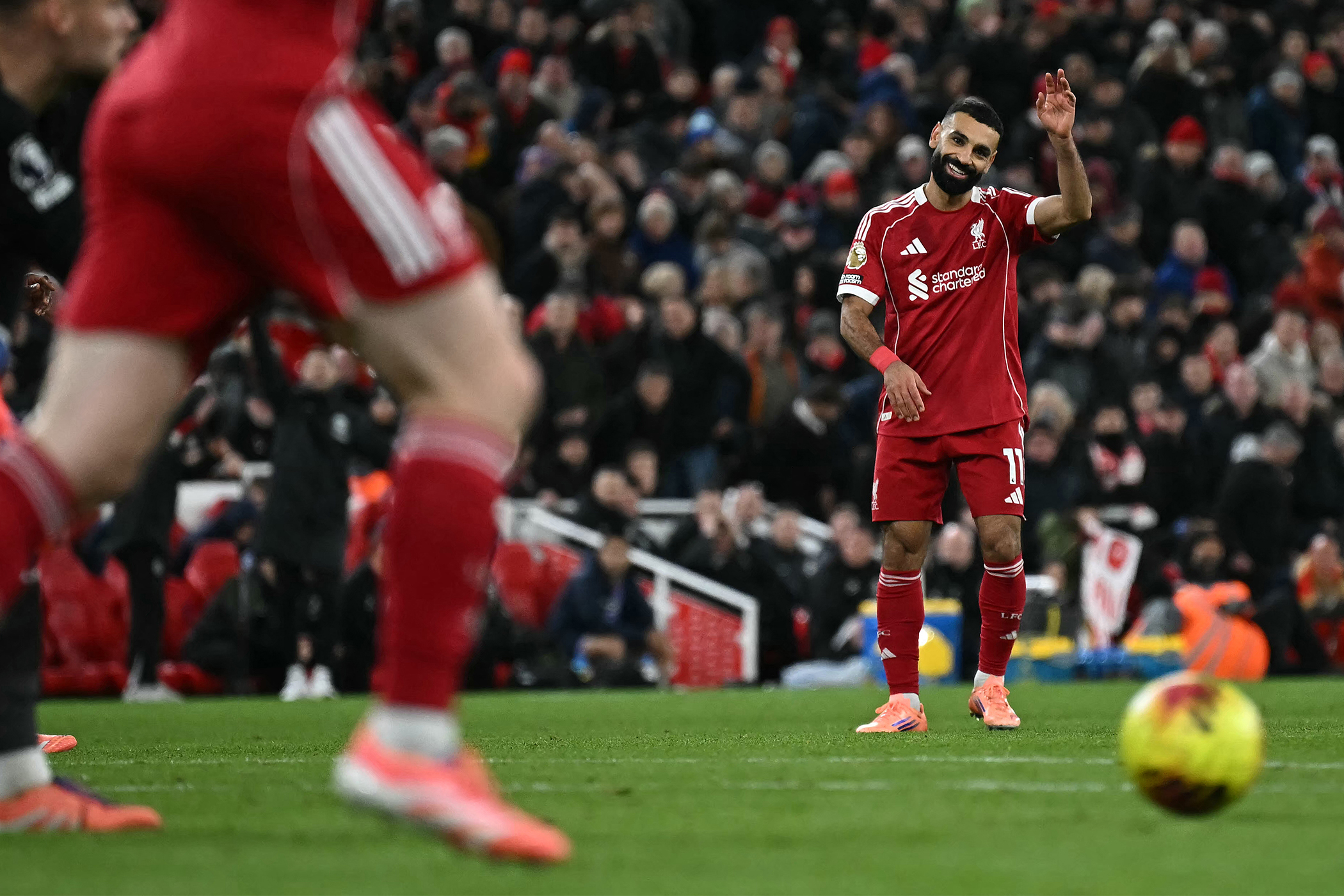

By the time he had finished the pleasantries – the post-match handshakes with his Liverpool teammates, and the consolatory hugs with their vanquished opponents – Mohamed Salah found himself, as he has so often in his time at Anfield, in the perfect position. He was standing in front of the Anfield Road End, the great swath of the pitch yawning in front of him. It was time to say goodbye.
Well, it was definitely time to say goodbye for a while. Anyone hoping for clarity on the issue that has consumed Liverpool in the seven days since Salah decided to vent his frustrations in the mixed zone at Elland Road was destined for disappointment. It was, instead, an afternoon of fuzzy ambiguity, of questions rather than answers. It may have been Salah’s bittersweet farewell. But it might also have been Salah’s see you later, be right back.
His lap of honour was distinctly enigmatic. It had felt, throughout, like this was the main event; the 100 minutes of football that had preceded it, resulting in a perfectly acceptable but broadly forgettable 2-0 win for Liverpool, was a warm-up act. The real action would begin on the final whistle. Football is a television show now; this was the promised resolution of last week’s cliffhanger.
And so, a camera operator trailing him every step of the way, Salah walked slowly and deliberately along the length of the stand named in honour of Sir Kenny Dalglish, soaking in and reciprocating the applause of the crowd. He came to a halt in front of the Kop, staring up its steep bank, his eyes seeming to glisten with just a hint of tears.
He did not, though, dally too long. He was there for a minute or so, no more. He turned and walked to the Main Stand, where his family – in attendance at his behest – were seated. He did not seem to spend a huge amount of time seeking them out. Ibrahima Konaté ran past him, topless, rather undercutting the solemnity of the moment. And then Salah walked down the tunnel, exchanging high-fives, an Egyptian flag draped over an advertising hoarding.
The exact nature of what we were witnessing is unclear. Everything about this afternoon was somehow blurred, a series of events that will be scoured for meaning with such ferocity that everyone will be able to find evidence of whatever they want to see. That is, of course, how it should be. For all of the Premier League’s telenovela qualities, it is not actually a soap opera. It is real life, and real life is chaotic and messy and compromised.
The circumstances of Salah’s introduction were testament to that. The question facing Arne Slot beforehand had been interpreted almost as a binary. Once named on the teamsheet, he could force his mutinous superstar to spend yet another game on the bench, a little further punishment pour encourager les autres.
Or, conversely, he could show magnanimity and allow him a few testimonial minutes at the end, a chance for both the player and his fans to share one final bout of mutual admiration before he sails off first for the African Cup of Nations and then for Saudi Arabia or Major League Soccer or Bayern Munich or wherever.
Nobody had really raised the prospect that he might be introduced as a 25th-minute substitute for Joe Gomez, Liverpool’s right-back. Given the anticipation, there was something vaguely anticlimactic about the whole thing.
His sudden appearance seemed to catch everyone by surprise. Salah had not yet had a chance to warm up, swiftly going through his shuttle runs after he had come onto the field; Anfield had not yet made its mind up how to react.
Newsletters
Choose the newsletters you want to receive
View more
For information about how The Observer protects your data, read our Privacy Policy
There was a ripple of applause – maybe for Salah, maybe Gomez, maybe both – and a brief rendition of the song that has soundtracked his eight years here.
That uncertainty echoed through the game. At one point, Anfield offered a chorus of his name and then, immediately afterwards, expressed their appreciation of Slot, as though the fans were keen not to be seen to be taking sides. They are, after all, caught in the middle; whether they agreed with the content or even the fact of Salah’s decision to vent his grievances in the mixed zone at Elland Road last week, their primary response has been sorrow at the idea of one of Liverpool’s modern greats being at war with the club itself.
The denouement was no less numinous. Salah did not dawdle for long enough that his intentions were apparent. He left – whether by accident or design – enough wiggle room that he might yet be able to return, late in January or early in February, and pretend nothing has happened.
Slot, for his part, has adopted an adroitly conciliatory tone in the past seven days. He had said he would speak with Salah before this game, one of a number of conversations between the two sides that have pockmarked the week.
How that tête-à-tête went he would not divulge, beyond asserting that “actions speak louder than what has been said.”
Salah was back in the squad, and then in the team; that should indicate that some sort of truce has been brokered. Salah created the second of Hugo Ekitiké’s goals, pointing to the Kop as he ran off to celebrate with his teammates. “When I had to make my first substitutions I brought him in,” Slot said. “And he performed as every fan, including me, would like him to perform.”
There is, as far as Slot is concerned, “no issue to resolve.” He will treat Salah “the same as any other player” when he returns from Morocco. Whether he will have the chance to do that, of course, he does not know. Nor does Salah, for that matter, or Liverpool’s executives, much less those fans applauding him from the pitch.
Wanting to leave and finding an acceptable exit route are separate things. Wanting him to stay and persuading him to do so, too.
In time, we will understand what this afternoon meant, what exactly it was. For now, as there has been for a week, we can only have questions.
Photograph by Paul Ellis/AFP via Getty Images