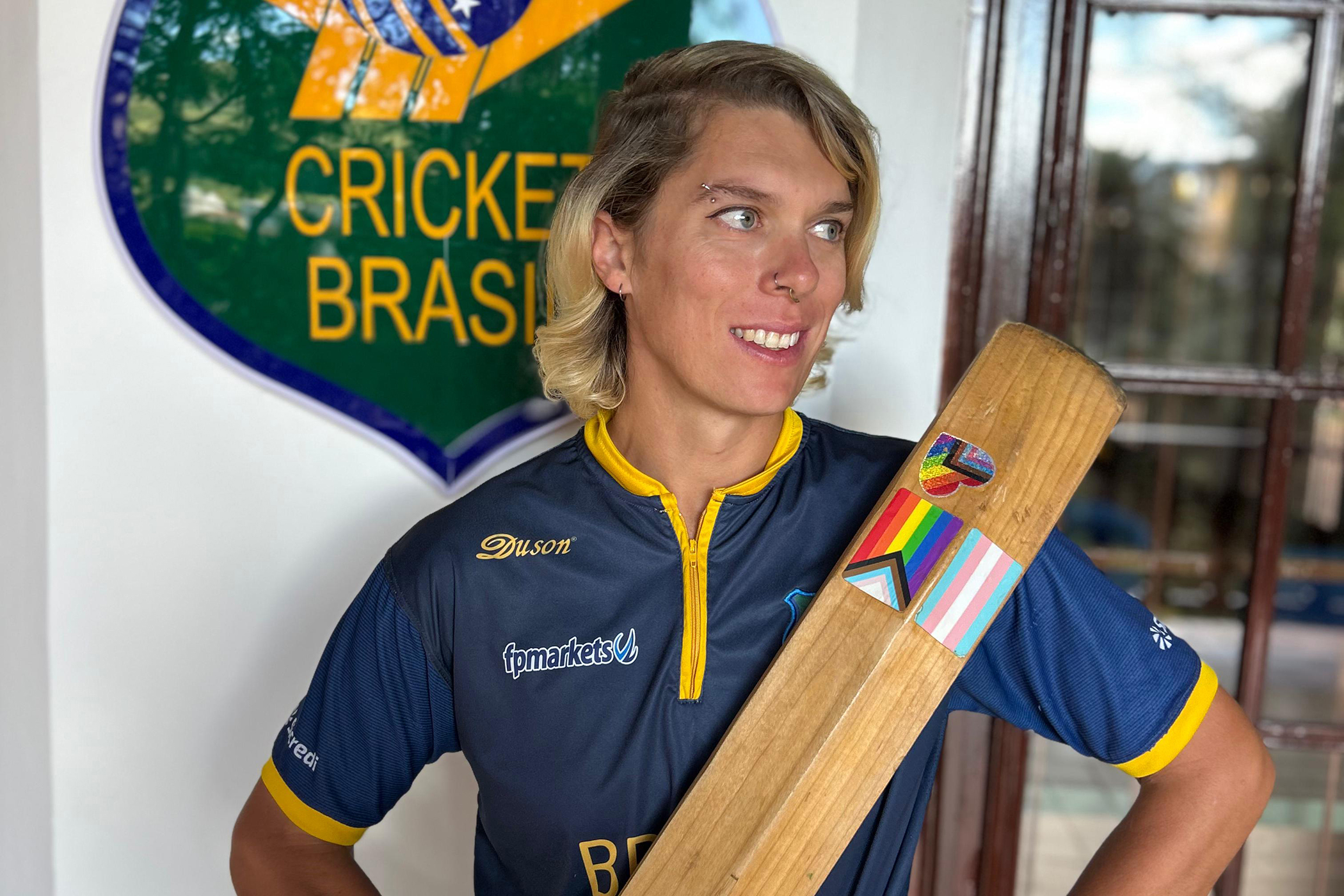

When a cricketer’s career ends, rarely, if ever, is it someone else’s decision. But for Danielle McGahey Ribeiro it was a stranger’s signature that forced her into early retirement overnight.
In September 2023, Australian-born McGahey Ribeiro became the first transgender cricketer to play in an official international match.Two months later, the International Cricket Council (ICC) barred transgender women, effectively ending McGahey Ribeiro’s career.
McGahey Ribeiro played six official games representing Canada in Los Angeles. She was the leading run-scorer at the 2023 Women T20 National Championship and scored the only century of the tournament.
In her own words, McGahey Ribeiro was “ready to throw in the towel” after the ICC’s decision, but a move to Brazil to live with her wife resurrected her cricketing career.
McGahey Ribeiro is now training to join Brazil’s men’s cricket team, a decision she has been worried about, fearing potential backlash.
“My biggest challenge is worrying about what the trans community will think of me playing with men,” McGahey said. “Sometimes I feel like I’m a sell-out. I want to be here for my community and right now this is the only way I can do it, it’s the only way to have a platform.
“I want to make it clear that if I could play women’s sport, I would. This isn’t through choice, it’s through regulation. I want to end my career on my own terms.
“There have never been any issues on the field. Everyone I’ve played against has always taken the field with me.
“I’ve also been on hormone therapy for five years and physically don’t have the same attributes as men, so that’s another challenge.”
In April 2025, the UK Supreme Court ruled the legal definition of a woman will be based on biological sex. One month later the England and Wales Cricket Board (ECB) banned transgender women from women’s cricket. In March, the International Olympic Committee (IOC) banned transgender women athletes from competing in the female category and introduced mandatory one-time sex testing.
Newsletters
Choose the newsletters you want to receive
View more
For information about how The Observer protects your data, read our Privacy Policy
“How long until our rights as trans people are completely removed?” McGahey Ribeiro asked.
“How long until I’m no longer the wife to my wife?
“The conversations are hard but that’s where we’re headed and with very little pushback. My identity could be erased with a politician’s signature.”
The IOC has had a long history of conducting sex testing, ranging from showing medical certificates, to physical examinations, to chromosome testing and testosterone-level testing.
In March, IOC president Kirsty Coventry announced eligibility for the female category would be determined by a screening test to “detect the absence or presence of the SRY (Sex-determining Region Y) gene”.
“Since Coventry was elected [as IOC president] last year, we knew this was coming,” McGahey Ribeiro said. “It’s the simplicity of the ruling that frustrates me the most. This ban will have a far greater impact than just trans women. That’s the unfortunate part.
“Some cisgender women will find out they have a Y chromosome or they’re intersex and that will be hard.
“They’ve grown up as women, played sport as women, faced all the disadvantages that come with that, reached Olympic level and now they don’t meet the IOC’s classification of what it means to be a woman.
“The ruling disproportionately also affects women of colour because they have a higher rate of DSD (differences of sex development).
“The IOC missed a huge opportunity here, they have the resources, data and global platform to lead large-scale, sport-specific research on this topic. Instead of investing in evidence, they’ve moved to a blanket ban policy, an easy way out. They could’ve made significant changes regarding trans athletes at elite levels, but chose not to.”
The IOC says its new eligibility criteria was introduced through the findings of its Working Group on the Protection of the Female Category, as well as “various IOC consultations, and consideration of recent developments, including in international human rights law.”
At the Paris 2024 Olympics, Algerian boxer Imane Khelif and Taiwanese boxer Lin Yu-ting found themselves in a contentious debate around gender regulations. Yu-ting was later cleared to continue boxing after undergoing a sex verification test.
It is unclear at this stage who will pay for the sex test, but a financial element would also impact players from disadvantaged communities if the cost is passed on to individual athletes.
McGahey Ribeiro socially transitioned to a woman in November 2020 and started medically transitioning in May 2021.
Since then, she has not seen her family, although she hopes to be reunited with her mother later this year. “It hasn’t been easy and I know it’s a big change for them. I guess they felt like they’d lost a child,” she said.
Throughout her life, McGahey Ribeiro has prioritised self-discovery. She’s wanted to do things on her own terms and now as she embarks on a new adventure, she hopes her story ignites inspiration in others.
“If someone had told me to just be myself, things could’ve looked different in my life,” she says.
“As long as I’m here, I’m going to continue fighting everyday for our community. “We deserve love. We deserve rights. We deserve respect.”