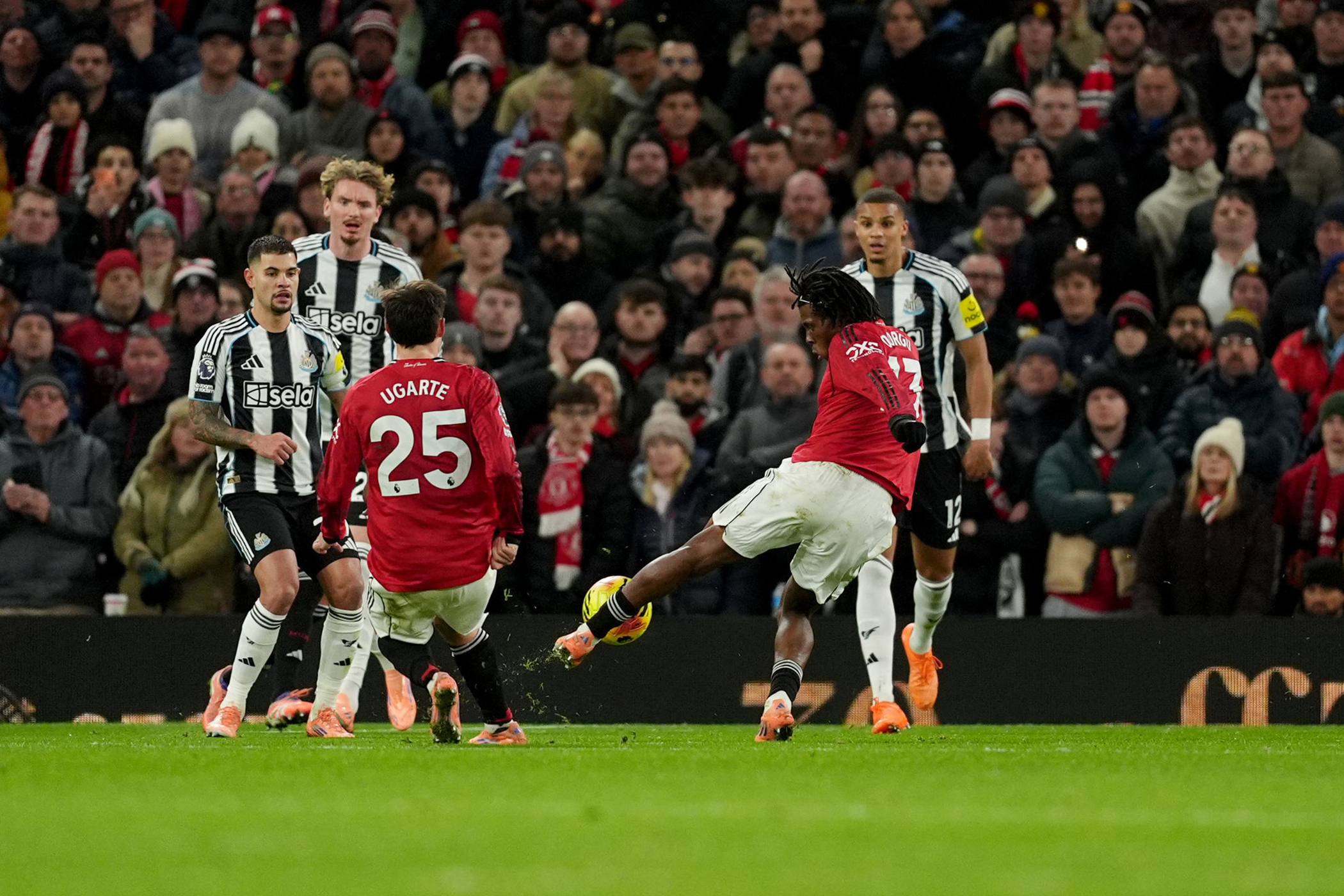

The most eloquent description of the win that sent Manchester United – temporarily, at least – into the Premier League’s top five came from Old Trafford itself. There had been groans when Sam Barrott, the fourth official, revealed there would be seven minutes of injury time. The whistles began with a couple of them left to play, encouraging his line manager, Anthony Taylor, to put everyone out of their misery.
It would be hard to imagine a more fitting manner for United to draw a line under their 2025. Ruben Amorim’s team started the year in 14th place, in the full flush of a crisis that had seemed to undermine his reign almost from the beginning. Beating Newcastle meant that they ended it in the thick of the race for the Champions League. That is progress: material, concrete, palpable.
Watching it, though, that all felt vaguely like cognitive dissonance. Even in the leaner years of the last decade at Old Trafford, there can have been few games in which United have been so pinned back, so penned in; the second half, in particular, seemed to take place almost entirely in the hosts’ half. United’s patchwork team showed commendable resolve, but that Newcastle did not score was testament more to their own shortcomings than United’s strengths. The abiding emotion, when Taylor eventually did call time, was not triumph. It was relief.
Amorim could, it should be pointed out, cite legitimate mitigating circumstances: injury and the Africa Cup of Nations had stripped his team of half a dozen regulars, including the talismanic Bruno Fernandes; after all the farrago over his treatment of the fruit of the club’s fabled academy, he named five homegrown teenagers on his bench, brought two of them on, and still found a way to win. It would take an act of extreme scepticism to paint that as anything but a positive.
And yet it is impossible not to notice that whatever progress Amorim has made in his year and loose change at Old Trafford is, if not quite an optical illusion, then certainly dependent on a certain amount of squinting.
A couple of weeks ago, a table did the rounds on social media, showing the Premier League since Amorim arrived. United were 14th. In one light, beating Newcastle was the game which sent a surging United into fifth. In another, it was their third win in nine matches, their first victory at home since October, against a team that has now scored seven goals in nine games away from home. Are they improving? Probably. Are they good? Kind of. Sometimes. Maybe. What do you mean by ‘good’?
Over the last year or so, the league has become chronically unpredictable; almost every team is inconsistent to the point of instability
Over the last year or so, the league has become chronically unpredictable; almost every team is inconsistent to the point of instability
That uncertainty, that sense that they are a sort of Schrödinger’s football team – both good and bad, encouraging and disappointing, recovering and stagnating, all at the same time – does, at least, make this particular version of Manchester United a perfect avatar for the current incarnation of the Premier League.
The sudden fixation on set-pieces might be the top flight’s most eye-catching characteristic of 2025, but its defining trait has been different. Over the last year or so, the league has become chronically unpredictable; almost every team is inconsistent to the point of instability. Prior to this weekend, there were exactly two teams who could be said to be in form: Manchester City, on a run of seven straight wins, and Aston Villa, victorious in 10 of their last 11. A generous definition of the term might allow Arsenal into that select group, although four wins in seven is not exactly imperious.
Outside of that select group, only two teams had managed consecutive wins in the run-up to Christmas. Those sides were Liverpool and Fulham. Neither quite fits the traditional definition of “in form.” Everyone else has lost at least once in their last three, other than Chelsea, Bournemouth and Leeds. Two of those are in the bottom six.
The roots of that phenomenon seem fairly apparent. As tempting as it is to decry this season, like every season, as proof that the league is not what it once was, the reality is the opposite. Every single one of the Premier League’s 20 constituent clubs is now one of the richest in the world; almost all of them have access to the sort of talent that even the grand houses of the continent would envy. Set-pieces have become increasingly significant, in part, because this is now a league of impossibly high standards and equally fine margins.
Newsletters
Choose the newsletters you want to receive
View more
For information about how The Observer protects your data, read our Privacy Policy
The consequences of it, though, have perhaps not quite been grasped. The top three and the bottom two apart, almost every team now exists in a state of permanent flux. Everyone is on the cusp of both Europe and relegation. Whether a side is in crisis or bursting into form changes every week. Everyone is both good and bad, often at the same time. Forget a Schrödinger’s club; United have come to embody what is now a Schrödinger’s league.
That might seem to be perfect for what football has become in the digital era: source material for talking heads and hot takes, where winning, as the Screen Rot podcast has put it, is defined not by what happens on the pitch but by which team has the most convincing representative on The Overlap: Fan Debate. The league has contrived to produce a reality in which, to misquote Peter Pomerantsev, nothing is true and everything is possible; you can cherry-pick information to defend basically any position imaginable. You can see whatever you need to see to produce the content that your audience needs to hear. But it also creates a problem; noise, after all, is a form of pollution. It takes what can be a painstaking, fiendishly complex process and exposes it to extreme pressures. That can accelerate it, supercharge it, but it can also destroy it. Which way it will go for Amorim remains almost as unclear, at the start of 2026, as it did at the beginning of 2025. United might be better than they were. They might not be. Just as it does for the rest of the Premier League, it depends when you look, how you look, and what you want to see.
Photograph by Martin Rickett/AP