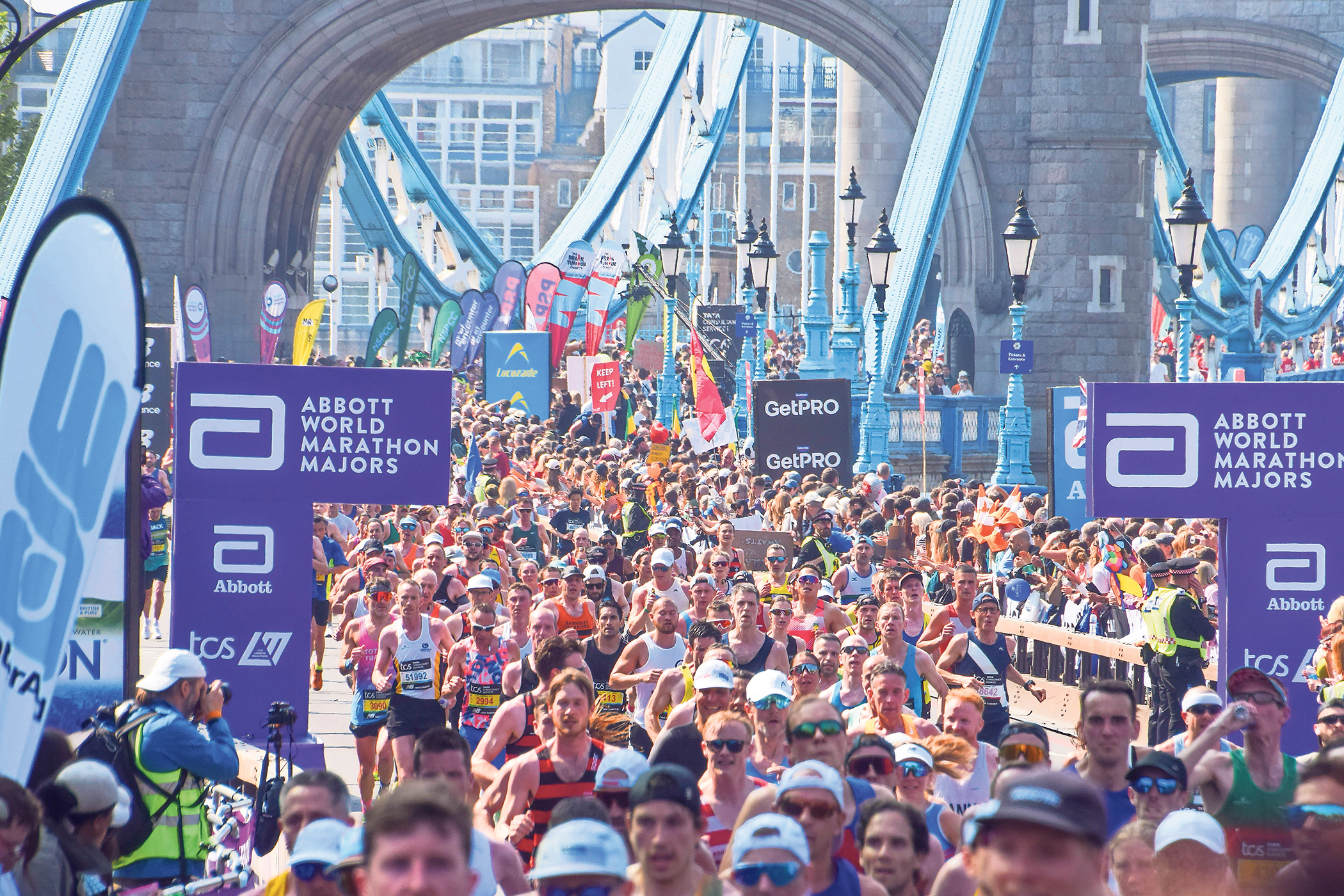
London Marathon organisers are expecting more people than ever before to complete the event this Sunday. With an estimated 59,000 people hoping to cross the finish line on the Mall, and a record 1.1 million having entered the ballot to have the opportunity to do so, the running boom is showing no signs of slowing down.
Nothing better demonstrates the ever-increasing popularity of the marathon than the way in which ballot entries have doubled since 2024.
The demand is so great that the hope is there will be two London Marathons next year, with races on the Saturday and Sunday. While plans are not confirmed yet, London Marathon Events CEO, Hugh Brasher, is optimistic.
The idea is that the double Marathon weekend will be a one-off for 2027, but London Marathon Events, the company that organises the marathon, is continuing to expand. Not content with organising events like the Brighton Marathon and Bath Half, it announced at the start of the month that it had bought Motion Events, which organises the Frankfurt Marathon, among others.
Brasher is bullish that the enthusiasm from the masses for running 26.2 miles is only going to continue. He cites fears over AI, as well as the unstable global situation, as pushing people towards exercise.
“Having this ‘IRL’ experience is what the world needs more of. People are reaching out for more,” he says. “We need more of that community spirit and more of that togetherness.”
Whatever it is driving people to start lines across the country, the boom is big business. Entries to the marathon cost £79.99 and London Marathon Events turned over £59.7m in 2024, up from £48.8m in 2023.
Yet this is not a simple profit-making exercise. Even leaving aside the huge amount of money raised for charity – Brasher believes £130m could be raised across a double marathon weekend – money is also funnelled back into the elite level of the sport. The winner of each race will receive $55,000 (£40,500), with additional bonuses of $150,000 for any man who runs under 2hours 2mins or any woman under 2:15. A world record would bring a further $125,000.
“So many athletes want to run a marathon in terms of an elite because the pay is so much better than running on the track,” Brasher says. “Build the base, you’ll build the top.”
More marathons does mean more competition for the elite athletes, too. The physical demands of the distance mean that athletes rarely race more than two a year. The World Marathon Majors have expanded to seven, adding Sydney to the existing list of New York, Chicago, Boston, London, Tokyo and Berlin, with more likely to come, alongside a newly launched European Marathon Classics series.
Newsletters
Choose the newsletters you want to receive
View more
For information about how The Observer protects your data, read our Privacy Policy
At London this year, the rivalry to keep an eye on is between Sabastian Sawe, of Kenya, and Uganda’s Jacob Kiplimo. Sawe was last year’s winner, with Kiplimo finishing a little more than a minute behind. Since then Sawe has gone on to win in Berlin, while Kiplimo won in Chicago and set the half-marathon world record of 57:20 in Lisbon.
Tamirat Tola, Ethiopia’s 2024 Olympic gold medallist, will hope that he can upset the applecart, while Germany’s Amanal Petros, who finished second at last year’s World Championships, has his eyes on the European record of 2:03:36.
On the women’s side, there have been some significant withdrawals, including fan favourite and 2023 champion Sifan Hassan and 2024 champion Peres Jepchirchir. Tigst Assefa is back after winning last year and breaking the women only world record, and she is hoping to go even faster. One intriguing London debutant is Kenya’s Hellen Obiri. The 2024 Olympic bronze medallist, Obiri has been incredibly successful on the other side of the Atlantic, winning both the Boston and New York City marathons twice. Her personal best is significantly slower than Assefa’s but she has never run a marathon that permits the use of pacemakers, as London does.
When it comes to British hopes in the men’s race, Patrick Dever is an interesting prospect. The America-based athlete ran his first marathon last year in New York and ended up being awarded third after the original third-placed finisher Albert Korir was banned for doping. Phil Sesemann and Mahamed Mahamed will be battling it out with Dever to be the fastest British man.
Eilish McColgan will be one of the most recognisable elite runners as she makes her second attempt at the marathon after finishing eighth last year. Rose Harvey is the fastest British woman over the distance to be competing, while Jess Warner-Judd is returning to the marathon following a break from competitive running after being diagnosed with epilepsy.
Photograph by Vuk Valcic/SOPA Images/LightRocket via Getty Images