
Related articles:


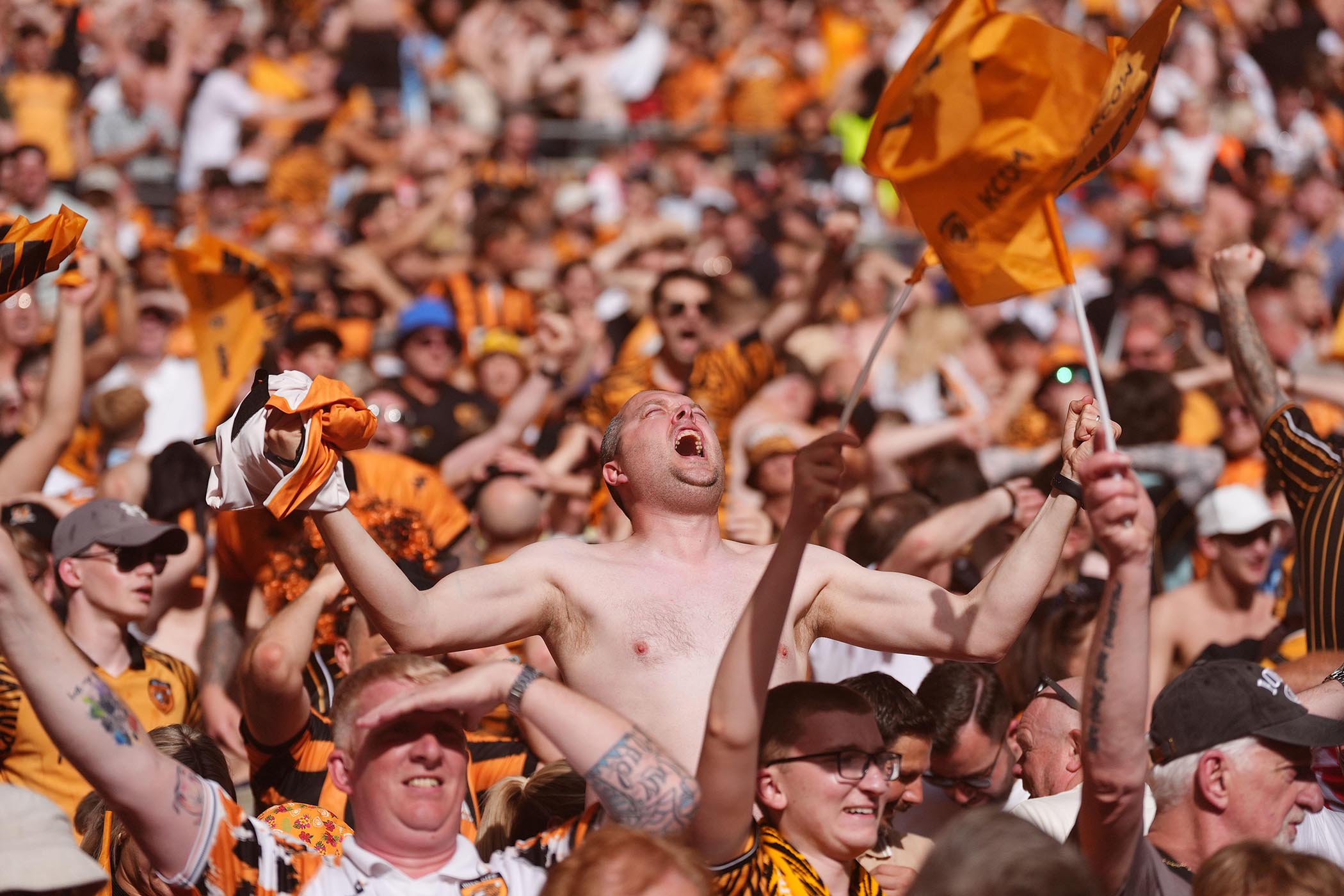
On the pitch, Oli McBurnie tore his shirt from his shoulders and cast it aside, as though the very existence of clothing might constrain his joy. As his teammates swamped him, swarmed him, Cody Drameh beat his fists against the turf, releasing the tension not just of the previous 94 minutes but the last two weeks. In the stands, Hull City’s fans melted in sun-drenched ecstasy.
But nowhere will the celebrations at the injury-time goal that ended Hull’s nine-year exile from the Premier League have been more frenzied, more sincere, than in the offices of the EFL. The will-they, won’t-they playoff final – a game that encompassed two independent investigations and a couple of legal hearings – was conclusively, indisputably over.
Barely an hour before the game started, that was not guaranteed. His team safely ensconced inside Wembley’s dressing room, Hull’s owner, Acun Ilıcalı, had raised the spectre of legal action should his team lose to Middlesbrough; the EFL’s decision to reinstate them in the wake of Southampton’s ejection was an “incredibly wrong decision.” Whether that would have worked or not – Middlesbrough’s presence was consistent with precedent; it is what happens, for example, when a team fields an ineligible player – was immaterial.
It is not much of an exaggeration to suggest that Hull pursuing promotion through the courts would have risked unravelling the ever-fraying strands that hold English football together.
There has, unquestionably, been a dark comedy to the scandal that disgraced Southampton and overshadowed the EFL’s showpiece occasion, the game that likes to style itself as the richest in football.
The details are too absurd in some fundamental way not to be sort of funny: the grainy image of an operative hiding in a bush, filming on an iPhone; the account, revealed in the EFL’s report, that he had run away when confronted, and then changed his clothes in a golf club toilet before fleeing the scene; the use of the word “espionage” to describe something that sounded so tinpot, so low-rent.
But that should not obscure the fact that Spygate – or more accurately Spygate II: The Sequel, Marcelo Bielsa having directed the original during his time at Leeds – was a serious transgression, not just on a sporting level but on a moral one, too.
Most immediately, as the independent report into the incident found, there was the pressure placed on junior employees to carry out instructions that they knew to be wrong.
Related articles:
“Such staff were in a vulnerable position without job security and with limited ability to object to or resist the instructions that were given to them,” the report wrote. This is an egregious abuse of power and a profound failure of care, one with a very real human cost.
More broadly, though, the whole incident has laid bare just how fragile football is as a construct, how reliant it is on everyone involved not just adhering to the rules as they are written – no matter how draconian or illogical they might occasionally appear – but doing so in good faith. The alternative, as we have seen over the last couple of weeks, is a sport that is settled by writ. That end point, the one McBurnie’s goal averted, is chaos.
Newsletters
Choose the newsletters you want to receive
View more
For information about how The Observer protects your data, read our Privacy Policy
Southampton do not deserve much credit from a mess entirely of their own making, of course, but the club did belatedly have the decency to accept the failure of their appeal against the EFL’s sanction on Wednesday night. They did not attempt to take it further, to seek an injunction against this game taking place at all, to find a higher legal arbiter that might give them what they wanted.
In the most trying circumstances, the EFL have managed to come out of the last couple of weeks with credit
In the most trying circumstances, the EFL have managed to come out of the last couple of weeks with credit
But what if they had? What if we had to wait until the High Court decided who was promoted? What if Wrexham had decided that the £120m on offer for promotion was worth a speculative legal challenge? And what if Hull had lost at Wembley, as it looked like they might for most of the first half and at least some of the second, and Ilıcalı had challenged that? The Premier League starts on 22 August, the Championship two weeks before that. The wheels of justice grind slowly. Would the season start?
This is one of the unspoken and vaguely uneasy covenants that govern sport: that it is a bespoke ecosystem ruled by its own conventions, rather than the literal law of the land. Subject most of it to actual legal scrutiny and it has a tendency to fall apart; all of it, after all, is man-made, held together by little more than the string and glue of tacit consensus. Football is, in that sense, an act of faith.
For that to hold, though, it requires everyone involved to believe, to accept, to acquiesce. That applies no matter how serious the offence seems to be: chemical doping, financial chicanery, standing in a bush to film a training session. As soon as a thread is pulled, as soon as someone decides the rules are not to their liking and that justice, as they see it, is not being done, there is a risk that the whole thing unspools.
In the most trying circumstances, the EFL have managed to come out of the last couple of weeks with credit. Their decision was swift, efficient, emphatic. They have made it clear their rules matter and they will enforce them; there are other leagues in this country that might like to take that on board.
They should be excused a degree of relief, though, that McBurnie intervened, so they did not have to prove it again.
Photograph by PA Images /Alamy