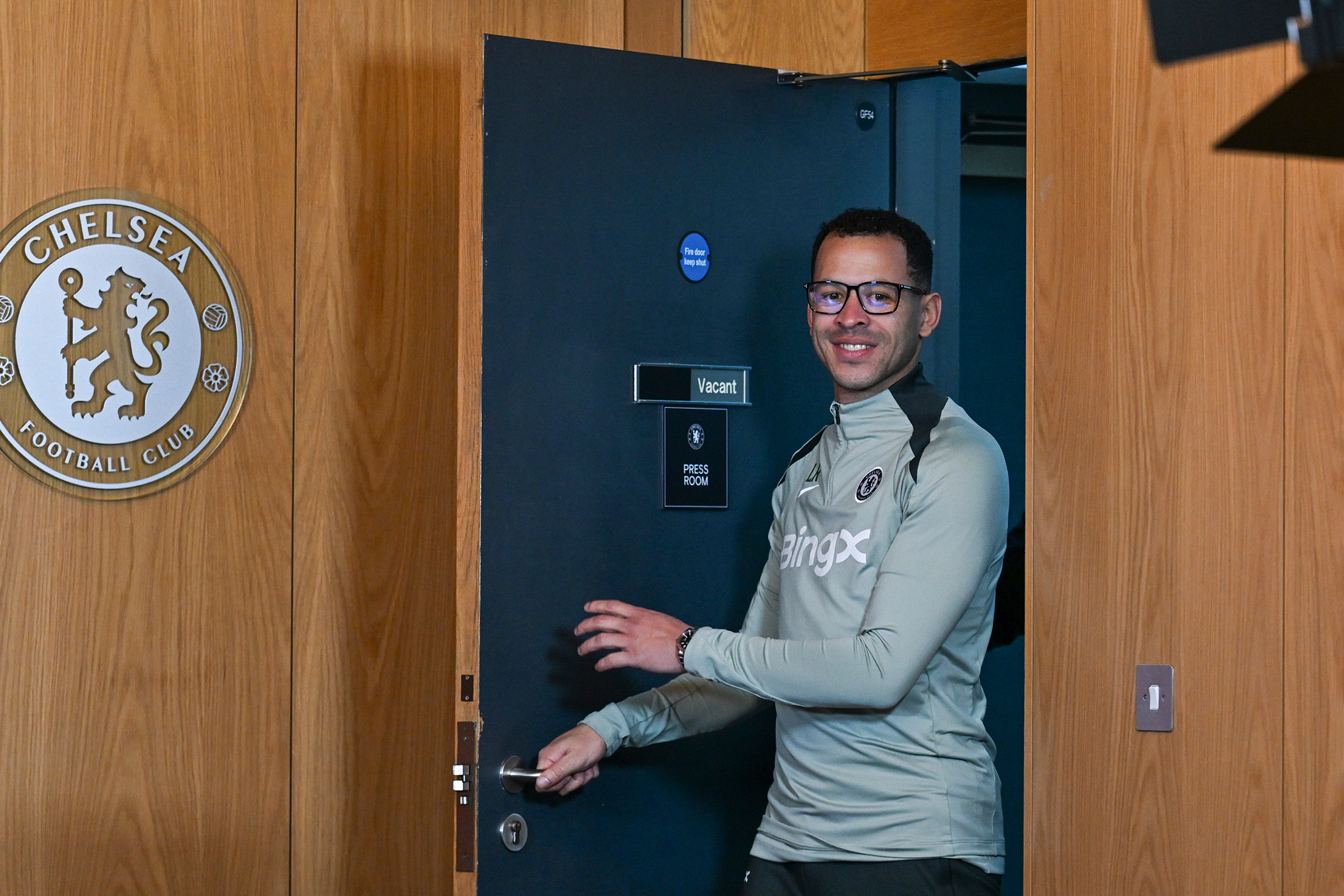

Marc Keller’s version of events would be compelling were it not for one glaring omission. As far as Strasbourg’s president is concerned, his club losing their promising young manager, Liam Rosenior, to Chelsea was deeply unfortunate. In his telling, though, it was also entirely unavoidable.
Rosenior, he told reporters this week, had been fielding interest from an unnamed Champions League club all season. That rings true: the 41-year-old’s stock had risen considerably in his two seasons in Alsace; he had become one of the most coveted young coaches in Europe. Strasbourg had, despite that, persuaded him to stay.
That changed this week, when Rosenior admitted to Keller that he was tempted by the idea of taking charge at Stamford Bridge. “I sensed a coach who dreamed of an opportunity in the Premier League,” Keller said. “I sensed a man who wanted to be closer to his family.” He had no choice but to “sit down and talk, because Liam Rosenior wanted to go to the Premier League”.
This is, in other words, just European football’s long-established food chain in action. It is the natural order of things. Striving, middleweight clubs like Strasbourg are inevitably vulnerable to the game’s apex predators; they must, at times, “adapt” to that reality. “Now, do you think I’m happy about it? No. This situation was neither planned nor desired by the club,” Keller said.
The problem, of course, is that the inner logic of Keller’s account depends on a very specific interpretation of the word “club”. He might not have wanted it to happen. The club’s fans, or at least a majority of them, certainly did not. But it is not, ultimately, possible to say the same of their owners.
In England, at least, Rosenior’s appointment has been presented – variously – as Chelsea recruiting from their “sister” club in France, or turning to their feeder team in their hour of need, or even, in some sense, promoting someone from within the network that BlueCo, their mutual owners, have established.
Perhaps, then, it is better to present the departure of Rosenior like this: last week, the owners of Strasbourg made a conscious decision that is very clearly – as even Keller admitted – not in the best interests of their club.
“What happened last Thursday was really disrespectful to the club and the institution of RC Strasbourg,” Maxime, a spokesman for Ultra Boys 90, the team’s main ultra group, said in an interview with The Observer. (Like most ultras, he spoke on condition of relative anonymity.) “It is the perfect example of why we were worried at the very start. It confirms that this [model] is not good for our club.”
That is not, of course, how Chelsea – or, more accurately, BlueCo – would present it. It was only because of BlueCo, which bought a majority stake in Strasbourg in 2023, that Rosenior was at the club. It was BlueCo which provided the finances that enabled the team to finish seventh last season, earning a place in the Uefa Conference League. It was BlueCo which has sent the likes of Andrey Santos, Angelo and Kendry Páez to the Stade de la Meinau on loan, and enabled the recruitment of Ben Chilwell, Julio Enciso and Valentín Barco.
All of it pales into insignificance compared with the broader meaning of the situation: that Strasbourg now do not exist for themselves.
All of it pales into insignificance compared with the broader meaning of the situation: that Strasbourg now do not exist for themselves.
Losing Rosenior in the middle of the season might not be ideal, in other words, but Strasbourg would not have had a manager so promising were it not for the link to Chelsea. As Keller was at pains to stress, the “balance of the relationship” between the two clubs has been “very, very positive” for Strasbourg.
Newsletters
Choose the newsletters you want to receive
View more
For information about how The Observer protects your data, read our Privacy Policy
That argument, though, is underpinned by the belief that all that matters is success, almost at any cost. It is a view that has long been orthodoxy in the Premier League, where the ambition of an owner is weighed in currency, where regulations designed to limit spending are seen as oppressive, where football is essentially seen as Darwinian.
But it is not a view that is universally accepted, either in England or, in particular, on the continent. At Strasbourg, the cost of acting as “subservient” to Chelsea – as a statement from the club’s supporters’ group put it this week – is seen by some fans as far greater than any benefit.
“When BlueCo bought us, we were a well-run club,” Maxime said. “We won the Coupe de la Ligue in 2019. We finished sixth in 2022. We maybe couldn’t buy the best players, but we were really proud of what we were. We had done it all under our own forces.”
The ultras objected immediately to BlueCo’s takeover – “it is written,” Maxime said, “that we protect popular football” – and have protested consistently for the last couple of years, refusing to sing for the first 15 minutes of games. It is not a measure that everyone supports; Maxime acknowledged that the issue has divided the club’s fanbase.
That this new version of Strasbourg qualified for Europe is not, in their eyes, relevant. Nor is the quality of players who pepper their squad, or that BlueCo has replaced Rosenior with Gary O’Neil, or even that it paid Strasbourg compensation for the loss of their coach.
All of it pales into insignificance compared with the broader meaning of the situation: that Strasbourg now do not exist for themselves. Instead, as the left-wing politician Éric Coquerel has put it in a bill designed to ban French teams being part of multi-club models in the future, the club are now a “vassal” of Chelsea.
This week, to Strasbourg’s ultras, has proved that beyond doubt. Their hope is that some good can come of it, that more fans will “open their eyes” to what has happened to their club.
“The issue is bigger than us,” Maxime said. “We are against multi-club ownership anywhere.
“Ours is almost a caricature of it, as though BlueCo have wanted to see what the worst way they can do it might be. I would be more proud if we were in mid-table, on our own strength, with our own values, than to be successful as a second team. The objectives for Strasbourg are not our own. It is for Chelsea to win titles.”
Photograph by Darren Walsh/Chelsea FC via Getty Images