
Pierre-Emile Højbjerg is not the only example, but he may be the best. Plenty of his team-mates at Marseille would also fit the bill. His manager, too. Their names are instantly familiar, but their faces hover on the edge of memory. The Premier League’s cultural gravity gives the club’s teamsheets the vibe of a real-life where-are-they-now quiz.
Some are deeper cuts than others. Roberto De Zerbi is still prominent enough that he was this week linked with the Chelsea job. Pierre-Emerick Aubameyang was a bona fide superstar, first at Arsenal, then sort of at Stamford Bridge, but remains a household name. Emerson Palmieri, like Højbjerg, is more of a seasoned mainstay. Nayef Aguerd is one for the true heads. Matt O’Riley may find his Premier League years are still to come.
Regardless of their individual legacies, the combined effect of seeing so many of them gathered together in Provence has been to afford Marseille the status of a Premier League retirement village, a place where players deemed to have outlived their usefulness by England’s top flight can be safely put out to pasture.
So goes the English perspective, anyway. It is a compelling one, a clear illustration of the power balance in European football, one of the continent’s grandest institutions reduced to operating in the Premier League’s shadow.
But there is an alternative viewpoint, one best encapsulated by Højbjerg. Combative and industrious, the Dane made more than 300 appearances over the course of his nine years at Southampton and Tottenham. When he moved, initially on loan, to Marseille in 2024, common consensus held that he had been run into the ground.
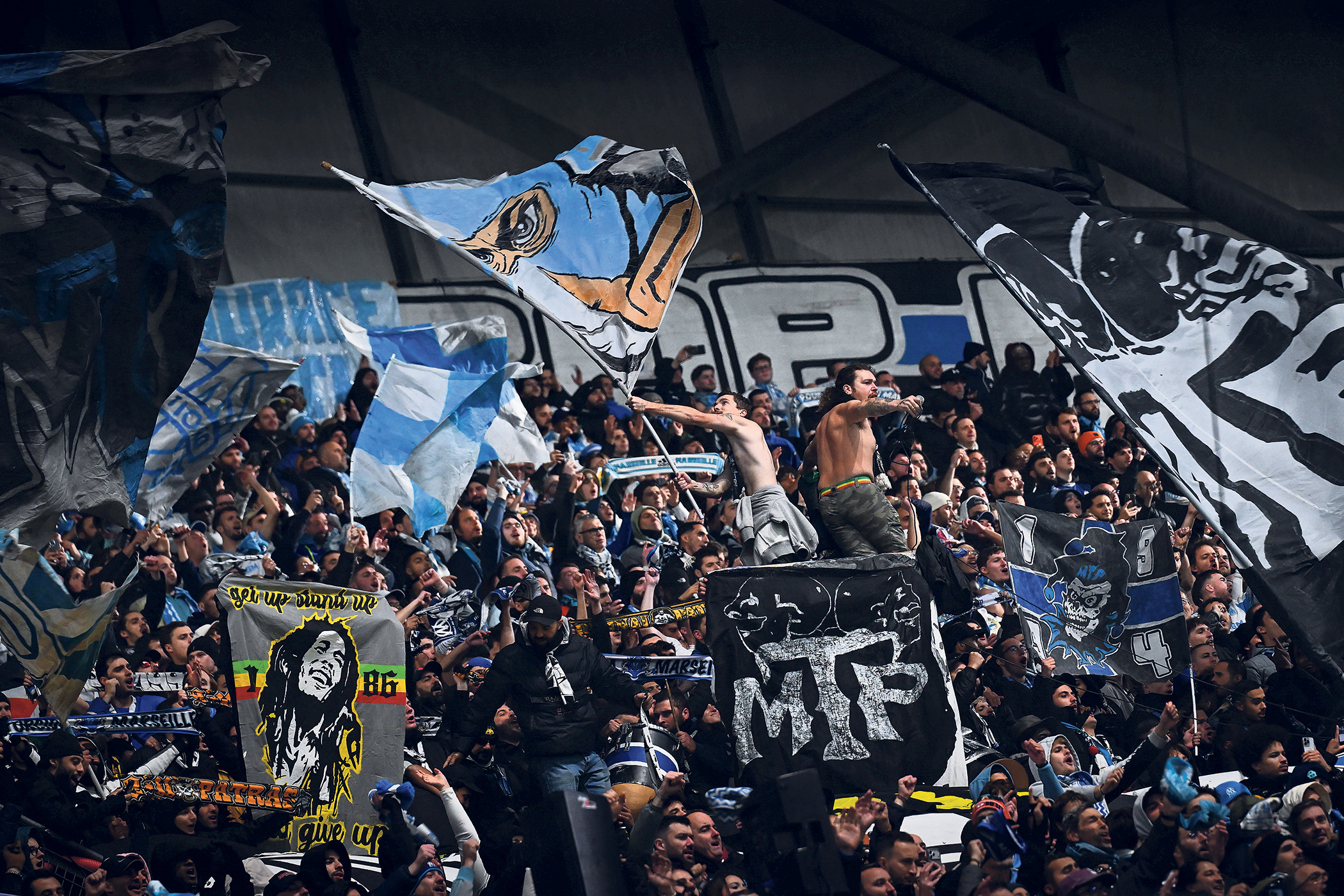
Marseille, though, did not see the miles in his legs as evidence of exhaustion, but proof of experience. At a club who have always been one of European football’s great exceptions – a little more volatile, a little more capricious, a little more untamed than most – that is a precious trait. Signing Højbjerg, and his fellow Premier League alumni, was not designed to change that, but to acknowledge it, an expression of self-awareness.
“We need players who have passed through all sorts of situations before,” said Pablo Longoria, the club’s president, in an interview last month. “They need to be of a certain level to deal with that pressure. We need a mix: experience and stability, as well as a little ingredient of craziness. We need charismatic players alongside our younger ones. We can’t have players who freeze.” Sitting in his office at La Commanderie, Marseille’s training base, Longoria returns to that theme more than once. He talks about stability as others might discuss enlightenment, or nirvana, or the concept of Zen. The idea of equilibrium is, in Marseille, not too far off a holy grail.
It is not especially hard to see why. Chaos, at times, seems to be endemic at Marseille. Occasionally, it is entirely self-inflicted: the city’s mayor called the club’s decision to sign Mason Greenwood in 2024 a “disgrace”; the morality of that deal prompted protests from a number of the club’s fan groups. Greenwood left Manchester United in August 2023 after an internal investigation into his conduct. He was arrested and charged with attempted rape and assault, but the charges were dropped in February 2023.
At other times, it is organic. In Longoria’s five years at the club, he has seen two coaches quit at least in part because of threats from the club’s own fans: Andre Villas-Boas in 2021 and then Marcelino, after just seven games, two years later. Longoria almost left at that point, too, only to be convinced to remain by the club’s American owner, Frank McCourt. When he says that Marseille boast a “South American atmosphere, but in Europe,” he means it as a compliment, but he knows it doesn’t always feel like one. Not all of Marseille’s potential sources of instability are quite so bespoke. In many ways, the club’s current reality is no different from much of the rest of European football. Marseille’s place in the game’s ecosystem has been shifted by the arrival of state ownership, the primacy of the Premier League, the rise of the continent’s superclubs. Their finances were decimated first by Covid, and then, like the rest of French football, by the collapse in Ligue 1’s broadcast deals.
“When Frank invested [in 2016], the thinking was that there would be the same level of growth [in France] as in the rest of Europe,” said Shéhérazade Semsar-de Boisséson, the chief executive of McCourt Global, the holding company that owns the club. “If you look at the data, that has not happened.” Even with the pandemic, she said, “Ligue 1 is some way below the others.”
Newsletters
Choose the newsletters you want to receive
View more
For information about how The Observer protects your data, read our Privacy Policy
That has only become more pronounced; without a domestic TV deal in place for this season, the clubs of Ligue 1 were forced to launch their own streaming service. The early signs have been encouraging – the platform passed one million subscribers within a couple of months of launch – and Semsar-de Boisséson feels, in the long run, that the clubs “owning all of our assets, in terms of the games” will prove to be a blessing.
It has, though, meant an immediate and substantial financial shortfall; Marseille will make less money from domestic television revenue this season than Benfica. In one sense, the club’s size mitigates the direst consequences of that; as Alessandro Antonello, the team’s general manager, said, Marseille are “capable of reacting in a way that other teams are not” to fill the hole.
In another, though, Marseille are especially vulnerable. Traditionally, it has been at moments like this that the tension between Marseille’s “expectations and reality” – to borrow Longoria’s elegant euphemism – has tended to create friction.
Semsar-de Boisséson believes the club have been able to avoid that, this time, because the “team, the management and the internal governance” is now in order. Longoria is confident that the fans’ demands can be managed so long as they feel “you are trying to protect the thing they love”.
Just as important, though – as exemplified by Højbjerg and the others – is the sense that this Marseille are at ease with themselves, that the club as a whole have come to understand how they have to think, how they have to operate, what they have to be.
Longoria’s assessment of the club’s strategy in the transfer market is artfully simple. “My economic model is to win games,” he said. It is a good line, but it is one that contains more subtle, strategic thinking than might be apparent.
There are two ways in which Marseille’s revenue might increase significantly in the short term. One is in the transfer market; the buy low, sell high approach that is held up as best practice across Europe.
But that does not work for Marseille. Longoria knows he cannot hope to outbid Premier League teams for the best young talent, even if it is with the aim of selling them on for a profit. Instead, he said, he has “to go where the English clubs are not going”. At the moment, that generally means experience, those players deemed too old to have much resale value.
That suits him perfectly, because the other route to greater income is the Champions League. Nobody is in any doubt just how vital it is that the club establish themselves as a regular presence among the continent’s elite. It would, in Semsar-de Boisséson’s words, be a major “milestone” for Marseille to make the last 16; Longoria feels it would be an achievement to reach the competition two years in a row.
To do that, Marseille do need to win games. And to win games, as Longoria said, they need players who do not melt when the Velodrome starts to simmer and boil. That, in turn, brings them to Højbjerg, and the others, players who can provide on the pitch what the club have found, at last, off it: stability, amid the frenzy.
Photograph by Serena Taylor/Newcastle United via Getty Images