


The Sunday Stat: At the close yesterday, with four wickets left in their second innings, and facing the prospect of being 2-0 down after two Tests for the eighth time in their last 10 tours of Australia, England had faced a total of 178.5 overs in the series. If they fail to bat for another 69 overs today, they will have faced their fewest deliveries in the first two Tests of any away Ashes.
That “record” has stood since 1950-51, when England lasted just 1,487 balls (185.7 eight-ball overs) in losing the first two Tests, at Brisbane and Melbourne, on two difficult pitches against a great Australian attack. Other than that, England have batted at least 300 overs in the first two Tests of every tour of Australia since 1903.
Even in their recent quadrennial thumpings, they have never crumpled with the speed seen in the last fortnight. In the seven Ashes series in Australia since 1990 in which England have been 2-0 down after two Tests (i.e. all of them, apart from the victorious 2010-11 series, and 1998-99, when rain prevented the traditional Gabba defeat), England had averaged 340 overs of batting in the first two matches.
In this context, Australia’s innings, a historically unexceptional 117.3 overs, felt like an elongated epic. It produced one of Test cricket’s more bizarre scorecards – 511 all out, with a highest score of 77 (the second 500-plus Test innings without anyone reaching 80), and no century partnerships, just the third 500+ score in Tests in which a team failed to add 100 for any wicket. For the first time in more than 2,600 Tests, all 11 players made at least 13. A strange cocktail of ruthless positivity and careless wicket-surrendering took them to 400 more swiftly than they had ever previously done against England.
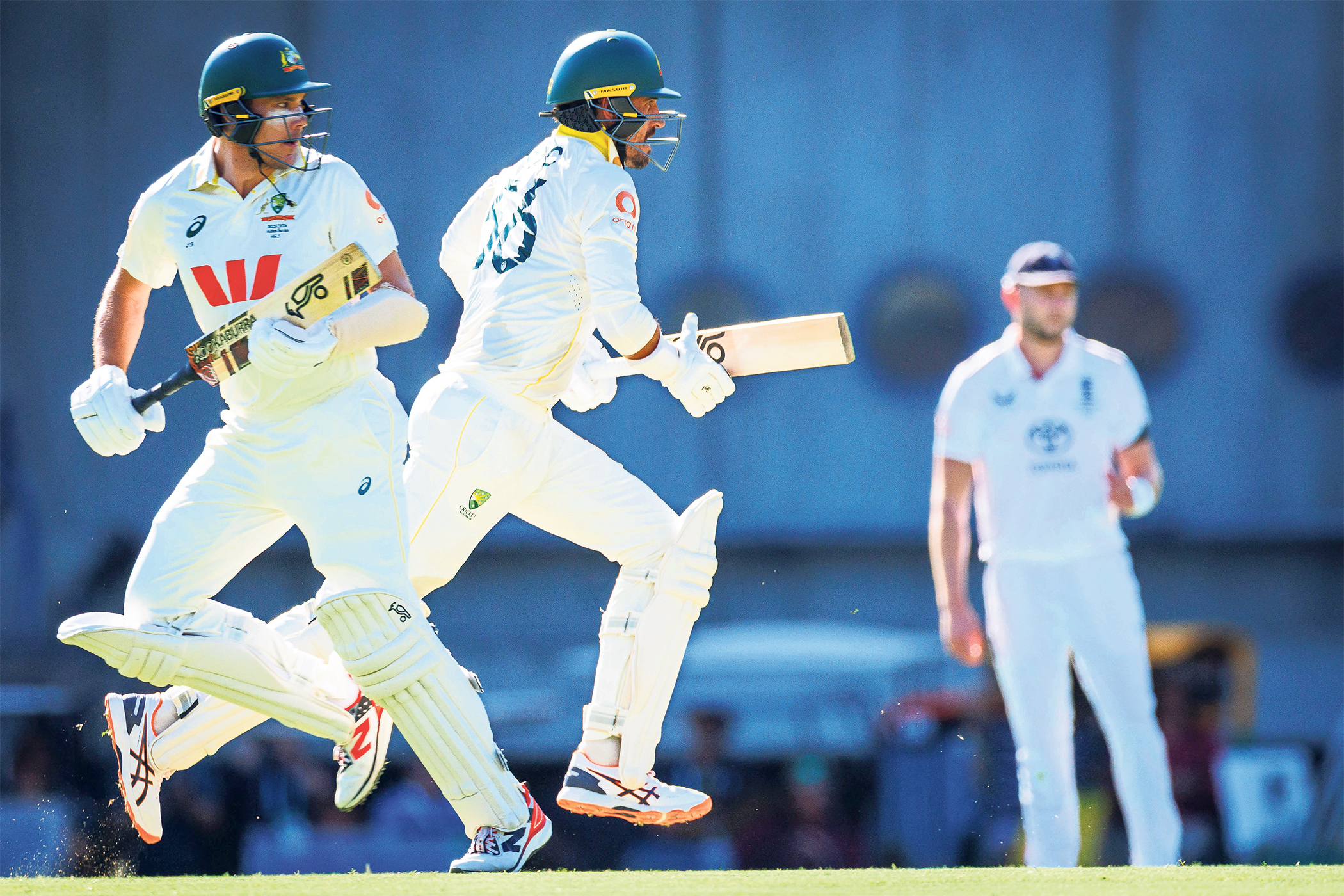
In an innings of statistical novelties and historically fast scoring, the crucial, match-shaping phase was a long period of riskless, strokeless defence, in which Mitchell Starc and Scott Boland reframed the contest with some retro-hued situationally savvy old-school grind.
Where Australia’s first-innings scorecard was loaded with useful contributions, England’s contained four ducks. Of England’s top seven, only Ben Stokes, who became the first England captain to be run out in the Ashes since 1975, was not dismissed for nought in at least one of the first three innings of the series. The only other Ashes team for whom five top-five batters bagged a duck within the first two Tests of a series was Australia in 1888.
Starc, dangling finely crafted, high-speed carrots, has feasted on the high-risk fundamentalist positivity of England’s batting. By the end of yesterday’s play, he had taken 18 wickets in 57 overs, and became the fourth bowler in Ashes history to have a six-wicket haul in both of the first two Tests of a series (after Shane Warne in 1994-95, and long-distant England greats Maurice Tate and Tom Richardson, in 1924-25 and 1896 respectively). Only Richardson has ever taken 10-wicket match hauls in the opening two Tests of an Ashes – Starc needs two of the final four wickets to join him.
His innings of 77 made him just the third player ever to take six or more wickets and score 75-plus in the first innings of an Ashes Test, after Australian all-rounders Keith Miller in 1946-47 and Jack Gregory in 1920-21. His batting has changed from his early flamboyance. In the first half of his career, he scored at 67 per 100 balls; in the second half, 50 per 100, and, this year, after several years without a fifty, he had made his two slowest half-centuries, this careful, influential innings following his 58 off 136 at a critical stage in the World Test final against South Africa.
Stokes will need to concoct a miracle to place alongside, or even beyond, Headingley 2019 to save his team in this game and series. His bowlers, after that mesmeric first onslaught in Perth, are taking a statistical battering. Carse conceded 100 in 14.1 overs, the fastest anti-century recorded by an England seam bowler. Gus Atkinson took more than 40 overs to take his first wicket of the series. Stokes has conceded 4.8 per over, currently the most uneconomical of all the series in which he has bowled at least 10 overs. Jofra Archer has bowled intermittently threateningly, but has taken only three wickets.
Other than Joe Root’s superb century, the top-order batting has failed. Pope still awaits his first Ashes half-century after 14 innings (of top-order England batters, only MJK Smith in the 1960s has begun his Ashes career with more innings without reaching fifty). Jamie Smith has made 79 in his last eight innings. Zak Crawley batted majestically, then departed frustratingly, in both innings, and has now failed to get through the 70s a startling nine times out of 15 attempts. Brook has not played like one of the highest-averaging batters in Test history. Duckett has not reached 50 in his last five Ashes Tests. And yet the achievements and potential of this batting line-up fuelled the pre-series optimism.
Newsletters
Choose the newsletters you want to receive
View more
For information about how The Observer protects your data, read our Privacy Policy
England have lost a wicket every 30 balls so far this series. In those seven other 2-0-down-after-two series, they lost a wicket every 52 balls. In 1928-29, the series in which they first played a Test in Brisbane, they batted for 589.5 overs in the first two Tests, losing a wicket every 118 deliveries faced. Different times, different balls, different pitches, different bowlers, but a harrowing statistic for any readers in the 100-to-150 age bracket. This series has, after the heady first four sessions in Perth, taken a familiar course, but at a new-age, Bazballian pace.
Photograph by Patrick Hamilton/AFP via Getty Images