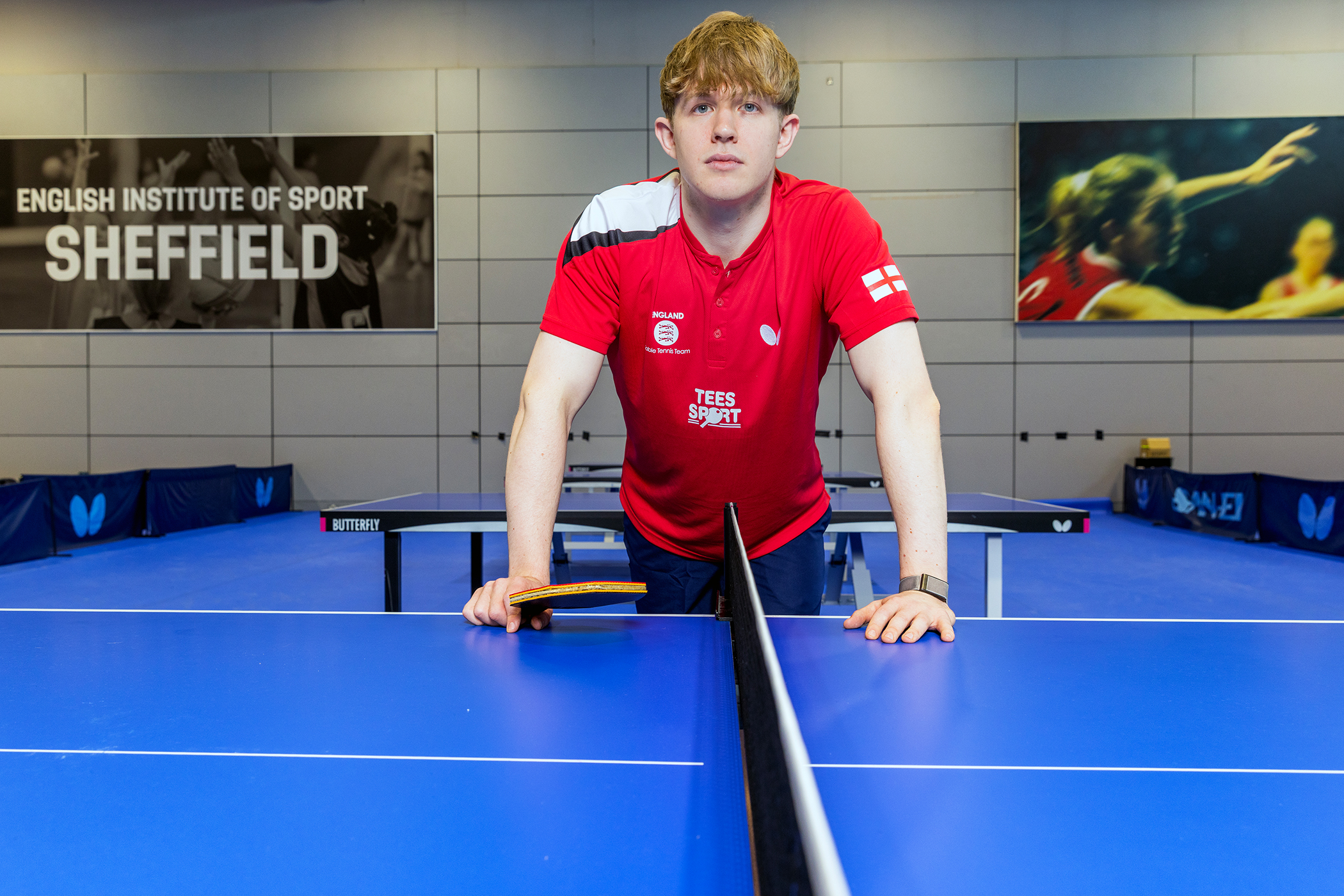


Tom Jarvis was confronted with an unfamiliar opponent. Then 16, he had moved from Skegness to Halmstad, a Swedish port city two hours by train from Copenhagen, a few days earlier. He had been a reserve for Team GB’s table tennis squad at the Rio Olympics weeks before, but this was different.
“I stood in front of it and rang Mum and said ‘What do I do?’,” he tells The Observer, a decade on, in Sheffield’s English Institute of Sport.
“She said ‘Have you got washing pods?’ ‘What are they?’ ‘Have you put your clothes in yet?’ ‘No.’” That was the day England’s No 1 table tennis player and national singles champion learned to use a washing machine.
He lived with two other 16-year-olds at a local academy – one Swedish and one Danish – training from 8.30am until 12pm, having lunch and a quick nap, then returning at 3pm to train for the rest of the day. He wasn’t quite ready to make it alone, but had little choice if he wanted to capitalise on his rare talent.
“I wanted to practise every day, and the level of practice and the league was much higher,” he says. “So few people make it in table tennis – you’ve got to give yourself the best chance from an early age.”
Now ranked 66th in the world, Jarvis shares a flat with two fellow players in Düsseldorf. Having moved in a year ago, they only “got the kitchen sorted” this week. Charming and modest beneath boyband blonde hair, he is the great hope of England’s squad for the World Team Table Tennis Championships, which begin on Tuesday across the Copper Box and Wembley Arena, 100 years since London hosted the inaugural event.
Of the 10 players selected across men’s and women’s squads, six are 22 or younger, with 14-year-old Alyssa Nguyen the youngest. In part, this is because younger players can rely on parents and educational structures to support their careers, meaning they can in effect train full time without the financial risk.
About the top 100 men’s players globally are fully professional, while that figure is lower for women. English women’s No 1, Tin-Tin Ho, qualified as a GP, although she is currently a full-time player.
“It’s more than a full-time situation,” says Paul Drinkhall, seven-time English singles champion and still in the squad at 36. “You have to live somewhere and commit your whole life, and it’s a hard thing to make it at.”
Currently dividing her time between playing, a master’s in clinical nutrition, and a day job as a physiotherapist, 22-year-old Jasmin Wong is entering what she calls “a period of transition”, deciding how much she can commit.
Newsletters
Choose the newsletters you want to receive
View more
For information about how The Observer protects your data, read our Privacy Policy
There is a direct correlation between success and early proximity to one of the nation’s few table tennis hubs. Connor Green – reigning national champion in the men’s doubles alongside Jarvis and 173rd in the world – spent two years at Grantham College Table Tennis Academy, where 17-year-old Ella Pashley still studies, while Jarvis’s grandfather drove him an hour and a half each way from Skegness every other day to practise at Grantham.
Wong attended Ackworth, a Pontefract boarding school with an in-house academy – “school, table tennis, sleep, repeat” – before studying at the University of Nottingham, the leading university table tennis program, whose facilities Green now uses. Nguyen lives 10 minutes from Joola Table Tennis Club in Plymouth. Between 11 and 22, Drinkhall spent six weeks every year training in China.
‘Playing can be the easiest part. It’s making sure you stay sane in between’
‘Playing can be the easiest part. It’s making sure you stay sane in between’
Paul Drinkhall
For true progression, moving abroad is the only real option. Playing in the European leagues – particularly Germany and France – is the best path to a sustainable salary. Having spent six years in Sweden, Jarvis now plays in the Tischtennis-Bundesliga for ASC Grünwettersbach, based in Karlsruhe in the Black Forest, who attract about 600 fans weekly in a “football environment”. Almost 3,000 attended a recent away match featuring the reigning Olympic champion. “It’s extremely important for the players there; winning the league with your club is one of the biggest things. It doesn’t have the same buzz around it in England,” says Jarvis.
Having spent two years playing in France, Green joined TTC immoXone Bietigheim-Bissingen, a third division side in a small town north of Stuttgart. Even in the lower leagues, his club have a dedicated training centre attached and “there’s more sponsorship, more national and local funding”.
He still lives with his parents in Nottingham, but he is home only “20-25% of the time” – Nottingham to London, London to Stuttgart, then “battling around some city in Germany you don’t really know”. Maintaining a social life and balance is harder now he has left school.
Jarvis says: “When I was 17 I didn’t go home for six months, away training and at tournaments. This weekend, I had a match on Sunday [in Germany], flew back, got home at 1.30am and was in Sheffield that morning. It just kind of gets normal.”
Table tennis is a solitary sport, but loneliness appears a fundamental part of being a table tennis player more generally. “In the UK there are things being put in place and national centres opening, which is a good thing,” says Drinkhall. “But if you want a chance of succeeding, you’ve had to be travelling, and a lot of that comes on your own.
“You’re in the airports, going to clubs, playing matches, practising. You might see people here or there, you’re spending a lot of the day alone.
“You get some players who are really good at the table tennis side, but can’t balance that lifestyle. On the table is sometimes the easiest part. It’s making sure that you stay sane in between practices, when you’re traveling around.”
Every player I speak to hopes that the World Championships will help raise interest and funding, help relieve the psychological and financial burden on them, open up more opportunities that mean they can spend less time on planes and trains. This centenary championships is a reminder that England was once a great table tennis nation. Can that be the case again?
Photograph by Gary Calton for The Observer