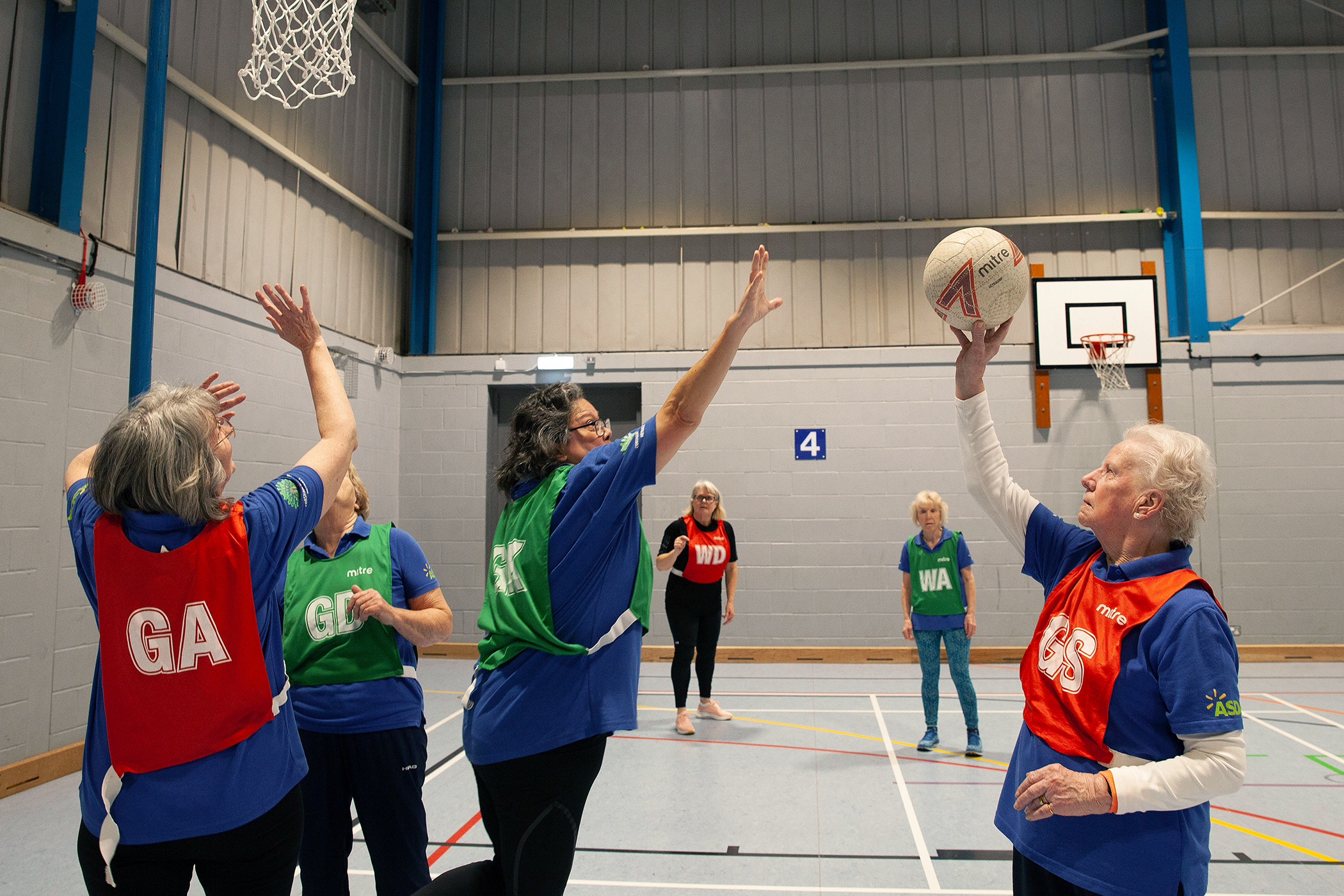

Playing walking netball for the Corsham Peacocks doesn’t just give Joyce Funnell physical exercise; at 91 and living on her own, it brings structure and momentum: familiar and new faces, team meals, theatre trips, travel to tournaments, and a messaging group - “We’ve all been chatting about the Winter Olympics on WhatsApp.” The benefits ripple far beyond the physical, and into mental and cognitive health.
But Funnell understood the power of team sport before some of us were even born. Between 1959 and 1975 she followed her husband’s RAF postings to Germany, Cyprus and Northern Ireland, organising the wives’ netball teams and arranging matches against local schools and other RAF stations. “Because we were away from home it was a sense of community, we looked out for each other,” she says.
Funnell had also joined the RAF herself as a policewoman, but her career was curtailed by the marriage bar. “I enjoyed my time there, but at that point, if you got married, ladies weren’t allowed to stay in the RAF. The rule changed about five years later as they needed recruitment.”
As International Women’s Day on Sunday invites reflection on how far women’s sport has travelled, Funnell’s life traces much of that journey. When she began playing at grammar school in around 1948, girls were not encouraged to be sporty. “Sport was never put to me when I was out and about,” she says.
Her summer schedule now reads less like retirement and more like elite conditioning. “I play netball twice a week and bowls three times a week so that takes up most of my time.” A weekly walk with a friend fits neatly between. The contrasting biomechanics matters too. “Bowls is a slower pace but when you play a game of bowls you walk up and down the rink 21 times and the exercise is that you are bending down to pick your woods up and you’re playing your woods. You are using different muscles to what you would when playing netball.”
On court Funnell wears the goal shooter bib, and, at 5ft 4in, occupies space with intent. “Some of them would say I’m a bit aggressive! I’m enthusiastic, I like to get into the right positions. It keeps all my muscles going and keeps me mobile.”
Funnell is part of a cohort of over-75s doing 150-plus minutes of exercise per week according to a 2024 Sport England Active Lives survey. It showed that activity rates among the over-55s are the highest since records began, and in the 75-and-over age group, levels have increased by 9.4% over eight years.
Sport England says that community sport and physical activity generates £122.9bn in “social value” each year. Its chief executive, Simon Hayes, says: “Our insight shows that older adults experience up to 50% more wellbeing value from being active than the general population.”
‘It’s just as much about friendship, laughter and feeling a sense of belonging as it is about keeping fit’
‘It’s just as much about friendship, laughter and feeling a sense of belonging as it is about keeping fit’
Funnell’s wellbeing value from sport is evident. She was welcomed immediately into walking netball.
“Mentality-wise I’m mixing with people and they’re a lovely lot of ladies,” she says. “Although I’m older than them they make me welcome and because I live on my own, getting out and about meeting people and having conversations with people, I think it’s very good for my mental state of mind.”
Newsletters
Choose the newsletters you want to receive
View more
For information about how The Observer protects your data, read our Privacy Policy
Research suggests that the nature of the activity matters as much as the movement itself. Dr Max Western, associate professor of behavioural science at the Centre for Motivation and Behaviour Change, University of Bath, and co-author of studies into active ageing, argues that enjoyment and connection underpin longevity.
“The more we can encourage older adults to do fun and social physical activities to get their steps in rather than for extrinsic reasons like guilt or even for health benefits the more they will have a thriving experience and do it long term,” he said.
“Sports and games like walking netball that support the basic psychological needs for autonomy, competence and sense of belonging with others are the best bet for active ageing.”
Funnell embraced it a decade ago without hesitation, though with one technical adjustment. “The problem was not to run. I’d always played netball and it was my first time playing walking netball and it was difficult not to run and jump.”
Across England, walking versions of football, rugby, cricket and tennis are offering lower-impact access to familiar games. England Netball has engaged 60,000 walking netballers since the programme began in 2016. Today more than 400 groups meet weekly, with about 6,500 participants. On average 12% are aged 75 or over. Many women of Funnell’s generation who grew up with limited organised sport are now cashing in their sporting pensions.
Helen Wynn, head of participation for England Netball said that while walking netball is gentle on the joints and can reduce the risk of trips and falls, the sense of community is its superpower. “For many of our walking netballers, it’s just as much about friendship, laughter and feeling a sense of belonging as it is about keeping fit.”
England Netball is marking 10 years of the program with a walking netball tour that began in Sheffield and is now travelling the country alongside selected Netball Super League fixtures before culminating at the Soft & Gentle NSL Grand Final in Manchester on Saturday 20 June.
Meanwhile, Funnell and the Corsham Peacocks have been strutting their way to tournaments in Calne, Tidworth and Weston-super-Mare.
“It is a big part of my life for exercise and socially,” says Funnell. “I intend to try and keep going, as long as the ladies will accept me and I keep saying to them, ‘If I’m holding you back, please let me know and I’ll stop’, and they say, ‘No, come along, we like you along’.”
Photography by Karen Robinson for The Observer