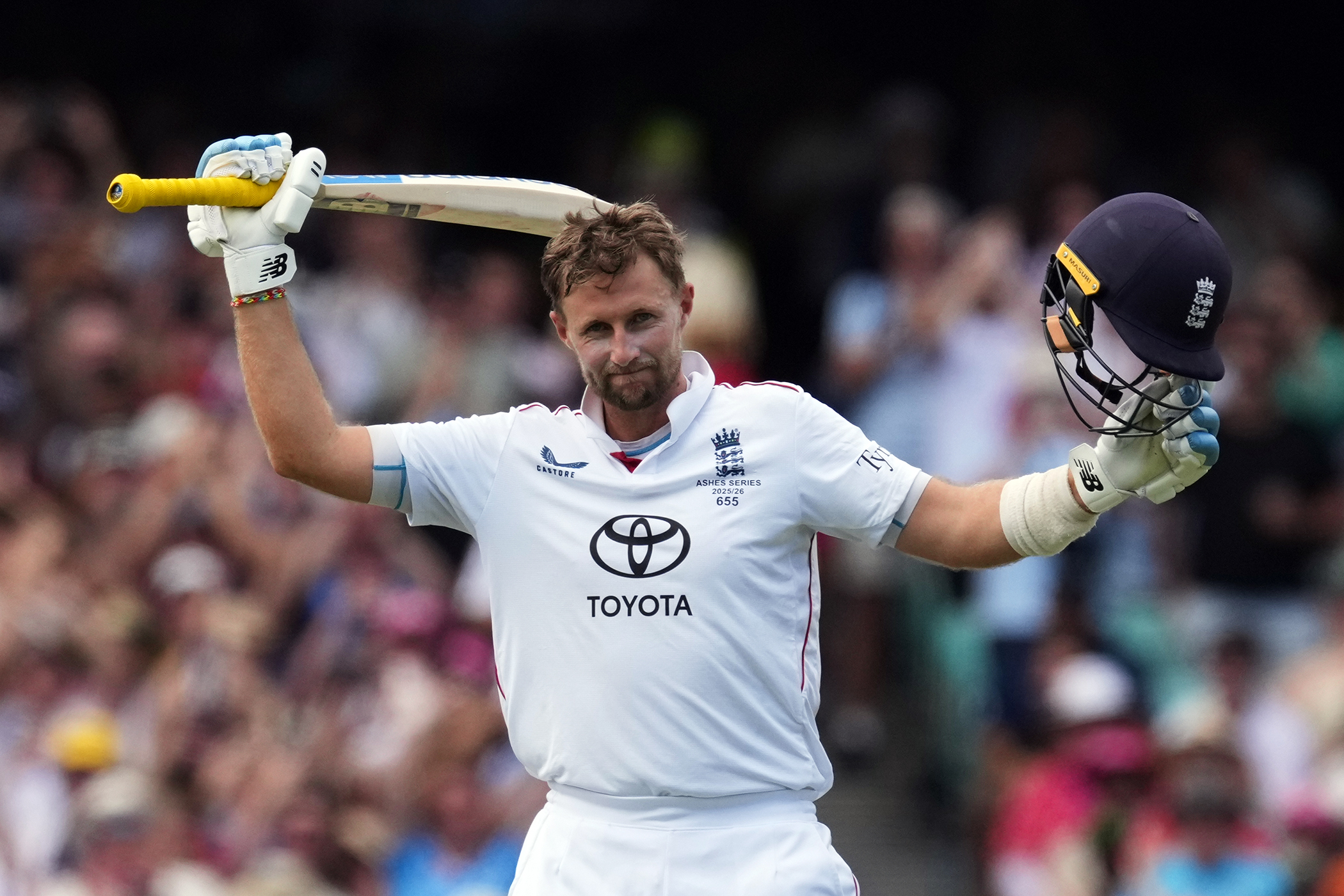


Hold me Joe and tell me everything’s going to be alright. Hold me while the world burns, while proper batting and defensive techniques die out with decency and morality. Hold me and tell me you won’t leave, that you can do this forever, that we should never have to imagine English cricket without Joe Root working a ball to third man and raising his bat as though almost ashamed of his own brilliance.
Root remains England’s north, south, east and west, working week and Sunday rest, comfort blanket and protector. He has never missed a Test due to injury and quashed any semblance of doubt about his own majesty with a chanceless, flawless 41st Test century, usurping his previous high score in Australia from Brisbane. In a team of possibilities, of boundless potential and talent but little to grab hold of, he is perhaps the sole definite, the only thing you can trust.
This was his 21st Test ton since the start of 2021, 14 more than any other player, the only England player to score two centuries in the same away Ashes in the past four tours, the only England player to pass 100 this series. A second-innings 56 will guarantee he averages over 50 this tour despite seemingly being quite bad for large periods.
Root has always been the English public’s ideal of sporting genius, none of the stereotypical trappings and edges of greatness, never altered by success. There’s supposed to be a downside, an opposite pole, an exchange at play. Root must be an incredibly difficult player to attempt to emulate and learn from, blessed with an innate innocence and security, almost too clean.
In Jamie Smith and Harry Brook, perhaps alongside Jacob Bethell, England appear to have three batters under 27 who could define the sport for a decade, but to suggest any of them could replace Root in any way misunderstands what he does as a spiritual and emotional centre. Smith and Brook are Bazball incarnate, the regime made flesh. Both they and this England team promise such fantastical, sugar-rush highs they somehow tend to leave you feeling unsatisfied and unfulfilled, as though they could always have achieved more, as though the next breakthrough was right around the corner.
At an SCG bathed in summer sun, England were comfortably on course for an unimpeachable 500, their first truly dominant position of the series. The turning point in this pursuit was Root watching Smith hole out to a Marnus Labuschagne bumper, the moment an Ashes series defined by its overwhelming if endlessly entertaining absurdity reached peak shenanigans, a state of divine tomfoolery.
Smith is clearly extraordinarily gifted. It looks great, all the right shapes and sounds, everything we have been conditioned to love. And despite only crossing 50 once in his past 13 innings, he averages 42, the highest of any English men’s Test wicketkeeper, although after his 184* against India in July – the highest Test score by an England keeper – his average was 59. For comparison, Jonny Bairstow’s is 36, Alec Stewart 39. His first 13 Tests were one of the great starts of any English player, still only 25 and 18 months into his international career.
Yet Smith has looked psychologically frayed by the past two months, pulled apart by the Australian experience like a spider by a sadistic child. A first-time father, he celebrated his son’s first birthday here, only his second tour and his first to last more than a month. He has somewhat redeemed himself behind the stumps, but averages 23 across the series, somehow thinner and hollower as a player, deprived of a vivacity which underpinned his early days.
“It’s not easy to replace experienced Test cricketers, you just have to be a little bit patient,” Usman Khawaja said pre-match. “Test cricket is a different beast.” For all the legitimate concerns around Smith’s decision-making, especially as pressure rises, it is easy to forget how young and relatively new to this he is. Alex Carey made his Test debut at 30. He has time. Let him learn.
Smith and Brook are both defined by extremes of genius and stupidity, of risk and reward. But the prevailing tendency to condemn them as somewhere between occasionally and terminally brainless not only entirely disrespects how good they are, it misunderstands what makes them good. Instilling more traditional values in them would strip something from them, products of a different world, a different game, to Root.
Newsletters
Choose the newsletters you want to receive
View more
For information about how The Observer protects your data, read our Privacy Policy
At 26, Brook is already the world’s No 2-ranked Test bat, with the highest average of any England player since the 1960s, his 84 here a comforting footnote to what will likely be Root’s last Ashes Test here. Whether under Brendon McCullum and Ben Stokes or not, this team will only develop more into Brook and Smith’s image, perhaps even more chaotic and frustrating, higher highs and lower lows. If you think the past three years have been bad, wait until you lose your safety Root. They are the way the game is going.
Of course, the real failure and weakness throughout this series has been with ball in hand. For all his momentary redemption in Melbourne, Brydon Carse opened the bowling for the first time in red-ball cricket with a casual disregard for such follies as accuracy or consistency. Matthew Potts, selected more out of desperation than expectation, was dispatched for 58 from his seven overs. After less than 21 overs, Australia were 100-1.
Another day which began freighted with promise ended with that promise being repeatedly pulled away for four by Travis Head, that same sunken disappointment, emotional exhaustion without catharsis. This drama is increasingly built into the format, and will only worsen. So, while you still can, hold me Joe. Tell me everything’s going to be alright.
Photograph by AP Photo/Mark Baker