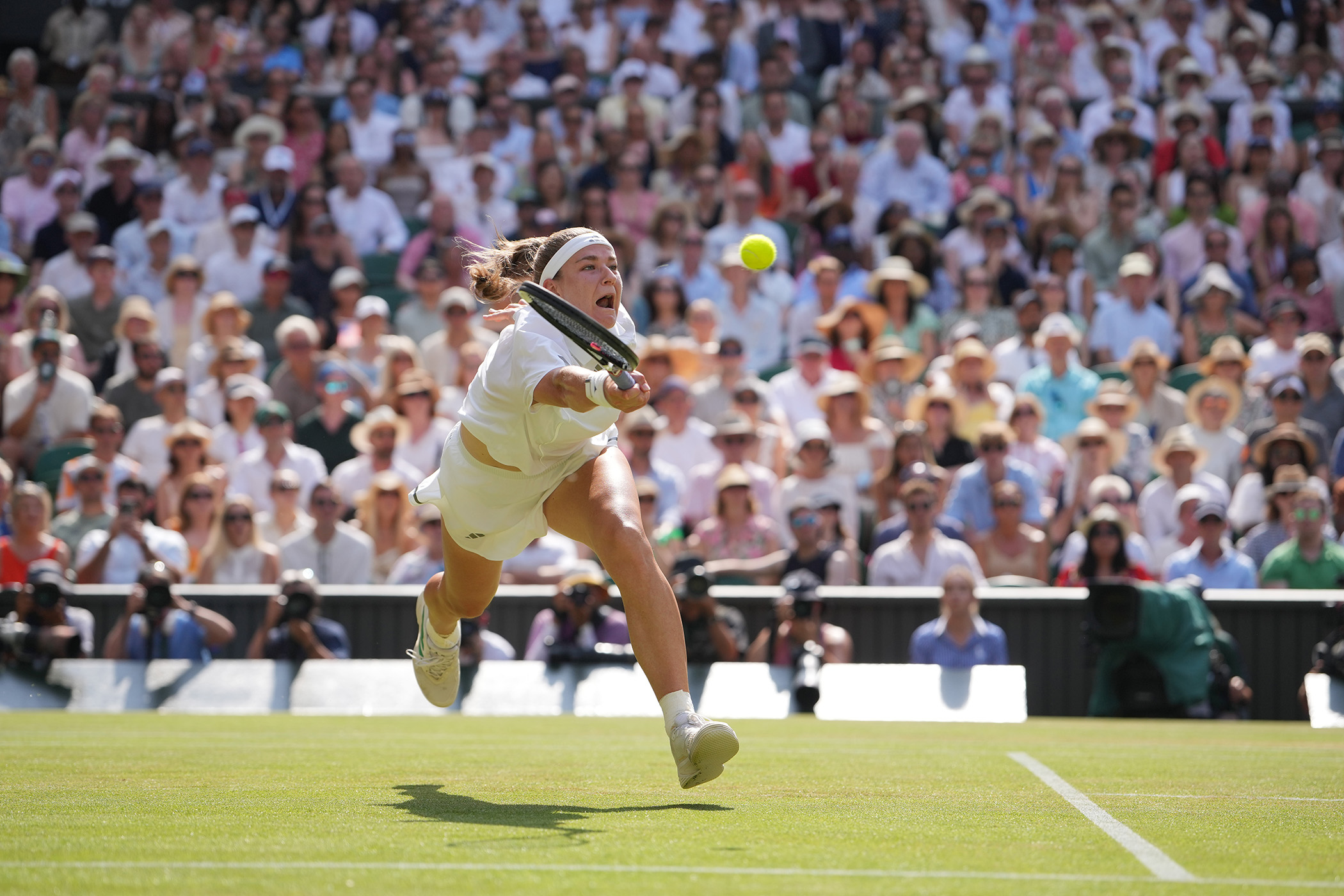
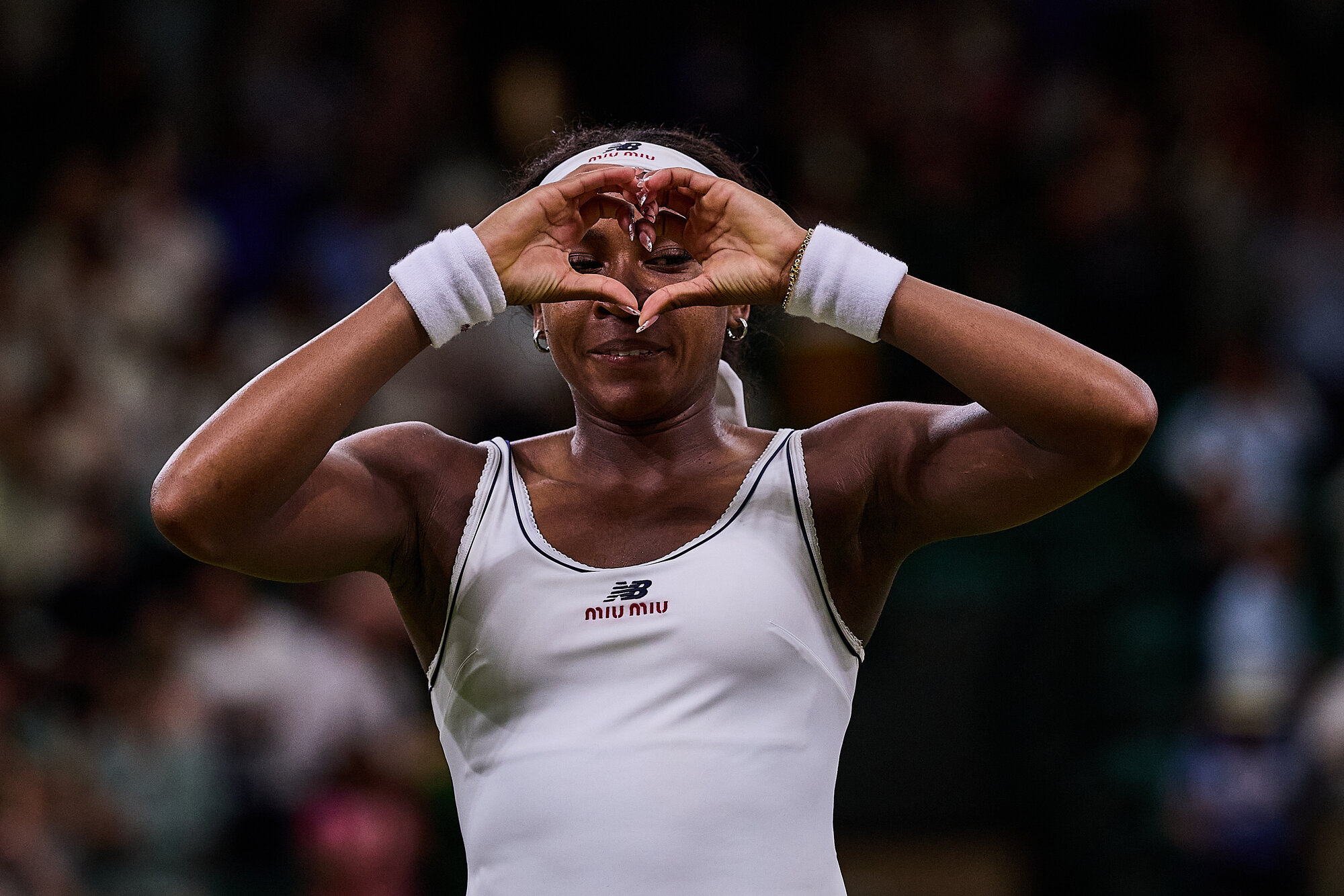
As the ball sailed towards Coco Gauff’s racquet, it was almost as if she looked beyond it, into the final that looked to be inevitably awaiting for her. She was at match point in the third set tie-break, with her opponent Karolina Muchová acres behind the baseline. Shaping up for the dropshot, she knew that if she put the ball anywhere in the court, she would be walking back out onto this very same grass come Saturday afternoon.
Instead Gauff awkwardly sent the ball straight into the net. Four points later and it was Muchová who was marching into her first ever Wimbledon final.
Gauff was philosophical about her decision-making after the match.
“If I make it, everyone says how clutch it was,” she said in her press conference. “It was my choice. That’s just tennis.”
There was reason enough for Gauff to be positive about her run at Wimbledon this year, even if critics will see that miss as further proof that she does not have the instinct to dominate the women’s tour. Yet at only 22 years old, Gauff became the youngest woman ever to reach this stage of all four Grand Slams since Maria Sharapova in 2007.
It is also the furthest she has gone in a Slam since her dramatic win over Aryna Sabalenka at last year’s French Open. And in this match full of pressure, in a year where her serve has totally disintegrated, on a regular basis she only double-faulted twice.
The first semi-final match oscillated between the two players with Muchová reeling off five games in a row to take the first set 6-2, before Gauff did the same to take the second one 6-1. As the two headed into a third set, it was natural to put the money on Gauff who has become a master of three-setters, with 13 wins going the distance this year already. She had already won four three-round matches at Wimbledon alone this year, explaining her secret by saying she hasn’t “ever gotten tired” in her professional career.
Gauff’s competence in longer matches stems from her strong defence which keeps her hanging in matches and wears her opponent down. Yet Muchová simply would not tire, even as her service games were put under more and more pressure by Gauff. In the end it was Muchová who could keep her fingers clinging onto the idea of the Venus Rosewater Dish for the longest.
This year’s tournament has represented an important redemption arc for Muchová for the past four years. She made the quarter-finals in 2019 and 2021, but has struggled with injury in the past and took a while to get back to her best after wrist surgery in 2024. But a first-ever title on grass in Bad Homburg just prior to Wimbledon was a good indicator of what could be expected from Muchová here.
Muchová became the fourth different Czech woman to make the final in six years, and barely two hours later she was joined by the fifth one. Ninth-seed Linda Noskova set up the first all-Czech final after beating Marta Kostyuk 6-4, 6-4 to make the first Grand Slam final of her career.
Newsletters
Choose the newsletters you want to receive
View more
For information about how The Observer protects your data, read our Privacy Policy
The secret behind Czech dominance at Wimbledon has been perplexing given that the surface is hardly in use there.
However, Tomas Berdych, a Wimbledon finalist in 2010, thinks the weather conditions might have something to do with it.
Speaking on the Sit-Down podcast, he explained that the transition from summers spent playing on clay courts to using indoor ones during harsh winters, means that Czech players are used to adapting their games to different conditions.
That ability to adapt is often more pronounced in the women’s game, where players only play best-of-three set matches, unlike in the men’s game where matches go longer and there is more opportunity for opponents to adjust at a slower pace.
For the 21-year-old Noskova, legacy is now also a factor. Admitting to Annabelle Croft, in an interview on Centre Court after her win, that she had not watched a huge amount of tennis as a child, she cited a match at Wimbledon as one of her first memories of tennis.
“One thing I remember is when Petra Kvitova won her Grand Slam here,” she said. “And it was one of the first moments I realised tennis exists.”
Kvitova won in 2011 and 2014, Marketa Vondrousova won in 2023 and Barbora Krejcikova won in 2024. Whoever wins on Saturday, there will be another Czech name to add to the honours board.
Photograph by AP Photo/Kin Cheung