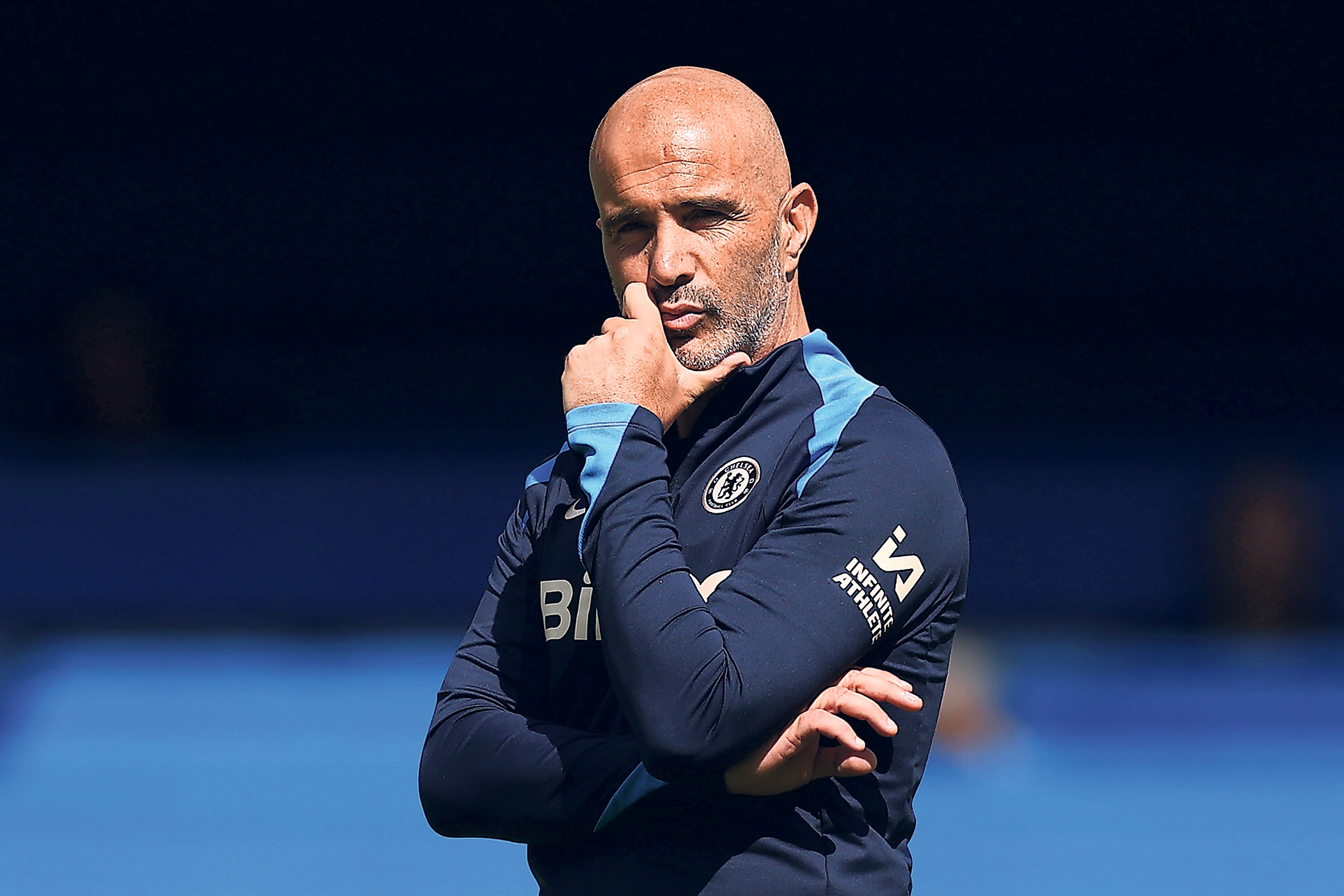


Enzo Maresca, it turned out, was nearly right. On 13 December, after watching his Chelsea team breeze to victory against Everton, the Italian decided – without either warning or explanation – to declare that the previous couple of days had been the “worst 48 hours” he had experienced since arriving at Stamford Bridge. That was three weeks ago. He has presumably now updated his rankings.
There was nothing especially surprising about Chelsea’s decision to fire Maresca 18 months after he took charge of the club, five and a half months after he won the Club World Cup – a competition which, officially, everyone associated with Chelsea decided was very important indeed – and with his team three points off a place in the Champions League.
True, it is a little unusual for a manager to lose his job on the morning of New Year’s Day. And, true, the crisis that curtailed the 45-year-old’s tenure did seem – from the outside, at least – curiously sudden, a squall that gathered from nowhere. It is not that long ago, after all, since Chelsea dismantled Barcelona, and then earned an over-celebrated draw with Arsenal.
But then this is what Chelsea do, and what has been done for most of the club’s modern history. Maresca’s run of form – one win in their past seven Premier League games – would have been enough to attract the attention, and quite probably the ire, of former owner Roman Abramovich. Chelsea have long worn their fickleness as a badge of honour; time and exposure have conditioned fans and staff not just to accept volatility, but almost to prize it.
And it is certainly what the current iteration of Chelsea do, the one awkwardly owned and operated by BlueCo, the consortium that represents the combined intellectual might of Clearlake Capital, Todd Boehly, Mark Walter and sundry others. (The precise order of power is not clear.) Maresca was the fourth permanent head coach of its (not quite) four-year custodianship. It has fired them all.
More significantly, there is a pattern in the manner of their dismissals. Far more eye-catching than the fact of Maresca’s departure on Thursday was the manner of it, both sides attempting to establish their narrative as the dominant one, to win the information war, to paint themselves as the wronged party in the divorce.
In what seemed to be Maresca’s telling – nobody has the nerve to go on the record, obviously – he had been left exposed by a cruel and uncaring hierarchy, his fine work in restoring the club to the Champions League and lifting two trophies underestimated by executives who did not understand the complexity of the task that they had set him.
In Chelsea’s, by contrast, Maresca had ignored the recommendations of the club’s independent medical department, and by extension risked his players’ health, by reneging on a well-established policy of rotating his squad. He had irked his former employers with those cryptic comments after the game against Everton; perhaps unsurprisingly, they had not been especially impressed by his revelation that he had held exploratory conversations with representatives of Manchester City about replacing Pep Guardiola in the future, either.
Related articles:
They had started to feel that he was a little too combustible, a little too troublesome, that he maybe could not cope with the stresses and strains of a job of that size.
Some or all of this may well be true; some or all of it may well be grounds for the club’s executives to have made the decision that they did. But at the same time it is hard not to detect just the slightest hint of déjà vu.
Newsletters
Choose the newsletters you want to receive
View more
For information about how The Observer protects your data, read our Privacy Policy
Maresca is not the first Chelsea boss to fall foul of what might be called internal politics. Thomas Tuchel, the coach that BlueCo inherited, reportedly disagreed with Boehly’s approach to the transfer market in 2022. That difference of opinion was regarded as intolerable. He was fired just a few games into the group’s first full season.
Two years later, pretty much the same thing accounted for Mauricio Pochettino. He disagreed not with Boehly – or even his co-controlling owner, Behdad Eghbali, by that stage a much more active presence at Stamford Bridge – but with the sporting directors that they had appointed to oversee recruitment. Pochettino, not helped by disappointing results, lost that power struggle, too, just as Maresca would do. (The exception to the rule is Graham Potter, who was fired for far less opaque reasons.)
What Chelsea ask their head coaches to do is complicated, two separate objectives that are mutually exclusive
What Chelsea ask their head coaches to do is complicated, two separate objectives that are mutually exclusive
The most obvious conclusion to all of this, of course, is that perhaps it is not the head coaches who are the problem. Tuchel, Pochettino and Maresca might all be intense and demanding – most elite coaches are – but they are hardly identikit characters. Tuchel apart, they signed up knowing the nature of their remit. That all three have met the same fate does rather suggest that the problem is not them.
Or, perhaps, the trigger is not personal chemistry; perhaps it is the model itself. Even at this stage of BlueCo’s ownership, the point of their investment remains unclear. Is it to win trophies? Is it to build a team? Is it to fatten players up for sale? If so, who to? Has it – as a cynic might suspect – become an exercise in disruption for the sake of disruption, a chance for the club’s owners to demonstrate how brilliantly clever they think they are?
If it is the former, then it is being undercut by a self-sabotaging streak. The constant deal-making, the sense of permanent revolution runs contrary to the received footballing wisdom that holds true: the idea that winning teams require a blend of promise and experience.
Chelsea’s determination to disregard that presents those head coaches who do sign up to the project with aims that are not only distinct but may well be mutually exclusive.
Maresca’s firing, after a poor run of results, suggests that Chelsea expect to be competing for honours in both the Premier League and Champions League; the sheer amount of money they have spent in the transfer market suggests as much, too.
Their head coach, though, must also oversee what is effectively an elite player development scheme, attempting to elicit consistency from a squad that exists in a state of neverending flux. That, as Maresca seemed to feel, requires patience, tolerance, an understanding that there will be times of want, as well as times of plenty. It demands that the club’s hierarchy wait today for a brighter tomorrow.
They do not seem to be able to do that; until they are, until they have a sense of where they want to go and how they want to get there, it is very difficult to see how this cycle is broken. This is just, and will be, what Chelsea do.
Photograph by Eddie Keogh/Getty Images