
For nine damp days in May 1926, Britain came to a standstill. But while nearly two million people downed tools, trains stopped and the government feared revolution, the General Strike quietly changed the cricketing lives of three Derbyshire miners.
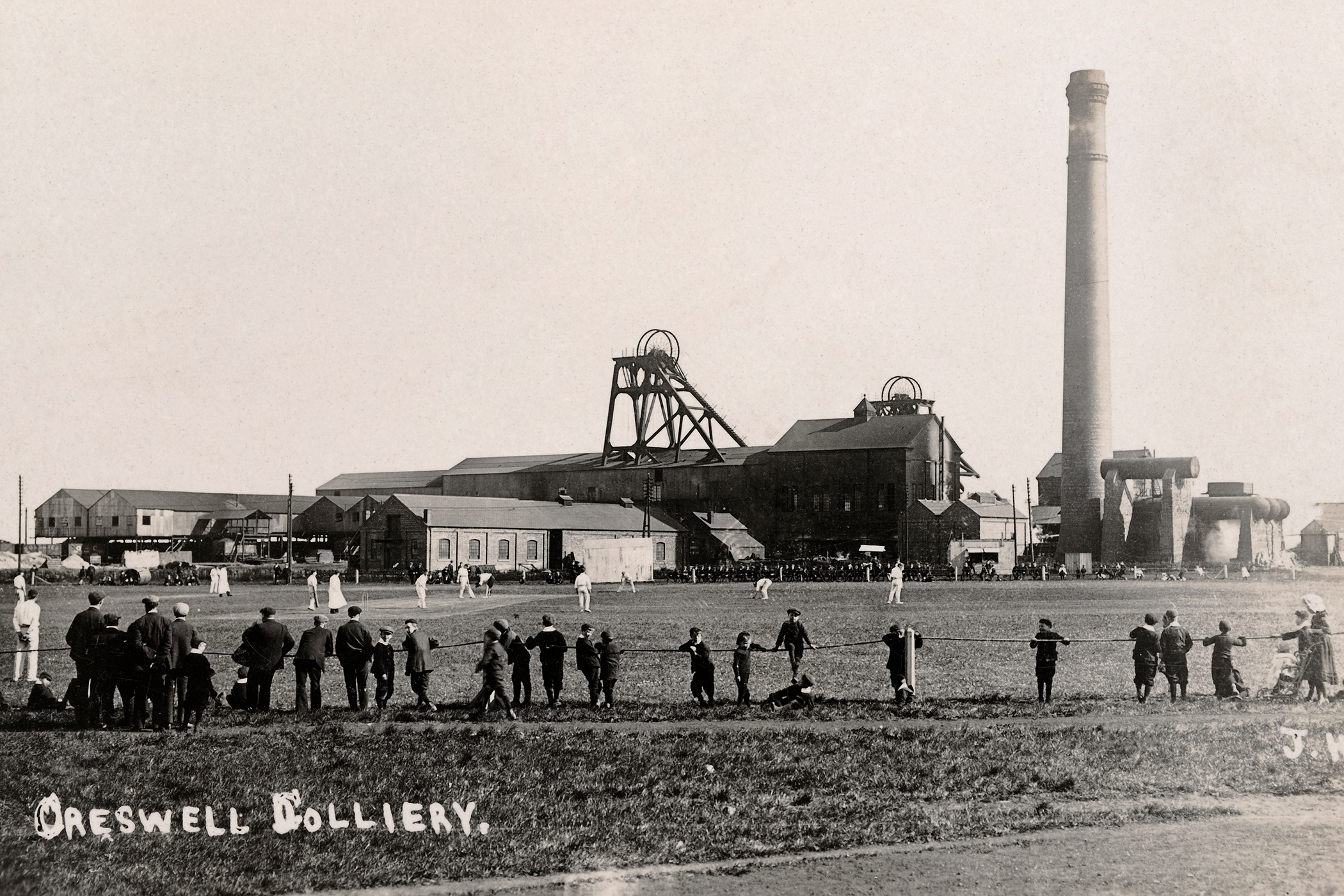
Tommy Mitchell was killing time practising his leg-breaks by the pithead at Creswell Colliery. He caught the eye of Guy Jackson, who had brought his goodwill Derbyshire side to play the striking miners. Jackson liked what he saw: Mitchell went on to play 300 times for the county, and five for England, including on the Bodyline tour.
Over at Morton Colliery, 18-year-old Bill Copson was also on strike. Though not a big cricket lover, he was persuaded to join his colleagues at the local recreation ground to play the police who were guarding the pithead machinery. There and then, he realised his talents as a fast bowler. Five years later, he too had signed for Derbyshire.
Not far away, a young Les Jackson was watching miners play cricket at Whitwell. He would remember it always. He worked in the mines during the Second World War, eventually making his Derbyshire debut in 1947, and becoming a Wisden Cricketer of the Year in 1959. His time at the coalface might have impeded his cricket career, but not his effectiveness. “If you saw him in a jacket,” says John Shawcroft, the Derbyshire historian, “you would think his massive shoulders would burst through.”
British history in the early 20th century is thick with coal dust. In 1913, a record 287 million tonnes were dug from the earth; in 1921, a peak of 1.25 million people worked in the industry. A seam of black gold also ran through cricket, particularly in Leicestershire, Nottinghamshire, Derbyshire, Yorkshire and Durham.
Compiling a tally of cricketers once employed in mining is a Herculean task. When Kit Bartlett attempted a provisional list of those who worked at the coalface (rather than above ground) for the winter 2008 edition of The Statistician, he found 23. In the next issue, letter writers produced five more. Among the best known are Gubby Allen’s “swollen headed, gutless, uneducated miners” Harold Larwood and Bill Voce, both from Nottinghamshire’s Annesley Colliery, where Larwood was a pit-pony boy at 14, and worked the night shift at 17. In Yorkshire, Johnny Wardle was an apprentice fitter at Hickleton Main and also worked at Cortonwood; Gerald Smithson was a Bevin Boy at Askern Main Colliery, given special permission by the House of Commons to tour the West Indies in 1947-48. Umpire Dickie Bird was a fitter at Monk Bretton, England captain Freddie Brown a welfare officer at Manvers Main.
Leicestershire’s Jim Sperry and Les Taylor worked at Bagworth, while Danny Mayer (Kingsbury) and William Smith (Polesworth) turned out for Warwickshire. Major Booth (Wath-upon-Dearne) and Roy Kilner (Darfield Main) shared a colliery background, as well as membership of Yorkshire – and the Leeds Pals battalion. Nottinghamshire-born Alan Brown (Rufford) appears to be the only miner who played for Kent, despite the county’s industrial heritage. Fred Trueman was born in the outside toilet of a miner’s cottage at Scotch Springs. But, while he worked in the tally office at Maltby Main, he avoided following his father and brother underground by the speed of his arm and the breadth of his backside.
Many combined the pit in the off-season with the pitch in the summer. The most successful mining team must be Derbyshire’s 1936 Championship winners. It contained 15 professionals, eight of whom had worked below ground. They included Mitchell and Copson, who both finished the season with over 100 wickets. The side were fearsome. “Their extremely hostile bowling was matched by absolutely aggressive, if not faultless, fielding,” wrote John Arlott. “Essentially, though, this was a single unit. It may seem hard to convey to the ordinary follower of today what an atmosphere they could create: especially on south country grounds, they made the cricket bristle with competition.”
In 1920, the Miners’ Welfare Fund was created, based largely on a levy on coal output. Between 1920 and 1952, it raised – and spent – £35m. Some went to clubs and recreational facilities, including cricket pitches and teams.
The treasure-trove archive of Coal magazine illustrated how cricket was embedded in mining communities. The June 1948 edition included an article by William Southgate entitled “The Cradle of Cricket”, in which he reported that nearly all the large collieries in the country, and many smaller ones, had their own pitches, “which rival the big county grounds in their situation and quality of wicket”. He noted admiringly that 30 colliery teams were taking part that year in the Yorkshire Council Championship and Bassetlaw League, while 19 of the 22 clubs in the two divisions of the South Riding League were pit-based.
Newsletters
Choose the newsletters you want to receive
View more
For information about how The Observer protects your data, read our Privacy Policy
“Curiously, cricket does not attract so many playing miners in Lancashire,” he went on, though he mentioned Briarcroft and Bickershaw. Coventry Colliery was praised, for its excellent record and pretty ground; so was the East Midlands Division, “where nearly every colliery has its own team and enthusiastic supporters”. Southgate concluded: “South Wales miners, particularly in Glamorgan, have always supported cricket, but the records show that, so far, only one miner has appeared in the county XI – Dick Duckfield.”
In June 1953, Coal reviewed Len Hutton by Laurence Kitchin, and Boys’ Book of Cricket by Patrick Pringle, as well as a film, The Final Test – “a charming comedy”. The wider social importance of the pits is illustrated by news that the sports committee of Desford and Merry Lees Collieries are buying their own bus because the travelling expenses for the various teams and societies, including darts, dominoes, bowls, football, firefighting and a male-voice choir, as well as cricket, had grown too large.
Four years on, Coal reported on an annual cricket knockout at Allerton Bywater pit, near Leeds, where Herbert Sutcliffe was employed as a checkwayman. There, 15 teams from different divisions played each other, including A-One Face v Lamproom, Wages Office v Machine Fitters, Pityard v Electricians, and Pipemen v Screeners.
It was around this time that a teenage Geoff Boycott was fine-tuning his sporting ambitions. He was born in Fitzwilliam, and his father was left a “ruined man” by a mining accident when Boycott was 10. “My father worked down the pit, and my two uncles,” he says. “None of them wanted my two brothers or me to go down. They knew how bad it was.” Young Boycott got a break at Ackworth CC by filling in for miners who were given a last-minute double shift on a Saturday, and grew up playing with and against them. “I don’t think anyone could go straight to a cricket match from the pit. They were covered in black gold. They needed to shower at the pit baths, and go home to eat a proper meal. All they had down a coal mine was sandwiches in a snap tin made by the wife before they left for work.”
More than 100 miles north of Fitzwilliam lies Ashington, once known as the world’s biggest coal-mining village. It had its own distinctive dialect, Pitmatic, and has produced an absurdly large number of successful sportsmen: alongside Bobby and Jack Charlton, and Jackie Milburn, sit Steve Harmison and Mark Wood. Harmison’s father, uncle and father-in-law were all miners, and Steve remembers elements of the 1984 strike, when he was six.
“My dad and uncle were around a lot and, when I was off school, I got meals at the miners’ welfare hall as the child of a miner who was off work,” he says. “Growing up in this area, you had to work hard: you weren’t given a great deal. But mining was a well-paid job, and mining towns and villages were vibrant. When I first met my father-in-law, he was the belt deputy at Elton Colliery and hadn’t seen daylight for six months, working seven days a week. These guys down the pit had a great work ethic, and that work ethic brought me up.
So did watching my dad do lots of
different jobs once the mines closed.”
That industriousness was appreciated at Durham’s Riverside. “Geoff Cook always told me he would look for kids in the mining villages, because he knew the type of character they were, that they’d go that bit extra to get everything out of themselves,” says Harmison. “And look at the conveyor belt – [Neil] Killeen, [Phil] Mustard, [Graham] Onions, all within a stone’s throw.”
Alan Walker, now Durham’s assistant coach, is one of the last county cricketers to have been a miner. He left school at 15 to train as a plumber, but gave it up “because I thought I was never going to make any money”. So he went down the pit, to the disappointment of his dad, also a miner.
“I absolutely loved it,” says Walker. “You had a task to do, and you did it. I liken it to cricket: you’ve got a job, to bowl your overs. For a working-class lad, you could earn decent money, do lots of overtime. It was a bit macho, and I liked that sort of challenge. It built your upper-body strength, your shoulders and forearms. There’s a lot to be said about work and lifting in a natural way, not a manufactured way in a gym. You might not look as chiselled… I worked with some guys who were beasts, but didn’t look like they were off a catwalk. The camaraderie was similar to a changing room: your mates looked out for you. You’d have a shower at the end of a shift, 100 blokes in there, washing each others’ backs with flannels.”
When Walker was 20, he joined Northamptonshire, initially on a six-month contract. “The pit had said they’d keep the job open, but things were getting tight – so in the winter of ’83-84 I worked in a development pit, where you got paid for the amount you did. I was just supplying materials, and I worked with crazy sorts of guys. I could see that kind of mining could be more dangerous.”
Soon after, the miners went on a year-long strike against Margaret Thatcher’s government. “My dad and brother stuck it out,” says Walker. “You were blacklisted if you went back – and at Emley Moor [West Yorkshire], hardly anyone did.
“I remember thinking, at the time I started at the pit, that it was a job for life. How ironic.”
The strike marked the beginning of the end for British mining, hastened by the urgent need to reduce carbon emissions. Kellingley, the last deep coal mine in the UK, closed in December 2015. Sixteen months later, Britain went its first full day without using coal to generate energy since the 1880s. In 2024, the last coal-fired power station shut down.
Time moved on. In June 2025, the Coal Industry Social Welfare Organisation provided 50 solar panels to Dodworth Miners Welfare club. Ian Lavery, who took over from Arthur Scargill as president of the National Union of Mineworkers, is now the Labour MP for Blyth and Ashington. “Pit teams would have a big club bag with everything provided,” he says. “They would play at miners’ welfare clubs, where the wickets would be cut, and the grounds were fantastic. Most are gone now, handed over to different organisations. The loss of the pits had a huge impact. It took out the hearts of the community. They aren’t the same, and don’t have the same sporting cohesion.”
Cricket thrived in those close-knit villages, among the mining brotherhood who cut a two-foot seam in the heat and the dark.
This article is an extract from Wisden Cricketers’ Almanack 2026, which is available to order now in hardback, paperback and ebook (The Shorter Wisden 2026)