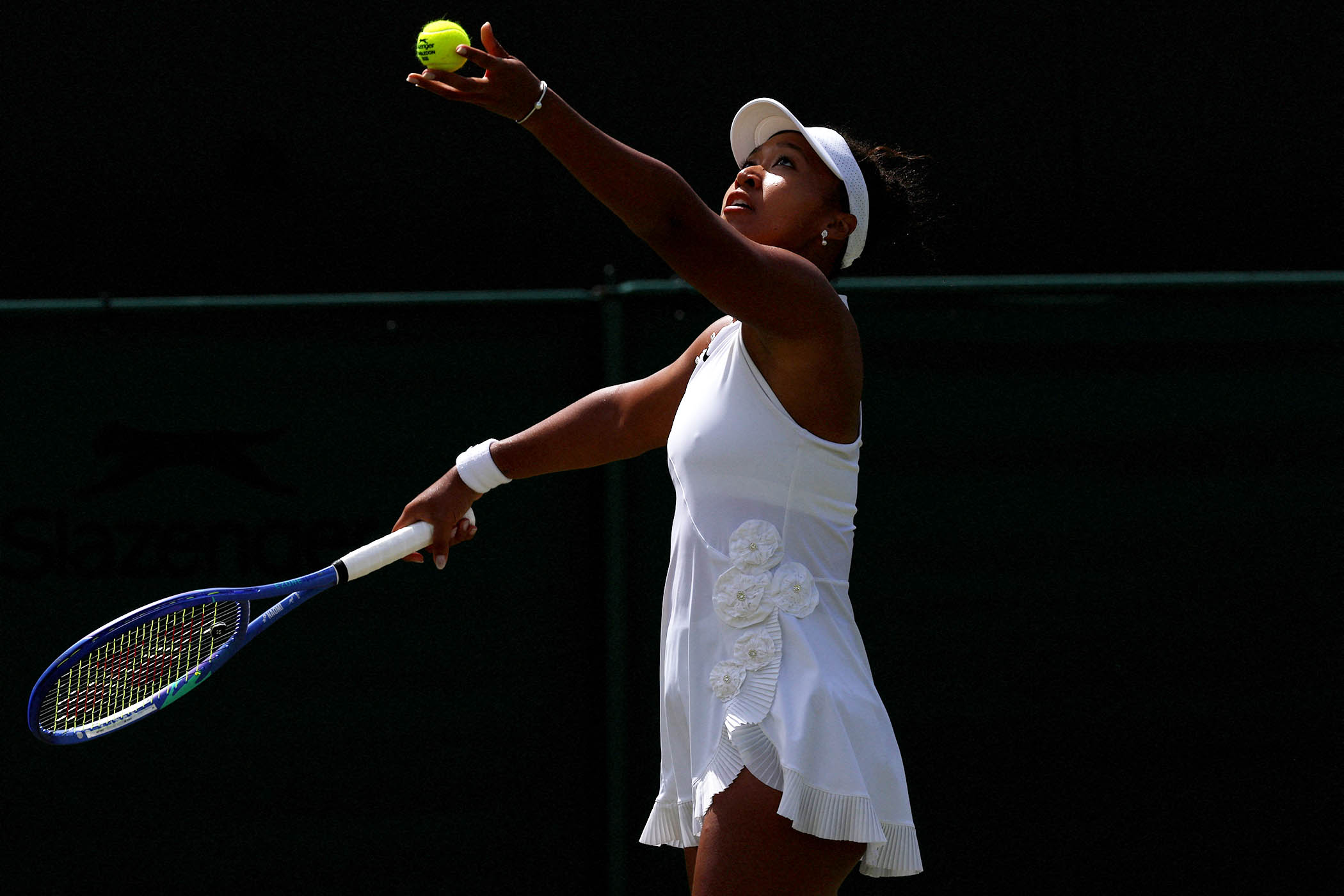

Few tennis players grind the social media commentariat’s gears as much as Naomi Osaka does. The ostensible reason for outrage is her decision to wear specially designed walk-on outfits. The underlying one would require a couple of psychoanalysts to unpick but from an armchair seems to stem from the age-old objection to a woman deigning to behave above her supposed station.
As Osaka walked out for her second-round match against Anastasia Gasanova, she was wearing a simple – by her standards – floral jacket, complete with floor-length train and obi belt. The four-time Grand Slam champion had also paid homage to her Japanese upbringing in her first round victory over Elsa Jacquemot with a “Kill-Bill” inspired kimono.
She said that the Wimbledon tradition of wearing all-white had made her think about her own cultures and heritage. “If I dive deeper into Japanese culture, I think about the most iconic silhouette, which for me is a kimono,” she said. “You don’t have to see the colour of a kimono to know that it is a kimono”
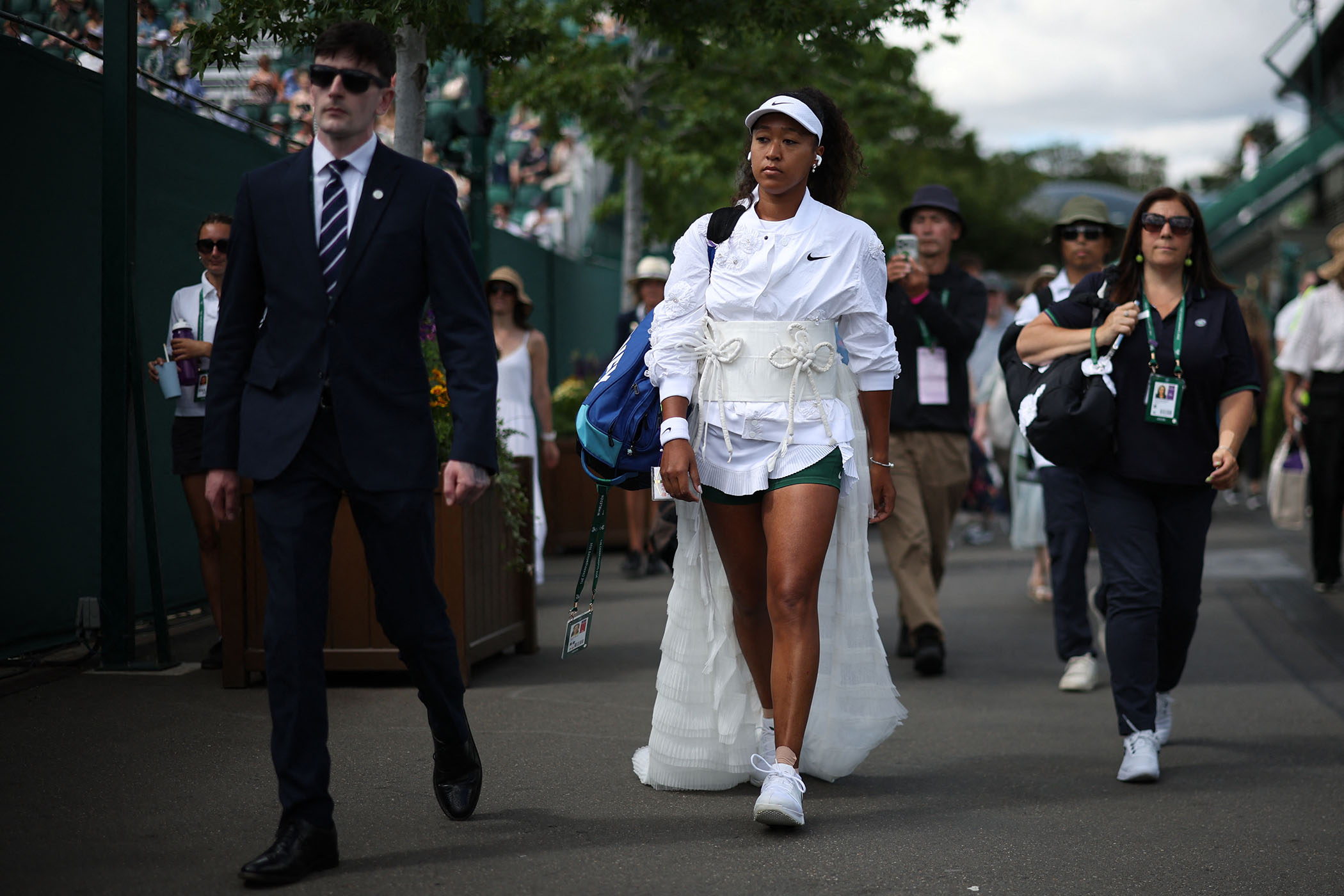
In some corners, there appears to be an assumption that by choosing to express herself through her walk-on outfits, she is taking away from herself as a competitor. It is a feat of mental gymnastics that can only be achieved by believing the misogynistic formulation that a woman who is interested in fashion cannot be interested in sports.
There was scant negative commentary about Novak Djokovic’s somewhat ill-fitting custom Lacoste blazer or Taylor Fritz’s homage to Roger Federer’s famous 2007 suit. It hardly bears thinking how that would have gone down if a woman with as many Grand Slam titles as Fritz (zero) had deigned to imitate someone like Federer. Fritz at least had the good grace to admit he would have looked “really stupid” if he had lost in the first round having walked out in it.
So what does Osaka as a competitor actually consist of? She equalled her best ever Wimbledon run by beating Gasanova in a quick 67 minutes on Wednesday morning. That comes after a run to the final of Bad Homburg last week, which she retired from whilst a set down to Karolina Muchova. In the past, she has excelled on the hard courts, winning her four titles at Melbourne Park and Flushing Meadows.
Against Gasanova, she was simply too powerful on serve for the qualifier to get anywhere near her. Osaka did not have to exert herself to find break points making it hard to judge whether her game has evolved enough to make a strong run on grass. But with the women’s draw a bit of a free for all, and Osaka on course for a fourth round match against world number one Aryna Sabalenka,
When Osaka was growing up, some of her early coaches expressed doubt about how much she actually liked tennis. Her older sister Mari was seen as the more driven one, with Naomi’s early focus more about attempting to beat Mari than pursuing the sport seriously. Throughout her career it has been clear that she has found the challenges of the limelight particularly tricky, refusing media duties and taking time away from the sport for her mental health.
Her focus on the fashion over the past year has drained oxygen from the room, and increased scrutiny on her. One objection made to it is the bad faith reading that her discussion of her mental health was simply about not wanting attention, and that this has heaped even more attention on to her. But amongst all that attention, it offers her an outlet that is separate from her on-court play, a suit of armour as costume.
During her match against Gasanova, Osaka does not make much noise but as she pushes through the second set a couple of “let’s go”s can be heard. It’s hard to actually watch her play and not think of her as a serious competitor.
Newsletters
Choose the newsletters you want to receive
View more
For information about how The Observer protects your data, read our Privacy Policy
Photograph by Adrian Dennis/ AFP via Getty Images