
Not that there is ever an ideal time in a hectic sporting summer to launch a new major competition, but this week of all weeks? The calendar is so full that for an embarrassingly long time I had entirely forgotten about the start of the Tour de France in Barcelona.
Rugby union outside the British and Irish Lions tours often has to fight for oxygen at this time of year. Being crowded out this week by sporting behemoths in the World Cup, Wimbledon, the British Grand Prix, Le Tour and the World Pickleball Grand Final was a distinct possibility. Alright, the last one is a bit mischievous.
This is a rough spot for the Nations Championship to be making its debut. This reconfiguring of rugby’s summer and autumn-tour matches has been designed to, in theory, give those quieter chunks of the annual schedule more significance, following the well-trodden path taken in recent years by football with the creation of the Nations League and in cricket with the World Test Championship final, to create more jeopardy in place of friendlies. Although if you can immediately recall the winners of the latest editions of both of those tournaments without checking, then well done.
South Africans still savouring a rare world title for the Proteas after several excruciating heartbreaks might understandably disagree, but both the Nations League and World Test Championship final still feel like secondary competitions, gap-fillers in the four-year cycle between World Cups, European Championships and Ashes seriesThe Nations Championship is designed to serve a similar purpose in rugby, pitting the teams from the Six Nations against the top six sides from the southern hemisphere – just go along with the generous interpretation of Japan belonging in the south – with three games for each team in the summer and another three in the autumn before a finals weekend at Allianz Stadium in November.
The finale is the most intriguing prospect, with the sixth-best side from the north facing the equivalent team from the south and so on, going up the ladder until the best team from each hemisphere meet in a grand final. A commercial golden egg at the end of the year which in future could potentially end up being played all over the world and going to the highest bidder. Qatar and the United States are potential destinations. The latter would make sense particularly in 2030, as a curtain-raiser for the following year’s Men’s Rugby World Cup on US soil.
The autumn internationals, a run of either three to four friendlies, have admittedly always felt a little flat with nothing riding on them. The loss of summer tours, however, is a shame. Having to tour New Zealand, South Africa, Australia or Argentina, playing three Tests over as many weeks, made for a superb assessment period for each of the home nations, ruthlessly exposing each side’s weaknesses and making them all the better for it.
Under the new Nations Championship format, traversing across the southern hemisphere – or in England’s case, racking up more than 25,000 miles by flying back home from South Africa to play Fiji in Liverpool as an ‘away’ game before heading to Argentina – makes for an insane travel schedule, far removed from the short hops made by the All Blacks and the Springboks around Europe in November.
To revisit the point of sporting congestion, the fact that half of the opening-weekend matches at the Nations Championship were shown on ITV1 was a triumph, even if the most alluring fixture of the lot, South Africa against England, was on to ITV4 due to the broadcaster’s World Cup coverage.
There were numerous intriguing plotlines in the opening round. How would the All Blacks fare in their first game under new head coach Dave Rennie, taking on an under-strength France? Whether Andy Farrell’s Ireland could continue their momentum from the Six Nations against Australia, who pushed the Lions close last year.
Could a rebuilding Wales cope with Fiji’s multiple attacking threats, and how would Scotland fare in Argentina without Finn Russell? And finally whether England – after such a disastrous Six Nations campaign that their captain for this summer, Jamie George, suggested they had been tactically left behind by their rivals – could ease the pressure on Steve Borthwick and give double world champions South Africa a scare at their Ellis Park fortress.
Newsletters
Choose the newsletters you want to receive
View more
For information about how The Observer protects your data, read our Privacy Policy
The quality in the earlier matches, it has to be said, was outstanding. A depleted France threatened to ruin Rennie’s debut, the All Blacks’s new half-back combination of Cam Roigard, who scored twice, and Ruben Love providing a glimpse of the future in guiding New Zealand to a tight 34-32 victory.
This is the age of the attack, with defences currently run ragged, and that memo also reached Australia and Ireland in their 10-try thriller in Sydney. Ben Donaldson’s long-range penalty would have secured a first win for the Wallabies in this fixture in 2018. His kick failed to curl around enough, meaning a 33-31 Irish triumph.
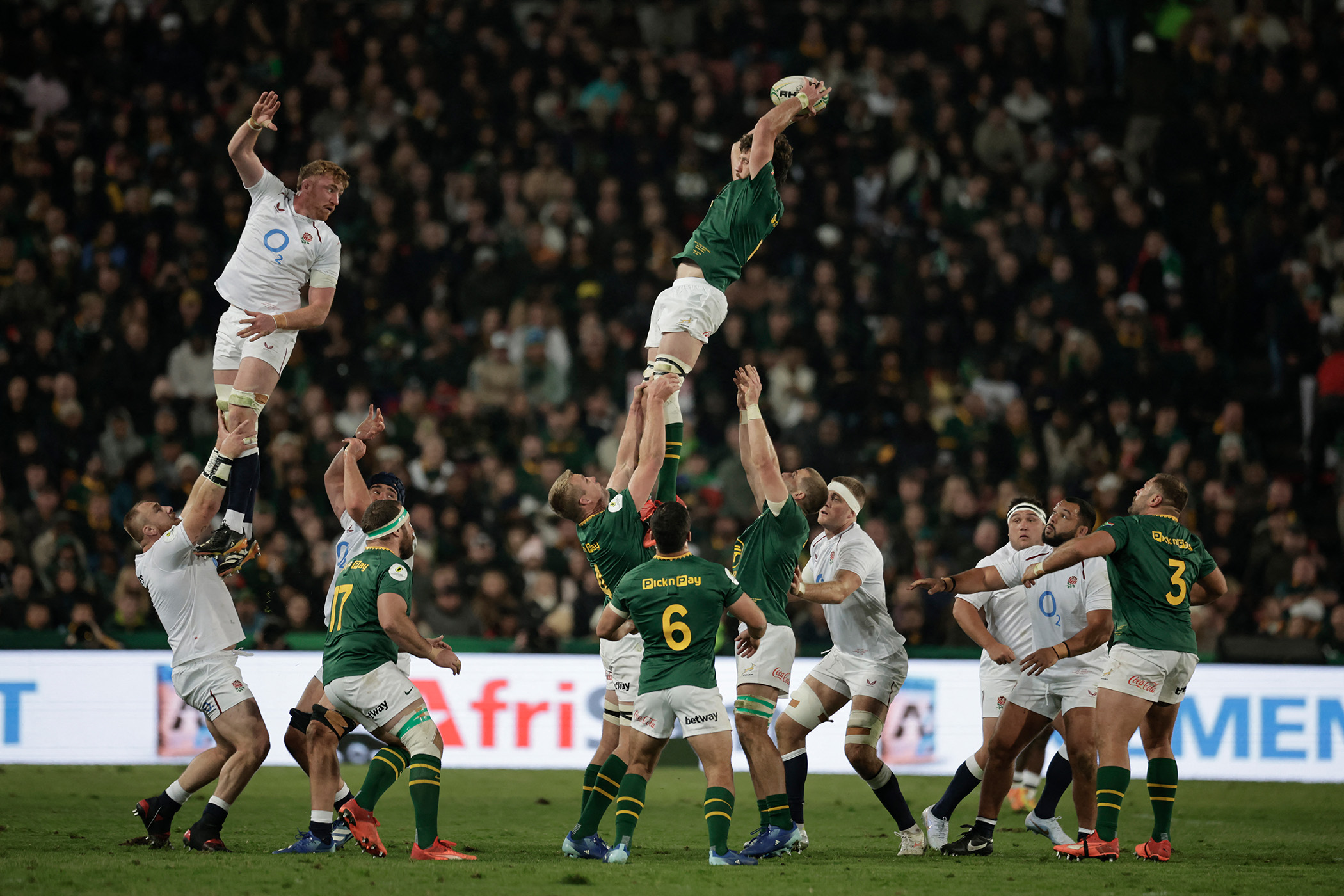
The bloodthirsty way that South Africa started ripping into a 17-0 lead had all the signs of a massacre until England belatedly found their feet, cutting the deficit to only three by half-time, in no small part thanks to a thundering George Martin score. But even with half their starting pack missing through injury, you can only contain the Springboks’s many threats for so long. An England humiliation would have been disastrous for Steve Borthwick. That said, the way that his side folded to lose 45-21, with two late yellow cards continuing their inglorious run of poor discipline, put this loss right in the disaster category.
Japan won well against Italy, 27-10, in spite of their head coach Eddie Jones being suspended for abusing match officials. And then there was the latest brick in the wall of the great Welsh rebuild, with Wales’s driving maul acting as the foundation for a 39-24 win over their ‘hosts’ Fiji in Cardiff, producing three tries. That marked back-to-back Test wins for Wales for the first time since the 2023 Rugby World Cup. Tangible progress.
As for the Nations Championship as a spectacle, this was an encouraging start. Perhaps this format can work.
Photograph by Phill Magakoe/AFP via Getty Images