The Sunday Stat: For the fourth time in their last five Tests – both matches this summer, plus the third and fifth Ashes Tests in Australia – England have been the slower-scoring team in the first innings, having had higher runs-per-over than their opponents in 38 of their 39 matches, dating back to the start of the 2022 series against South Africa in the first Bazballian season.
There is a famous old saying in Test cricket, dating back to its smog-shrouded, legend-festooned early decades, that states: “If you make five changes to a winning side, due to a cocktail of disciplinary complications, injury, childbirth and the selectorial alchemy required to field a balanced XI, meaning that (a) your bowling attack has a combined total of fewer than 200 wickets [for the first time since 2010], (b) you have only three players with 20 or more caps [for the second time in 35 years], (c) you have five players either on debut or playing their second Test [for the third time since 1952], and (d) you have a new wicketkeeper and a new-but-old captain, do not be surprised if you find yourselves staring defeat in the face at the end of the third day.”
The identity of the cricketing sage who first muttered this timeless wisdom is sadly lost in the swamp of history (which is currently in a sorry state, overflowing with jettisoned facts, fly-tipped knowledge and ignored warnings). However, the pertinence of the words was illustrated over the first three days of the second match in a curious series.
Little could be read into England’s first-Test victory, due to the randomising nature of the pitch, and equally little can be read into their second-Test struggles after the 1980s-throwback barrage of changes. The first innings runs-per-over difference (England scored at 3.46, New Zealand 4.05) might be further evidence that the rampant positivity of the early Bazball era has dissipated, or the inevitable byproduct of a regenerating batting line-up against a high-quality opposition attack.
The first-innings deficit of 100 was accounted for largely by Glenn Phillips’s excellent maiden century – both sides had seven players reach 20 in their first innings, but only Phillips made more than 60 – and a scintillating half-century by extras, reached in the 79th over. Only once in their Test history have England conceded 50 extras earlier in an innings, and on that occasion, in the 1934 Oval Ashes Test, Frank Woolley, aged 47 and very much not a wicketkeeper, deputised behind the stumps for the injured Leslie Ames, and conceded 37 byes.
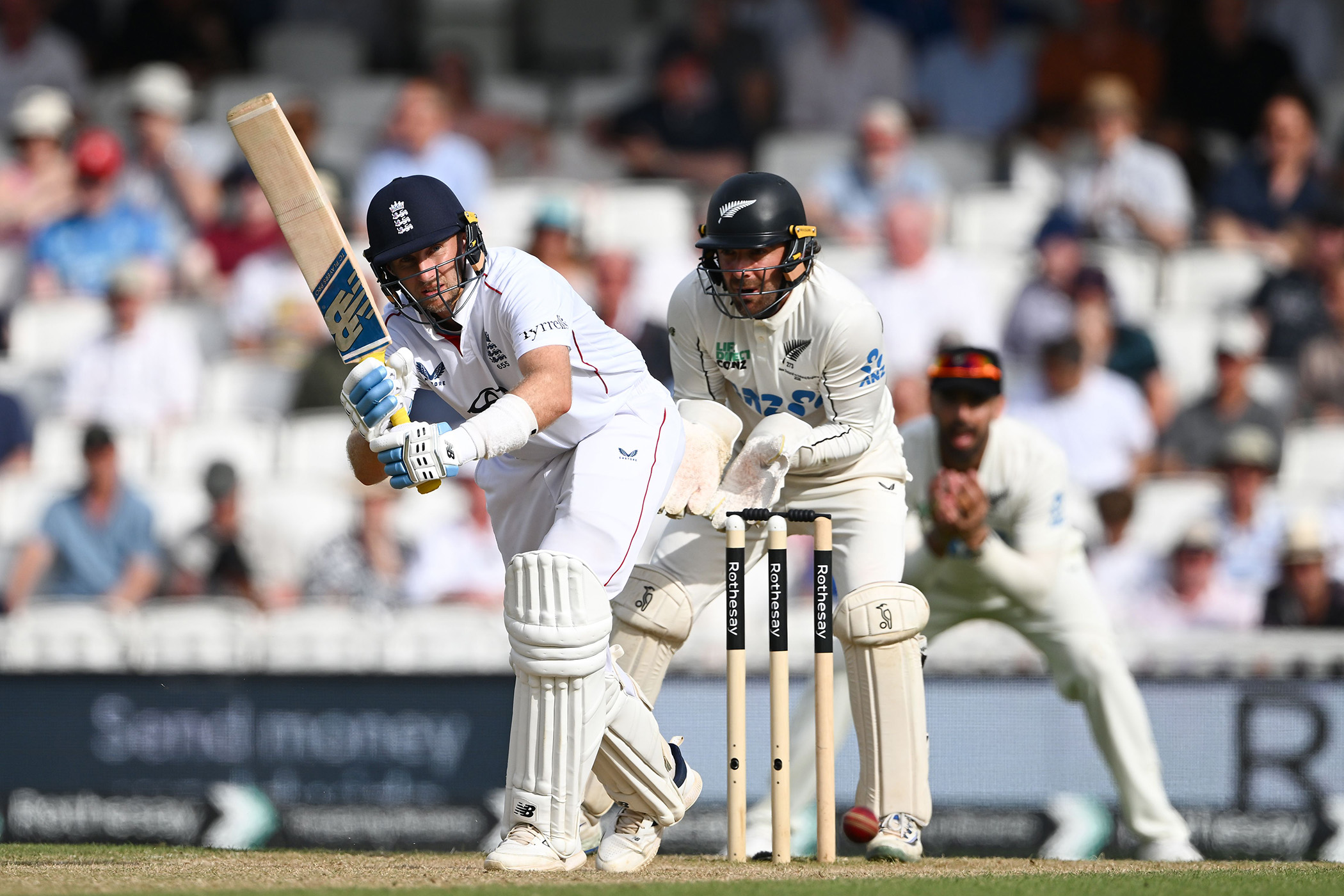
Unconverted starts was a recurring problem in last winter’s Ashes – between them, Ben Duckett, Harry Brook, Jamie Smith and Ollie Pope had 21 innings of 20 or more, but only one over 60. It has continued this summer, forgivably in the Lord’s snakepit, damagingly in the first innings at the Oval. Brook (24), James Rew (24) and Jordan Cox (27) combined for the first instance in Test history of England’s numbers 5, 6 and 7 all being dismissed in the 20s.
It has, thus far, been an unproductive game for England’s newcomers, but they found themselves undone in their first innings by an opponent who perfectly illustrate the difficulties of judging the qualities of a Test player based on early impressions.
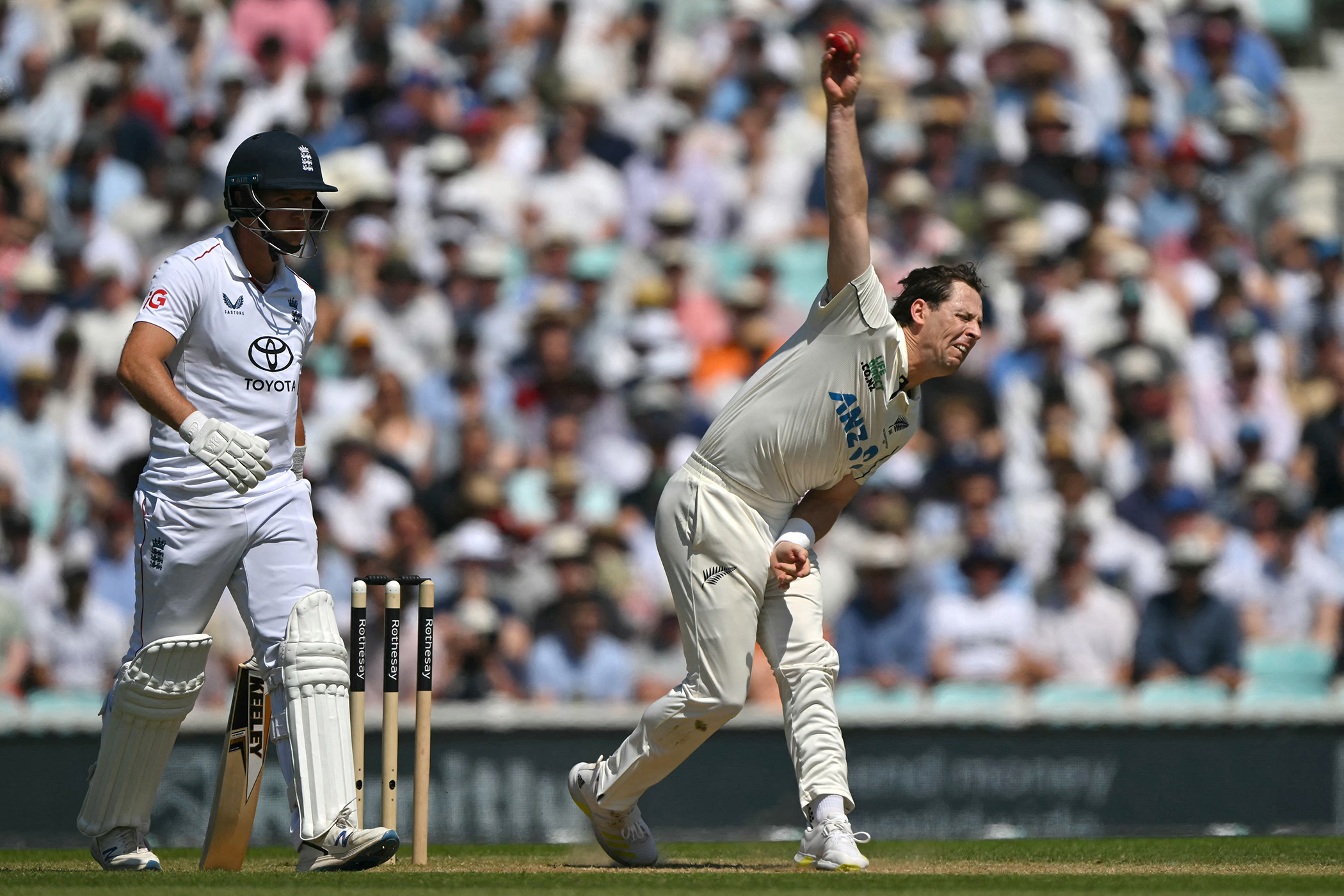
Matt Henry’s technique-probing craft brought him his sixth five-wicket haul in his last 12 Tests. After his first 13 Tests, sporadically spread over six years from 2015, and approaching his 30th birthday, Henry had taken 31 wickets at an average of 51.5, with a strike rate of a wicket every 95 balls. There was ample statistical evidence that, despite occasional successes and an improving first-class record, he was not good enough for Test cricket.
He was given another chance in the 2021 Edgbaston Test, and took six wickets in a dominant New Zealand victory. Since then, in his 30s, in 21 further Tests, he has added 109 wickets, average 20.3, striking every 40 deliveries, including 68 at 16.4 in his last 12 Test matches, 10 of which have been against Australia, India or England.
Of all the seamers who have bowled more than 600 Test overs after turning 30, Henry’s over-30 average is currently sitting at sixth or seventh-best (depending on whether you consider early 20th-century bowling genius SF Barnes a seamer, or a spinner, a matter which is still being litigated in statistical courtrooms).
Newsletters
Choose the newsletters you want to receive
View more
For information about how The Observer protects your data, read our Privacy Policy
Henry is therefore nestling among many of the global greats of fast bowling – behind only Barnes, Jasprit Bumrah, Richard Hadlee, Malcolm Marshall, Alan Davidson and Imran Khan, and ahead of Curtley Ambrose, Josh Hazlewood and Allan Donald, Glenn McGrath, Joel Garner and Freddie Trueman.
Jimmy Anderson and Stuart Broad both averaged around 40 in their first 20 Tests, before evolving to world class.
There is, no doubt, a famous old cricketing saying about being patient with new players, but sadly, in this impatient age, everyone was too busy to look it up.
Photograph by Glyn Kirk/AFP via Getty Images