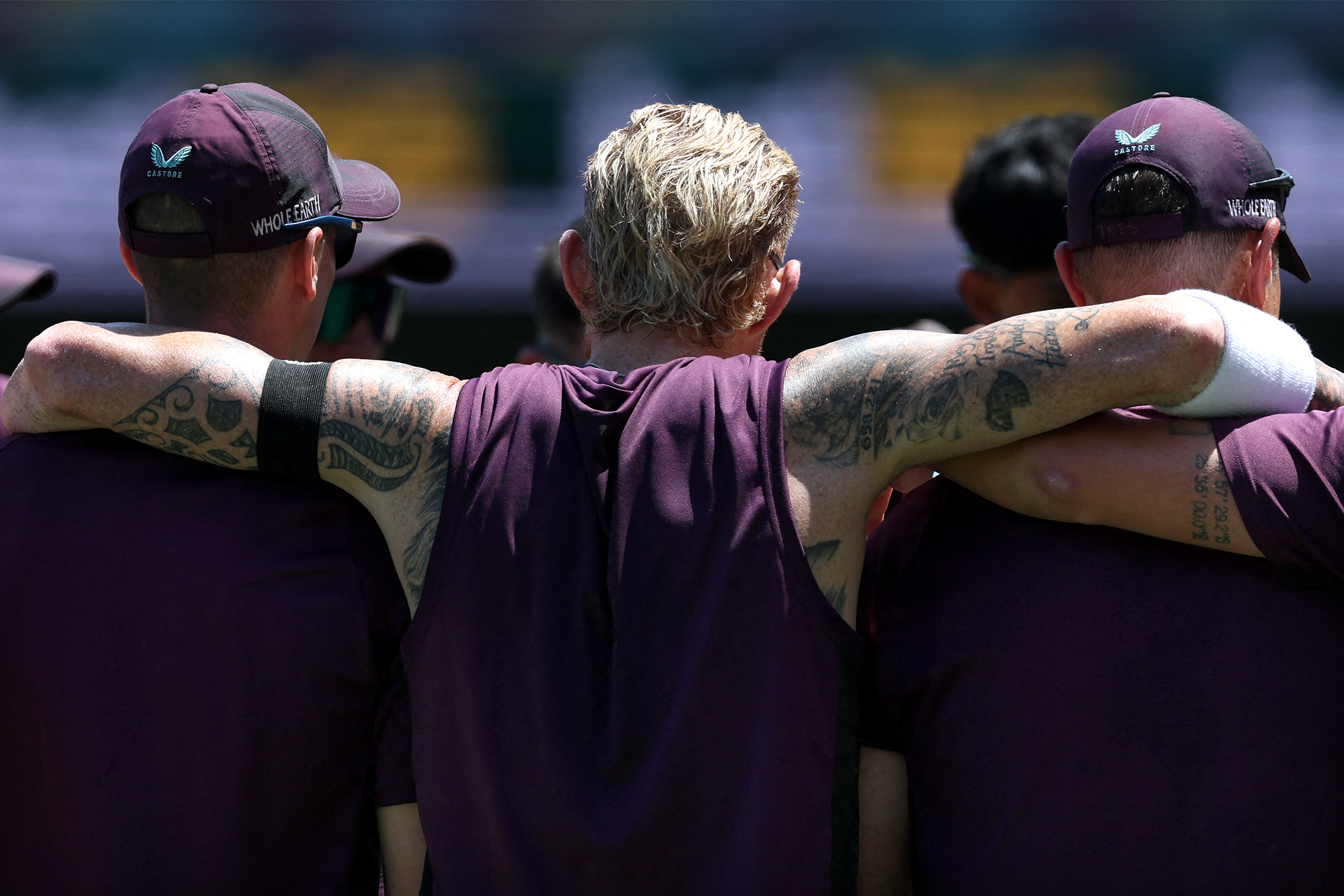


Could all the weak men and women please take one step forward? Those unsure of the definition should ask whether they have tried to hit a cricket ball in ways inappropriate to the circumstances of the match.
“There’s a saying out here that Australia isn’t a place for weak men,” said Ben Stokes after the disastrous Brisbane Ashes Test, sounding like an Outback tourist guide. “Well, any dressing room I’m captain of isn’t a place for weak men either.”
No country for bold men either, if boldness means refusing to let a delivery pass harmlessly to the wicketkeeper. Or if it means playing the same silly shot that got your mate out five minutes earlier. Stokes’s rebuke to this England team was his second inexact use of sweeping language. His first was calling the legends who had criticised England’s non-preparation “has-beens” – a putdown he regretted and retracted. Then came a strike at the current side’s character, their moral fibre, almost, as he questioned their ability to cope with pressure.
Ability – or willingness? There falls the shadow. And while it is easy to see why Stokes, in his humiliation, reached for the reductionist terminology of weak v strong, his beef was with a broader mindset: indiscipline, self-absorption, and a failing that all captains and manager hate – the internal voice that says, this collapse isn’t my problem, accountability is for others.
Players who were granted a licence to “entertain” by the deceased brand known as Bazball could respond that it is the authors, not the practitioners, of swashbuckling cricket who have most to answer for. These England players will be praying the theory gets all the grief – not them.
Stokes was right to get stuck into Ollie Pope, Zak Crawley and Harry Brook, but none of those authorised the short-ball bowling fixation that Australia shredded, or neglected, when the series started, to insist on pragmatism, or calculation – the best way to give yourself a chance of winning an Ashes series in Australia. That is on Brendon McCullum (the coach), Stokes and Rob Key, the England men’s managing director at the England and Wales Cricket Board.
Fecklessness is a charge that sticks to Brook. Recidivism is one that fits Pope and Crawley snugly. But the nuclear option of alluding to “weak men” is one Stokes will probably come to regret. He needs the team to be behind him in Adelaide, not stewing from a character assassination. It’s an easy mistake to make. Even when a public excoriation is correct, the damage usually outweighs the gains.
Sport rolls around in the language of toughness, resilience, mental strength. It fetishises mind over matter and never giving in. These are real qualities. Millions draw inspiration from the 12th-round comeback, the winning penalty in a shootout, the hero captain putting their body out front.
It pays though to bear in mind that strength is nuanced – and personal. On the day Stokes was calling out the weak men in his team, people with advanced motor neurone disease (MND) were gathering along Kevin Sinfield’s fundraising route in Scotland. Each was trapped in a mortal struggle healthy sportspeople could not even imagine.
Which is not to deny sport’s right to bathe in “heroism”, as this week’s BBC Sports Personality Awards will. It’s more that binary strong/weak categorisations don’t illuminate what’s really going on out there.
Newsletters
Choose the newsletters you want to receive
View more
For information about how The Observer protects your data, read our Privacy Policy
Even “choking” – in a Wimbledon final, say – isn’t the tombstone spectacle we frame it as. This year Amanda Anisimova lost the Wimbledon women’s final 6-0, 6-0. It didn’t stop her reaching the US Open women’s final eight weeks later: a small miracle of psychological recovery.
Another was Rory McIlroy winning this year’s Masters, which made him warm favourite to beat Chloe Kelly and Lando Norris for the main prize at the BBC’s pageant, which still has its place as a chance to relive the year.
McIlroy’s Masters win exemplified grace under pressure. Augusta had tortured him from the day he blew a four-shot lead on the final day in 2011, when he swiped a drive into the trees around some cabins and proceeded to fall apart. When he finally made amends in April this year he hadn’t won a major title for 11 years.
McIlroy lost this year’s Masters – then won it back, blowing his lead in the last six holes, landing himself with a play-off, then marching back out with consummate poise to win a shootout with Justin Rose and complete his career grand slam of The Open, US Open, PGA Championship and Masters. Every stress and strain of elite sport was compressed into those two dramas at the 18th – one “tragic”, the other redemptive, minutes apart.
On that scale of so-called strength and weakness, it’s probably not a congenital flaw that’s undermining England’s cricketers; more a culture that they’ve succumbed to, and now hide behind. Stokes’s use of “weak” was an imprecision that has created a whole new sideshow.
There is another interesting truth around what we call weakness. Most of the time people in sport can control what they are doing, which is why they are in the England side, in a Wimbledon final or top of the Masters leaderboard. Sometimes, they can’t, and conventional notions of “strength” won’t help them, because they’re human, and it just becomes all too much.
Photograph by David Gray/AFP via Getty Images