
F. Scott Fitzgerald famously said that there were no second acts in American lives; there are vanishingly few in Australian cricket. Retirement these days, of course, takes the form of a striptease – first you give up ODIs, then T20s, then Tests. But when you’ve shed that last vestige of your former playing self, it is time to put on a blazer and dish out hot takes.
Now, however, Steve Smith is having an unexpected sequel, so successful it might even stand on its own. In the first run of his captaincy, Smith’s record was a commendable 18 wins and 10 defeats from 34 Tests; in this second run, as Pat Cummins’s occasional substitute, his record is an extraordinary seven wins and a draw from eight matches.
His batting in the context of leadership is also worth citing. As skipper between 2014 and 2018, he averaged 70.4 versus an overall average of 61.4; as skipper since, he averages 58.3 versus an overall average of 49.8. That reflects a modest slippage from the gargantuan heights he achieved in the first half of his career, while also a continuation of the possibility that to his batting the captaincy is more help than hindrance.
Is Smith a better captain than he was? Or is he leading a better Australian team? The latter may be true, but it is worth allowing that Smith has only captained Australia recently in the absence of Cummins, who happens to be the country’s best bowler. It recalls what used to be said about Pakistan’s duelling captains in the 1980s and 1990s – that while Imran Khan always had Javed Miandad in his side, Javed seldom had Imran. In these Ashes, Smith has been without Josh Hazlewood, too, and he led Australia more effectively without Nathan Lyon in Brisbane than Cummins did in 2023.
My sense, allowing that these things are hard to judge from afar, is that Smith, this time round, is a more resourceful and complete skipper au fond.
Initially, Smith’s captaincy was a furtherance of his batting – his capacity for the example-setting of huge scores and long partnerships. It unfolded largely in the pre-World Test Championship period, when pitches were generally flatter and totals larger, which played to this strong suit.
He could also be an open book who rode high on success, and was prone to abjection amid team and personal failure. See Hobart in 2016 after losing by an innings to South Africa: “I’m embarrassed to be sitting here… The boys have got to start being a bit tougher and getting in a grind and getting in a contest and try to build a few partnerships because right now it is not good enough… It comes down to that resilience and having a good defence; at the moment our defence is being challenged.”
See Dharamsala in 2017, an eight-wicket defeat by India in which he scored a century: “I set myself high standards and I wanted to lead from the front with my performances. I’ve been very intense in my own little bubble and at times I’ve let my emotions and actions just falter a little bit and I apologise for that.”
This first avatar of Smith was not a captain who gave much thought to culture; instead he fell in with a culture defined by personalities larger than his, in coach Darren Lehmann and deputy David Warner. In this, of course, one can see the seeds of his downfall, for it is impossible to reckon with this second captaincy act without recalling how the first ended, in the ignominy of Sandpapergate. An overlooked dimension of Sandpapergate is that it coincided with the first pressure on Smith’s batting of his tenure. He had made 142 runs at 23.7 in South Africa coming into that fiasco, coming off an Ashes summer in which he had made 687 runs at 137.4. For a cricketer who expressed himself chiefly by his performance, that was a burdensome distraction, and perhaps a weakener of judgment. For one who defined himself by his cricket, that year-long suspension was then a true penance.
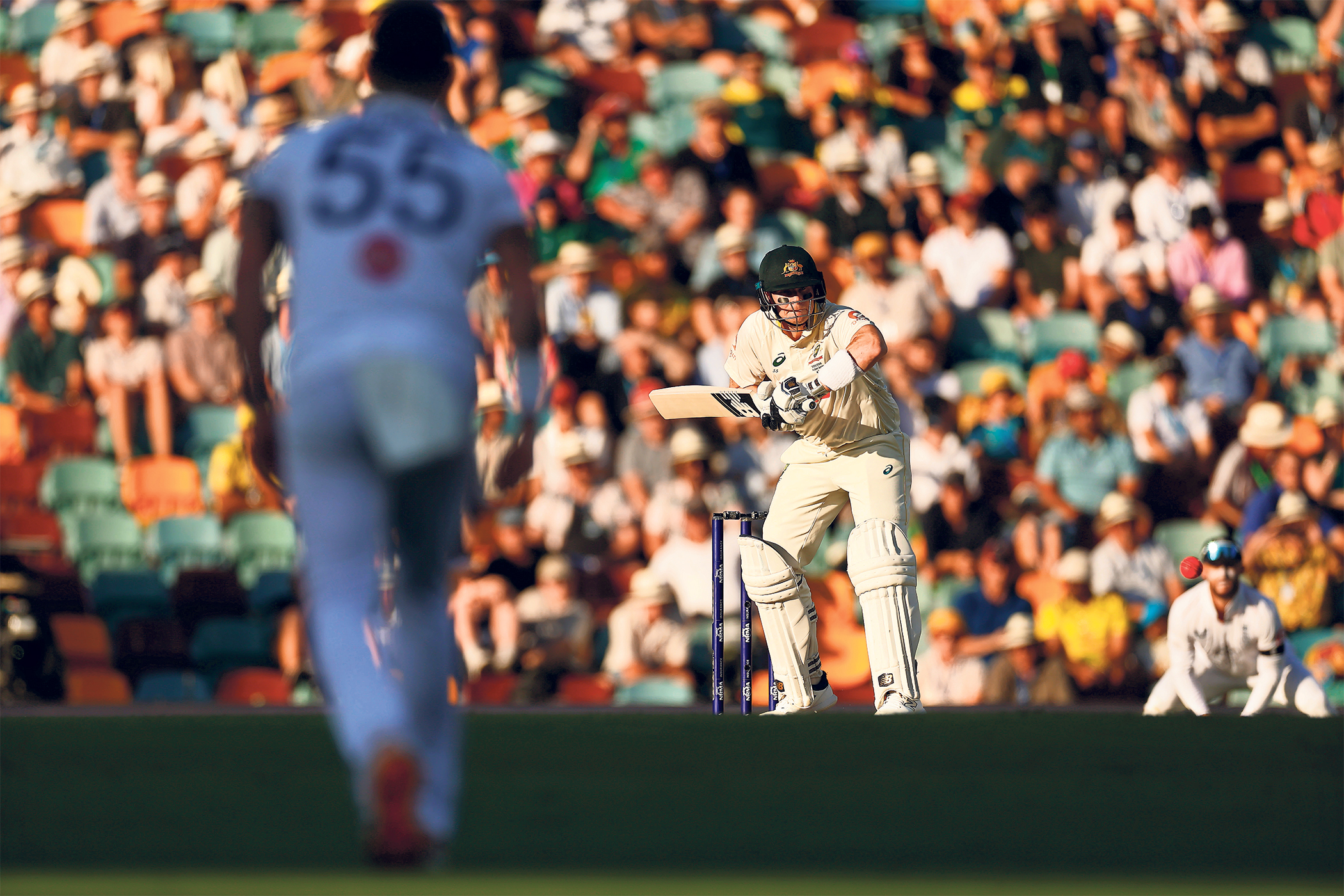
Smith today still looks pretty much like Smith then. There is the same totality of involvement; there is the same eager, almost boyish manner; there is the same repertoire of curious gestures, including my personal favourite, where he extends his arm to point, gloved palm upwards, as though about to address Yorick’s skull. Smith also remains capable of being quite childish, as when he took on Monty Panesar in a press conference the day before the Perth Test.
Newsletters
Choose the newsletters you want to receive
View more
For information about how The Observer protects your data, read our Privacy Policy
But there’s a difference. Smith is 36. Batting would not be getting easier for him, even were it not for the WTC and its trend to result pitches. He has been thoroughly worked over by oppositions, and dabbled unhappily in opening: the avidity with which he now holds on to the No4 position reflects a loyalty to what he perceives as a formula for success. Circumstances have drawn him out: he can no longer be a one-dimensional captain reliant on his bat. Cricket captaincy, furthermore, is a skill at which you can go on getting better, because you have encountered more scenarios, survived more pressure, dealt with more people, played in more places. There are times you are more receptive, adventurous, happier, grimmer than others, and Smith is in the pink of captaincy form.
I suspect, too, that, partly because of the legacy of Sandpapergate, there is a more sympathetic and holistic support for the Australian captain in the era of Cummins, and that it is not dependent wholly on his presence. For me, Australia’s most impressive performance of the previous WTC cycle was the 2023 Indore Test. Australia had been thumped at Nagpur and Delhi, and the venue for the third match of the four-Test series had been switched at the last minute from Dharamsala, which it had been hoped would provide an opportunity for Australia’s pace bowlers. Cummins had gone home to be with his dying mother, and there was a lengthy break with no cricket scheduled – much like England’s break now, and we know how well that’s playing.
Yet the atmosphere around the squad was completely calm, and Smith disarmingly buoyant, even when he lost the toss and India opted to bat on another made-to-measure pitch. To his unexpected office, the fill-in captain brought tremendous vitality and invention. Standing at slip, sweaty attire shaded with red dirt, he manoeuvered, chivvied and gingered, while Nathan Lyon took 11 for 99 and Australia won by nine wickets. He was also suitably modest afterwards, describing his successful unit as “Patty’s team”. The game was almost ignored at home – it could not bear on the Border-Gavaskar Trophy, already in India’s keeping. But it was a triumphant affirmation of character and of captaincy.
At the moment, the role of locum kind of suits Smith. He can perform the parts of captaincy he enjoys, on the field; he is excused the chores of glad-handing officials, greeting prime ministers. But I wonder: could Australia’s next permanent captain be….Steve Smith?
Cummins turns 33 next year. Although one presupposes him playing into 2027, by then his body will be crying out for a gentler schedule. Smith will be 38, younger than Usman Khawaja now. He has no children; he is wedded to cricket; not sought after by the Indian Premier League, he seems to have reached a perfect equilibrium, spending long periods in New York between short, intense bursts of preparation. Smith also appears to be thriving on his challenges. His mano a mano duel with Jofra Archer at the end of the Gabba Test showed a player still relishing the cut and thrust of the contest, and his remarks afterwards were even more delicious. He called it “good fun” and “good banter” that “stays on the field”.
“What history do I have [with Archer]? He was just bowling good pace. I’m not really sure what he said. I’m not really sure what I said. And it’s not really any of your business, either [laughs], so we’ll leave it out there.”
All his life Smith has been compared with Bradman as a batter. Might he eventually emulate the Don as captain, and lead his country at 40? That would be an improbable third act. But who would have foreseen this second?
Photograph by Darrian Traynor/Getty Images