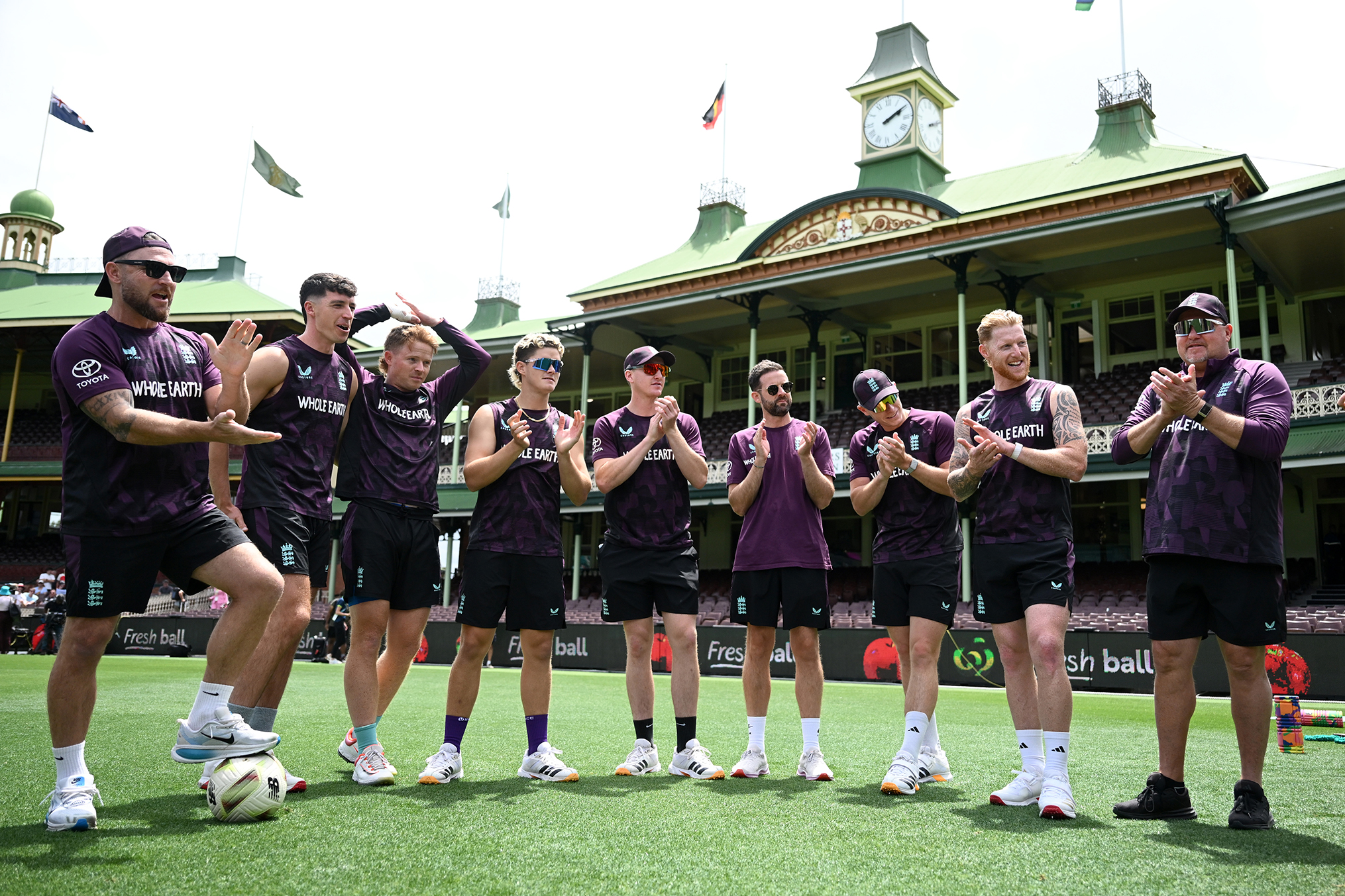


And so the Ashes crawls into Sydney, parched and shivering in the midday sun, dragging itself to the finish line by the final strands of fraying narratives and dreams, by the withering facade of enmity and meaning. Most English players haven’t been home since the start of October. This might not be the fifth Test we wanted, but it’s the one this sleep paralysis demon of a series deserves.
Something between a final blow-out and death rattle awaits for an Australia team which has largely held together across five Ashes series and eight years, but can hold no longer. It would be no great surprise if 10 or more of the current squad have retired by England’s next tour here, including the Fab Four – Pat Cummins, Mitchell Starc, Josh Hazlewood and Nathan Lyon – as well as Usman Khawaja, Scott Boland and Michael Neser, plus Steve Smith and Alex Carey, while at 36 Travis Head might have fallen apart or chosen to chase the franchise dollar. Marnus Labuschagne might only have one more chance to salvage his Test career, while Jake Weatherald’s miserable conscription is almost over having averaged 20.85 through the first four matches. Even of those on the periphery, Sean Abbott will be 37 in 2029, Beau Webster 36. It’s the end of the Ashes as we know it, and, frankly, England should feel fine about that.
Here is their chance to begin their own dynasty, their own 15 years’ dream-crushing dominance. They certainly have a headstart – Joe Root, Ben Stokes and Mark Wood are the only players from this tour likely to have been aged out of the next. There are increasingly solid foundations, a centre which should hold. Jofra Archer, Josh Tongue, Gus Atkinson and Brydon Carse are a varied and piercing attack. Root and Stokes should both last until 2027, unlikely to be true for at least Lyon, Hazlewood and Boland. England are already overwhelming favourites to reclaim the urn.
And still there is outrageous talent coming through the age groups and county game in basically every position. You’re about to hear a lot about Ben McKinney’s long levers, the significance of Asa Tribe’s ton in Brisbane, about the brothers Rew and Ahmed, Eddie Jack, Josh Hull, John Turner. Jamie Smith is 25, Harry Brook 26, Gus Atkinson and Zak Crawley 27. Crawley remains a fascinating figure, averaging 39.21 against Australia and 31.55 against India throughout a 63-cap Test career, more than Graeme Swann and Jonathan Trott. He could still play for a decade, or be dropped next summer, but has become oddly dependable.
Back in November, it felt as though England were at the start of something, and two months later, despite everything, it still does. This is Stokes’s team now more than ever, and for all the talk of his unflinching loyalty, as though he’s a labrador condemned to lie on his master’s grave, he is far too ambitious and close to the end to blindly support the Wizard of Baz if he does not believe in his magic. There is little obvious issue with England’s playing corps or talent pool – the greatest future threat is the same thing which condemned this current side: managerial incompetence.
“I can’t see there being someone else who could take this team from where we are now to even bigger heights,” Stokes said on Friday, as much an indictment of the state of English cricket administration and management as boosterism of his own genius. “Ashes tours in the past haven’t gone well. But if you do what we did four years ago, we’ll just end up in the same situation.”
He is largely right. The response to the past seven weeks should not be to blow it all up, then conduct a long and arduous search for England’s most boring man and play seven warm-up games on specially prepared wickets in 2029-30, the equal and opposite reaction approach. Neither should it be a reversion to repression-ball, handing the keys to public schoolboys who call their dad “sir”, is not going to help anyone. Suffering does not have to beget suffering. The England set-up needs a facelift, not a transplant. Given the total lack of other obvious options and the money at stake for their sacking, Brendon McCullum and Rob Key should get another chance to prove they can learn from their errors, rather than starting again from the position of maximum incompetence.
And at worst, Stokes and McCullum might have been early, and have unquestionably failed in their execution of basic preparation, drunk far too much of the Kool-aid. But they weren’t wrong. The two most prolific bats in this series – Head and Carey – are also two of Australia’s five quickest run-scorers ever, their Test strike rates only trailing Adam Gilchrist, David Warner and Victor Trumper. This is not a coincidence.
In 2025, KL Rahul was the only one of the world’s top 20 Test run-scorers to score at less than a run every two balls (48.50). 13 of that group scored at over 60, seven over 75. In the wobble-seam era of Test bowling, aggressive batting has become necessary investment rather than frivolous risk, and also what most of these players are being prepared to excel at. Another indicator of this is the collapse of the No 3s, the position which requires the most psychological flexibility and resilience – in Tests against the top nine nations last year, those coming in at first drop averaged 25.48, a record low.
Test cricket is already slouching towards Bazball, solid defences an inevitable victim of the white-ball era, the IPL Century. There will be more two-day matches, and that will be ok. But we are less than six months on from England-India, one of the best five-match runs of the modern era, where there was play on all 25 available days of the series, and only occasionally scuppered by rain. For all but the most ardent traditionalist, there is a fair argument the game is as entertaining as it has ever been, reflected by the viewing figures and lack of draws.
Newsletters
Choose the newsletters you want to receive
View more
For information about how The Observer protects your data, read our Privacy Policy
As is often the case after these tours, it is six months until England next play Test cricket after Sydney, a genuinely ridiculous failure of scheduling, an excellent chance to forget any lessons learned, to push lingering problems further and further away until they can be quietly hidden and allowed to fester. McCullum will now oversee the T20 World Cup, and abject failure in India and Sri Lanka would likely make the ECB’s decision on his future for them.
Yet from the wreckage of one dream, hope springs anew. It could even be in both sides’ interests to lose in Sydney, England for some clarity on what this series means, Australia to help expedite the coming of a new age. This is the end of something. Maybe it’s the end of everything.
Photograph by Gareth Copley/Getty Images