The seventh leg of the 2023 World Darts Championship final, Alexandra Palace in its winter dress. Michael van Gerwen is one set up against Michael Smith, then the sport’s great choker. Van Gerwen falters eight darts into a nine-darter – the perfect leg – Smith goes one better. “I can’t spake, I can’t spake!” screams commentator Wayne Mardle, channelling a classic rugby league clip.
If you’ve only watched one leg of darts, it was probably that one. If you’ve watched a million legs, you’ve probably seen that one the most. It’s on YouTube under “The best leg of all time”. But it is possibly also the greatest piece of sports broadcasting, a masterpiece of televisual storytelling and technical skill in just over a minute and a half.
Between Van Gerwen’s first dart and the first replay, 77 seconds elapse in which the camera cuts or zooms 41 times, each orchestrated by director Sean Randle – a distinct cut every 1.9 seconds for over a minute. There are split-screens and 180 zooms, wide shots of the euphoria and close-ups of brains being crushed like tin cans. The leg, and darts as a sport, could not be the cultural behemoth it is without them.
For comparison, the first televised nine-darter, hit by John Lowe at the 1984 World Matchplay, lasts 35 seconds longer but the camera cuts only 17 times, meaning broadcasting darts has sped up around 3.5 times over 40 years. Part of this is players throwing faster, but mostly it is the constant refinement of a sport that has become the best on TV.
Video village
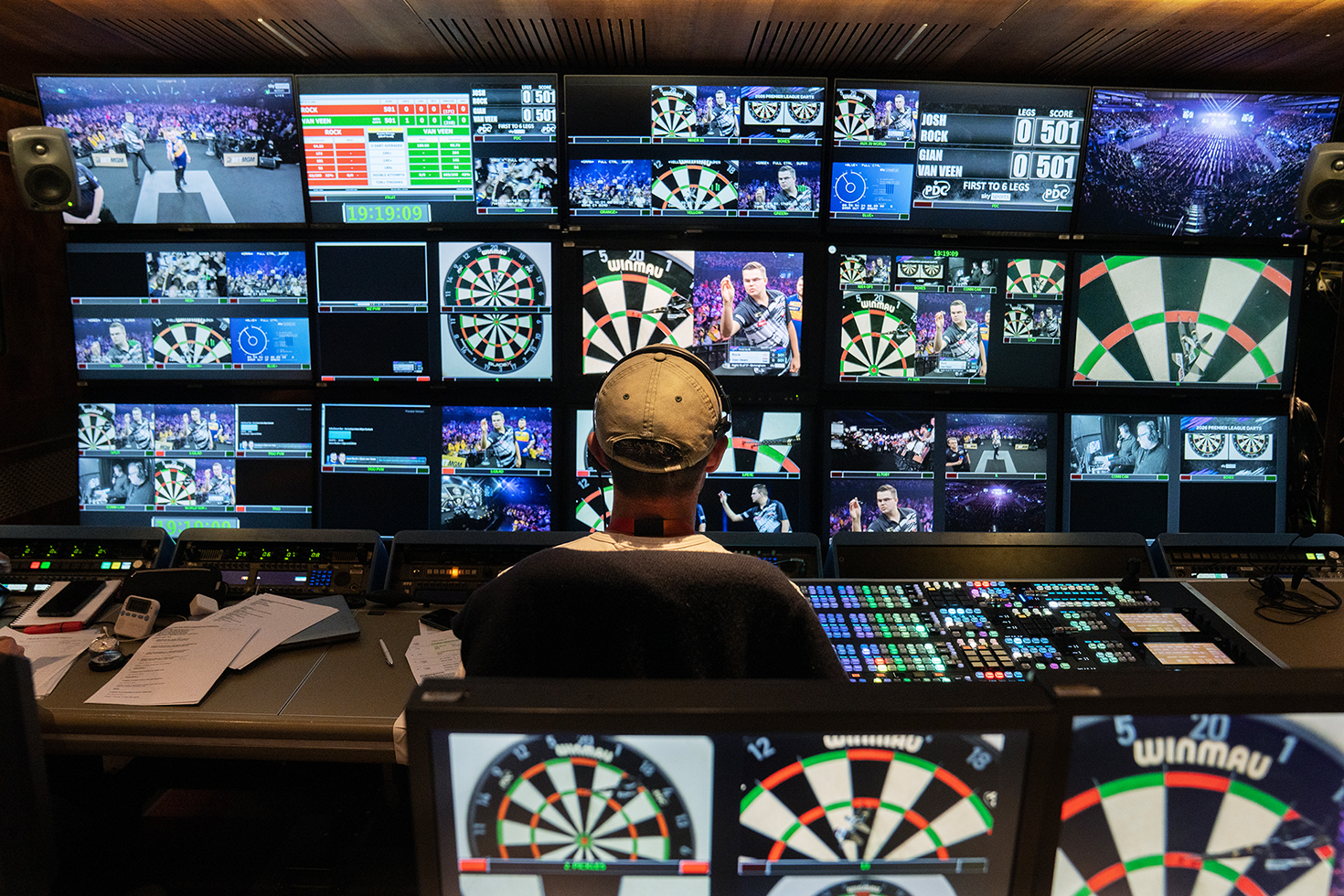
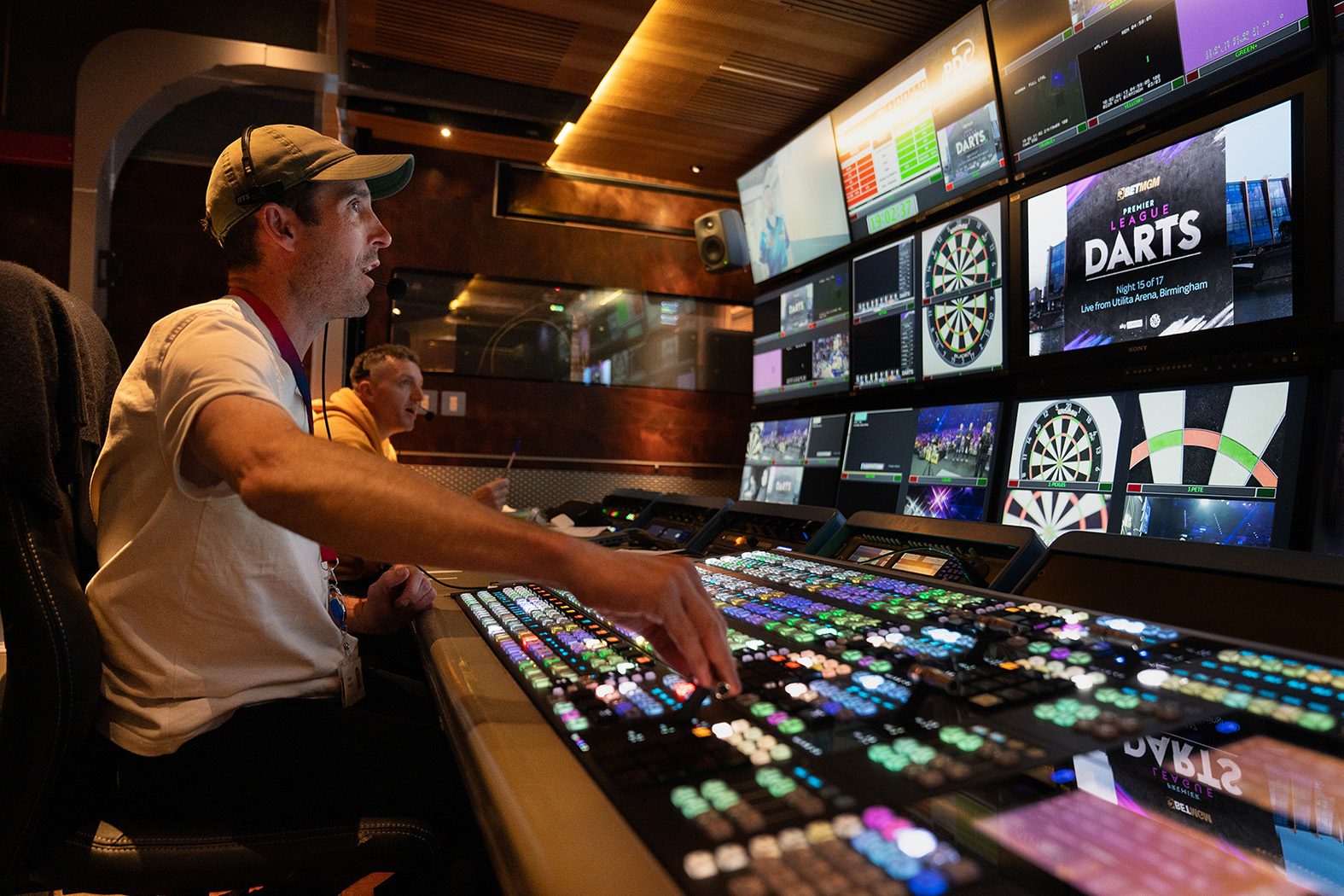
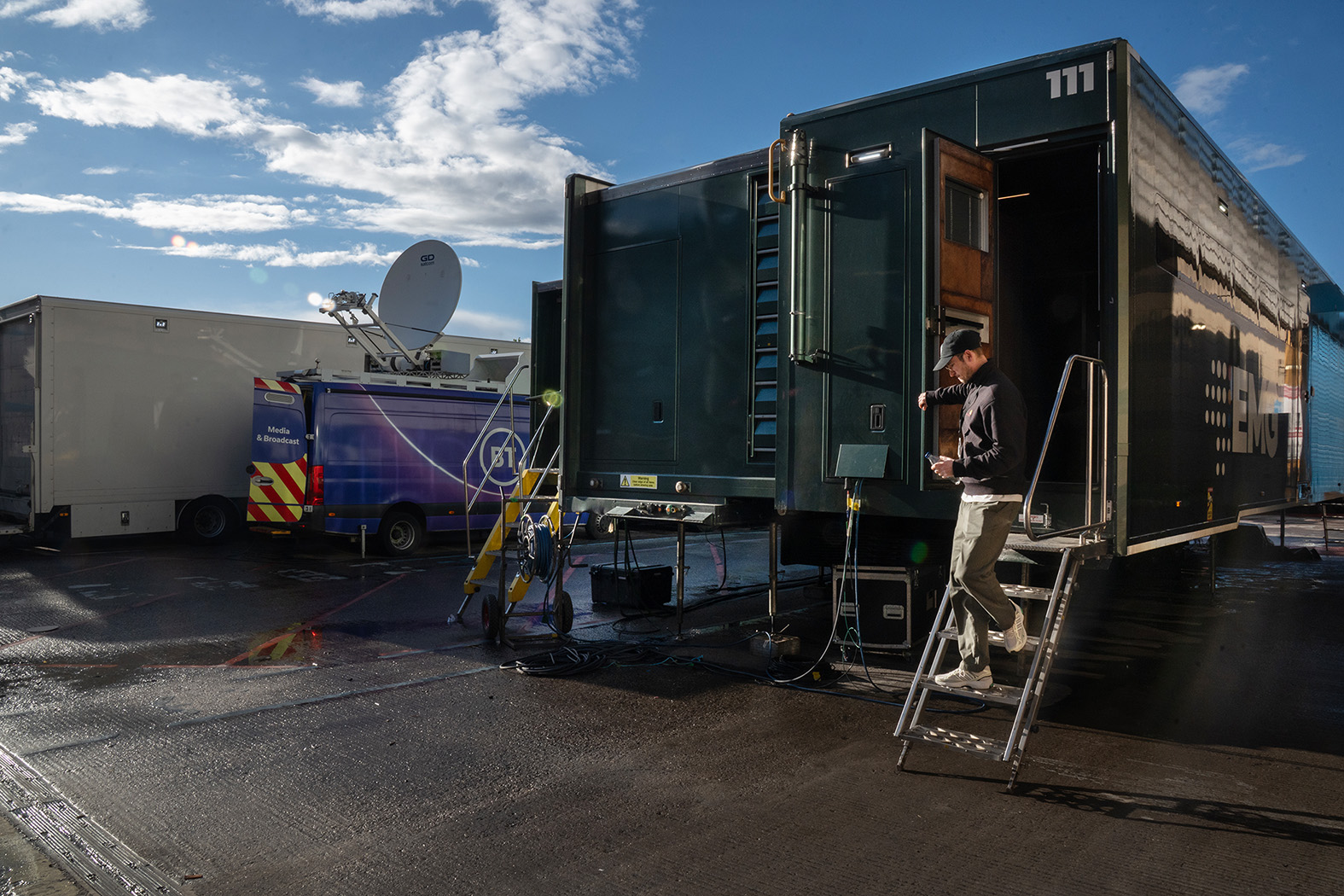
It’s a balmy Thursday night in a Birmingham car park as I clamber into a converted lorry that could host the intelligence operations of a small nation. Fifty-five screens line one wall, 20 more another row forward. There are 8ft computer units whizzing and whirring on one wall, four sound engineers crammed into a side room. This rig broadcast the Baftas the previous Sunday, but its day job is darts – this is its 15th Premier League night of 17, every Thursday from February to May, from Berlin to Belfast to Brighton. Sky paid the PDC a reported £125m to broadcast the darts until 2030 and for all they flirted elsewhere, the governing body knew nowhere else could begin to match their coverage.
Everyone seems to agree that directing the darts is the hardest job in sports broadcasting, perhaps all television. Training even experienced directors requires a year working on a dummy set before they are trusted with the real headset and buttons. Randle has worked at Sky for 22 years, and been part of its darts coverage since before it left Purfleet’s Circus Tavern in 2008. As here in Birmingham, he regularly works alongside producer Joe Clark Smith, who sits directly behind him. For a sport that thrives on chaos, the truck is eerily calm because everyone is so experienced, so comfortable in the flow state, a perfect equilibrium.
“Sport is all about the emotion, and darts players generally give us that in spades,” Randle says. “A lot of hard work goes into covering not just the dart going into the board, but the whole story around the match, whether it’s someone who’s just missed the winning dart, or their family in the crowd, or the audience rising for a potential nine-darter.
“You learn players and how quickly they step up to the oche. Have I got enough time to get one replay in? What about two? You’re working everything out in ultra-fast time.”
Perhaps the greatest challenge in broadcasting darts is the lack of a “camera one” safety net – in football or rugby, a full-pitch shot. No camera is powerful enough to precisely show darts going into a full board, so split shots are necessary. Every cut has a reason, forced by action that never stops. It is relatively rare for any single shot to be held longer than two seconds, particularly as checkouts approach. In each player’s final visit of the Smith/Van Gerwen leg, the footage cuts to the player’s face between each dart thrown, less than a second.
Newsletters
Choose the newsletters you want to receive
View more
For information about how The Observer protects your data, read our Privacy Policy
“In any other sport that would be the most jarring experience,” Randle says. “In darts, it just works.”
The spotter
If you have ever questioned how the camera seems to predict where a dart is about to be thrown, the answer is almost invariably the spotter. Charlie Corstorphine, who doubles as a PDC referee, sits in front of two screens – one showing the broadcast, the other the player’s eyes. His role is to anticipate what every player is going to do next. It requires incredible mental dexterity, an understanding of every player’s preferences and habits, and an unimpeachable nerve. In the fourth leg of Gian van Veen’s 6-3 quarter-final win over Josh Rock, he leaves a Shanghai finish – 120, usually taken out with one treble 20, one single and one double. Having hit two singles, almost every other player would add a third, but Corstorphine sees his eyes drop, and the camera lands on the bullseye just before Van Veen’s dart finds the outer ring.
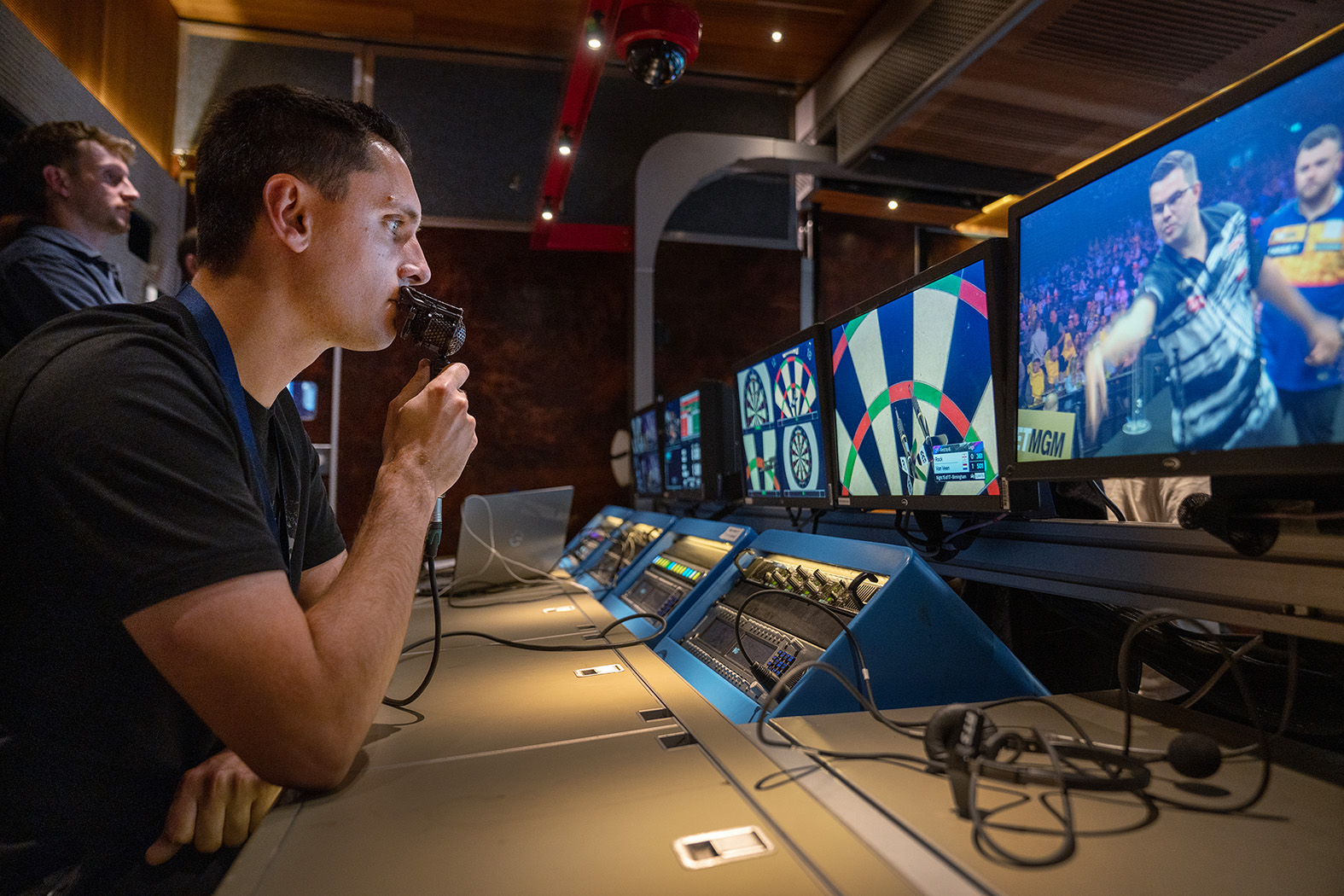
Corstorphine is one of four regular Sky spotters – alongside Richard Ashdown, a long-time referee and MC, Keith Deller, the 1983 world champion, and Owen Binks, another young referee. “I really struggled with maths at school,” he says. “But when I took up darts, my mental arithmetic just seemed to click, I memorised all the combinations. A lot of it is pattern recognition – we’re not necessarily doing the numbers bit by bit, we just see the pattern.”
Spotting is becoming increasingly difficult as the sport speeds up, with Luke Littler its greatest challenge. Everyone agrees Littler has made covering darts more difficult in one way or another – the pressure of added eyeballs, the new audience he attracts, how to make dominance interesting. For spotters his tendency to concoct unconventional finishes, or routes to a finish, is a nightmare. In the Aberdeen Premier League night, he won the final by taking out 26 through splitting six and double 10, while the camera was stuck on double 13. Meetings ensued.
Camera, action
As you leave the truck, you find two camera operators hunched over a desk in a quiet corner. There are 12 main cameras for each Premier League night – double for the World Championship – and only six or so camera operators qualified to sit at this desk, guided by the spotter.
Your eye is drawn to an interactive dartboard, developed about a decade ago and connected to every camera – the operators have only to press the relevant segment to switch shots. They have shortcut buttons – treble 17 is the little finger, treble 20 the index, treble 19 the middle. There are two operators because one is always a step ahead of the other – if one is focused on treble 20, the other will have treble 19 focused and ready. “We basically play that dance, that ballet, all night,” operator Peter Williams explains.
The sound and the fury
For all the focus on the 180 zoom, little is made of how important sound is to darts: the cheering masses; walk-on music; the “one-huuundred-and-aayyytteee” call; or the Chase the Sun riff that most people just know as “darts music”.
But most fundamental is that thud of tungsten hitting sisal. Six microphones are installed in the back of the board. “It can be lost on a Premier League night because there are a lot of casual fans, but there are games where 5,000 people go silent,” Wayne Mardle says. “That thud is absolute drama. If that thud wasn’t happening, it wouldn’t feel the same.” In the Smith nine-darter, every thud seems to crank up the noise. Last year Randle realised that fans were not hearing some of the best player reactions, the big shouts and Gerwyn Price’s cry of “booyah”, so he added extra microphones around the stage. A potential next innovation is adding heart-rate monitors to players.
Sound is the most obvious place where the sport’s audiences meet – the millions in their living rooms and the few thousand in the arena, still predominantly watching through big screens. “The really important thing is the energy and atmosphere that comes from the venue,” Clark Smith says. “It’s trying to keep the balance of making sure people watching on TV are enjoying it, but the people in the venue are having a great time too, so as soon as people turn the TV on, you’ve got a good atmosphere.”
The voice of darts
Aside from the actual sport, the element most people remember of that 2023 final is the commentary, particularly Mardle’s “I can’t spake!”, borrowed from an 80s rugby league line. Working alongside long-term darts commentator Stuart Pyke, his real genius isn’t in that moment, but 40 seconds earlier. After Van Gerwen hits the third perfect visit of the leg, Mardle says “they may both be on nines” while Smith is still six darts away. The odds of it happening from there are almost zero. Maybe he overpitches it, but he had a sense. For all he now dismisses it as luck, he also says, “Being a decent commentator is setting it up, having that foresight of what might happen.” He feels the moment coming, and matches it – Mardle is a genius of instinctive commentary. As Smith throws the first dart of his final visit, Mardle goes to say, “Come on Smith,” but pulls out at the “S”, somehow knowing the plosive “Bully Boy” works better. Everything he says around the final visit emphasises the meaning and scale of the achievement without ever seeming forced.
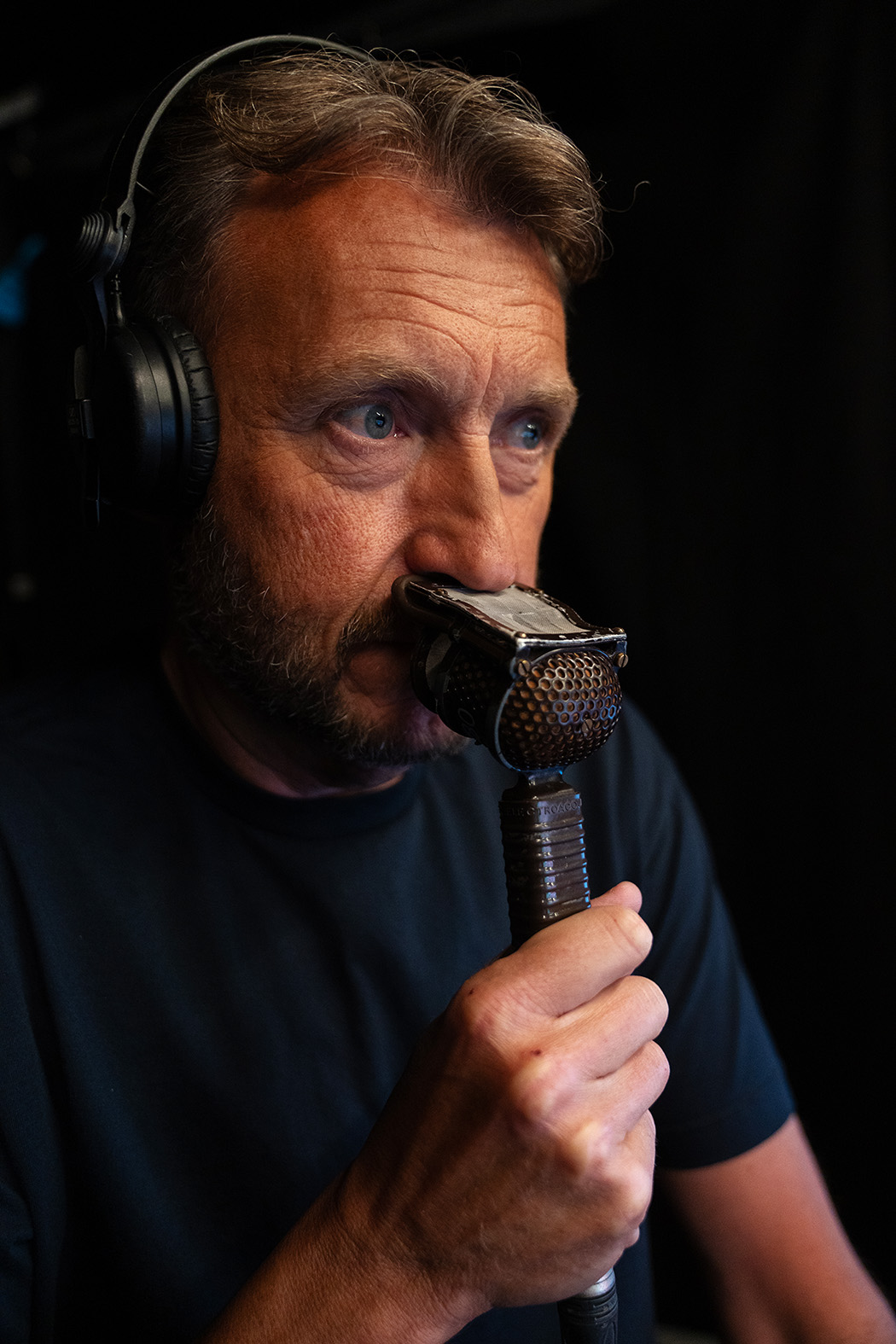
Mardle says his commentary mantra is “informative and fun” , and everyone in the broadcasting team believes their love of the sport accents everything they do. “If you miss that moment, it’ll never come back. You cannot miss a beat. Getting that every single time, it is an art.” And yet somehow, through directors and producers and spotters, through camera operators and commentators, they always distil pandemonium into perfection.
Photographs by Tom Pilston for The Observer